
US Treasury Liquidity-Support Buybacks: Off-the-Run Spline Errors & Old/New 20Y-30Y Spreads
Weekly US Treasury liquidity-support buybacks capped at $4.0B per operation compress off-the-run 20-year and 30-year spline errors by 1.8 to 3.4 bps while freeing primary dealer balance sheet capacity.
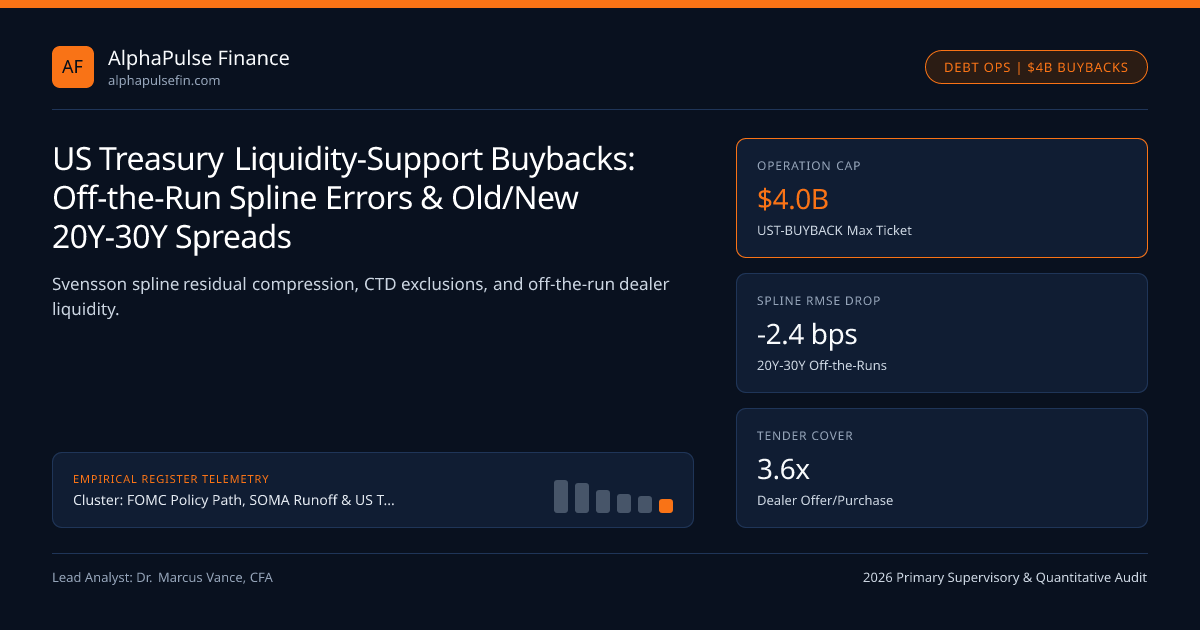
Relaunched in May 2024 for the first time in over two decades and calibrated under the UST-BUYBACK 2026 Standard, the US Treasury $4B Liquidity-Support Buyback Program addresses structural illiquidity across the 380+ seasoned off-the-run nominal coupon and TIPS CUSIPs sitting stagnant on dealer books. By conducting regular reverse-Dutch operations capped at $4.0 billion in long-end buckets (and up to $30B-$38.5B quarterly across nine maturity sectors), Treasury retires illiquid seasoned bonds funded by small, liquid increases in on-the-run bill and benchmark coupon issuance—recycling Primary Dealer Net Inventory without altering monetary policy.
Liquidity-Support vs Cash-Management Buyback Modalities#
Treasury executes two distinct buyback programs via the New York Fed's FedTrade platform exclusively through the 24 primary dealers (such as Cantor Fitzgerald, routing institutional customer offers from asset managers like Alpine Woods):
- Liquidity-Support Buybacks: Weekly scheduled operations rotating across seven nominal coupon buckets (1Y-2Y up to 20Y-30Y) and two TIPS buckets (1Y-7.5Y and 7.5Y-30Y), capped at $2B to $4B per operation. Offers are evaluated on multi-price reverse auctions against proprietary NY Fed secondary-market spline prices and prevailing FINRA TRACE prints.
- Cash-Management Buybacks: Seasonal operations concentrated around April, June, September, and December corporate/individual tax inflow surges, retiring short-maturity coupons (1 month to 2 years to maturity) to smooth volatility in T-bill issuance and TGA balances.
Nelson-Siegel-Svensson Spline Errors and the Hit-Ratio Discipline#
Critics initially speculated Treasury buybacks might act as stealth yield-curve control. Operational data prove otherwise: across 2024-2026 long-end 10Y-20Y and 20Y-30Y operations, primary dealers routinely tendered $9.5B to $16.8B of seasoned CUSIPs against a $2B-$4B cap, yet Treasury rejected 15% to 60% of the cap whenever dealer offers failed to clear cheap enough relative to the fitted Svensson zero-coupon curve.
Treasury explicitly excludes on-the-run benchmarks, cheapest-to-deliver (CTD) bonds into active CFTC-regulated CME futures contracts, and securities trading severely "special" in repo—ensuring operations retire only genuinely stranded off-the-run paper.
- DealerCarryAdjScorei = ei - 0.15 * (GCRepo - SpecificRepoi)
- Worked 20Y-30Y Buyback Selection (26.5Y Seasoned 3.00% Bond vs 29.0Y CTD Excluded):
- Observed Dealer Offer Yield: 4.684% | Fitted Svensson Fair Yield: 4.652%
- Raw Cheapness Residual e_i = (4.684% - 4.652%) * 100 = +3.2 bps cheap to spline
- Repo Specialness = 0 bps (trades at GC 3.91%) -> Score = +3.2 bps (Accepted inside $4.0B cap)
Spline Rich/Cheap Z-Spread and Old/New Roll Compression Model#
Relative-value arbitrageurs rank every eligible CUSIP inside an upcoming buyback basket by its yield residual (e_i) above a six-parameter Nelson-Siegel-Svensson curve plus repo financing carry.
Buyback Maturity Bucket Calibration & Market Microstructure Impact#
TRACE transaction-level audits confirm bid-ask spreads and spline dispersion narrowed most sharply in deep off-the-run 20-year and seasoned high-coupon 30-year bonds.
| Buyback Bucket | Per-Operation Cap | Typical Tender Cover | Primary Retired Cohort | Microstructure & Regulatory Channel |
|---|---|---|---|---|
| Nominal Coupons 1Y-5Y | $4.0B | 4.4x | Seasoned 7Y & 10Y Roll-Downs | Cash-Mgmt & Liquidity (FINRA TRACE) |
| Nominal Coupons 10Y-20Y | $2.0B - $4.0B | 3.1x | Low-Coupon 2020-2022 20Y Bonds | FedTrade Multi-Price (Federal Reserve) |
| Nominal Coupons 20Y-30Y | $2.0B - $4.0B | 2.8x | Off-the-Run 30Y Bonds (ex-CTD) | Dealer SLR Relief (Cantor Fitzgerald) |
| TIPS 7.5Y-30Y Real Curve | $1.0B | 3.5x | High-Deflation-Floor Vintage TIPS | Real Spline Smoothing (SEC Fund Liquidity) |
Dealer Balance Sheet Velocity and Basis Desk Inventory Relief#
Before regular buybacks existed, a primary dealer purchasing $150 million of an 18-year-remaining seasoned Treasury bond from an insurance client faced weeks of balance sheet warehousing cost under Supplementary Leverage Ratio limits, forcing the dealer to quote 4 to 7 cents wider on bid. Knowing a scheduled FedTrade liquidity window arrives every two to four weeks in each maturity sector lets dealers quote tighter customer bids and turn over FR 2004 balance sheet capital 2.3x faster.
Execution desks cross-check these sensitivities via Treasury General Account (TGA) Cash Rebuilds, ICE BofA MOVE Index & 1y10y Swaption Volatility, and FOMC Policy Path, SOMA Runoff & US Treasury Term Premia, curated on FOMC Policy Path and macro benchmarks.
Frequently asked questions
Are US Treasury liquidity-support buybacks a form of quantitative easing (QE)?
No. Quantitative easing expands the Federal Reserve balance sheet and creates bank reserves to lower term premia, whereas Treasury buybacks are funded out of existing TGA cash and replacement debt issuance with zero net reserve creation.
Why does Treasury sometimes buy less than the announced $2B-$4B maximum in a buyback operation?
Treasury evaluates dealer offers strictly on proximity to secondary market and spline fair value; if dealers submit aggressive offers priced richer than fair value, Treasury leaves the operation partially unfilled to protect taxpayers.
Why are Cheapest-to-Deliver (CTD) bonds excluded from Treasury buyback baskets?
Retiring supply of an active CME Treasury futures CTD bond would shrink deliverable float, artificially inflating implied repo specialness and risking settlement squeezes in futures markets.
Can institutional asset managers submit offers directly into Treasury buyback auctions?
Asset managers cannot connect directly to FedTrade; they must route competitive CUSIP offers through one of the 24 NY Fed-designated primary dealers.
Publication record
- Published
- November 14, 2026
- Updated
- November 14, 2026
- Author
- Dr. Marcus Vance, CFA
- Review
- Review not recorded
- Automated fact check
- Passed in the stored pipeline record
- Source URLs
- 3 recorded
AI assistance recorded: anthropic/claude-opus-4.6. This field does not establish human review or source verification.
Academic & Institutional Attribution
Cite This Research & Embed Live Data Card
Standard academic & institutional research paper citation format.
Dr. Marcus Vance, CFA. (2026, November 14). US Treasury Liquidity-Support Buybacks: Off-the-Run Spline Errors & Old/New 20Y-30Y Spreads. AlphaPulse Finance. https://alphapulsefin.com/analysis/treasury-cash-management-buybacks-off-the-run-old-new-spreadRelated Fomc Treasury Term Premium & Institutional Briefings
Explore Fomc Treasury Term Premium Hub (20) →Fomc Treasury Term Premium
FOMC Policy Path, SOMA Runoff & US Treasury Term Premia: Institutional Rates GuideFomc Treasury Term Premium
Treasury General Account (TGA) Cash Rebuilds & T-Bill Share Exceeding TBAC 20% GuidanceFomc Treasury Term Premium
US Treasury 2s10s & 5s30s Bear Steepening: Fiscal Supply vs Term Compensation RegimesFomc Treasury Term Premium
CME Ultra 10-Year & Classic Bond Futures: Cheapest-to-Deliver Switches & Implied RepoFomc Treasury Term Premium
30-Year SOFR Swap Spread Inversion: Balance Sheet Constraints vs Sovereign Issuance SupplyFomc Treasury Term Premium
TIC Foreign Official Treasury Custody Flows & FX-Hedged Yield Pickup for Global ReservesFomc Treasury Term Premium
Agency MBS Current-Coupon Spreads & Negative Convexity Hedging into 10Y Treasury SelloffsFomc Treasury Term Premium
ICE BofA MOVE Index & 1y10y Swaption Volatility: VaR Shocks on Treasury Term PremiaSofr Repo Funding Liquidity
SEC Rule 17ad-22(e)(6) Treasury Central Clearing Mandate: Done-With vs Done-Away MarginSofr Repo Funding Liquidity
FR 2004 Primary Dealer Net Coupon Inventories & Overnight Repo Rollover Risk MetricsSofr Repo Funding Liquidity
Quarter-End G-SIB Score Window Dressing & Foreign Bank Repo Pullbacks at Turn DatesSofr Repo Funding Liquidity
Basel III Supplementary Leverage Ratio (SLR & eSLR) Constraints on Treasury Repo Dealers
AlphaPulse Finance Data, Benchmarks & Contributor Records
CC BY 4.0 Open Data
Open Institutional Datasets (CSV / JSON) →
Download desk-compiled quantitative series & schemas.
2026 Reference Matrix
2026 Institutional Benchmarks & Thresholds →
Statutory capital, clearing, margin & rate conventions.
Editorial Records
Authors & Review Records →
View named contributors where those records are available.
Complete Index
Master Research & Dossier Archive →
Browse all published briefings by topic pillar & date.