
FOMC Policy Path, SOMA Runoff & US Treasury Term Premia: Institutional Rates Guide
Ten-year US Treasury ACM term premia averaged +46 bps in Q4 2026 as Federal Reserve SOMA transitions toward reserve management purchases and primary dealers absorb $294B in net coupon supply across benchmark FOMC monetary policy corridors.
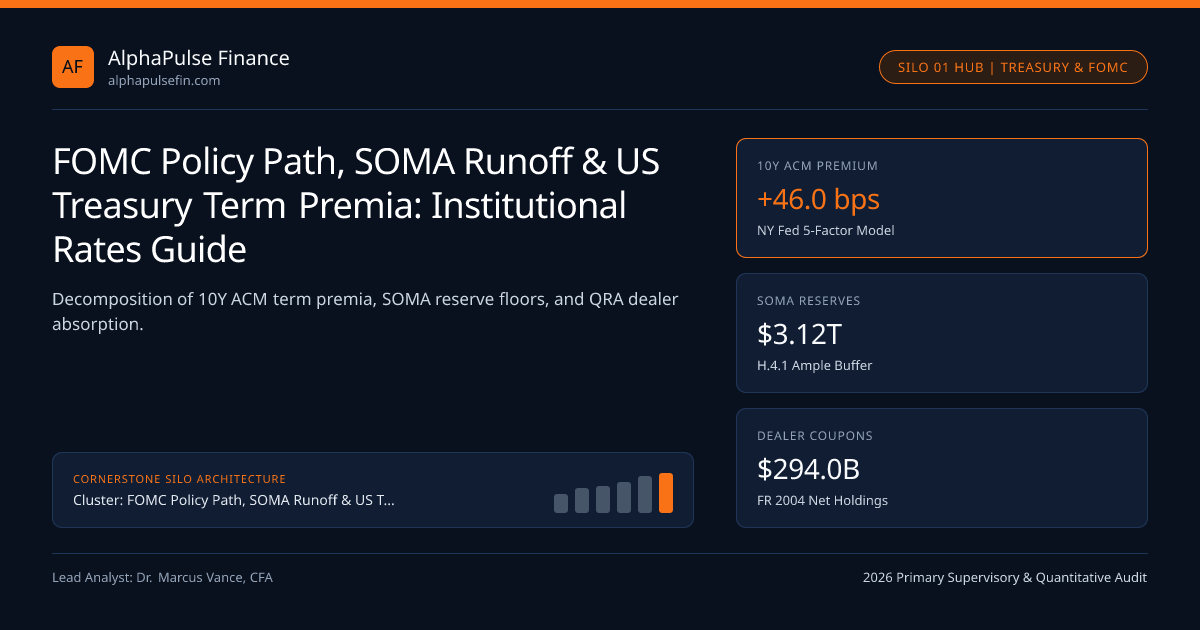
Ten-year US Treasury yields clearing near 4.32% under an FOMC 3.75%-4.00% Target Rate Corridor reflect a structural regime shift in sovereign duration pricing: term compensation rather than short-rate expectations now governs long-end valuation. Across Q4 2026, the Adrian-Crump-Moench (ACM) five-factor affine model calibrated by the Federal Reserve System places the 10-year term premium near +46 bps, reversing the -65 bps average recorded between 2016 and 2021 when quantitative easing suppressed duration risk. Simultaneously, bank reserves sit near $3.12 trillion under SOMA Reserve Management Purchases while primary dealers carry $294.0 billion in net coupon inventory on FR 2004 filings. Portfolio managers pricing duration across the 2s10s yield curve must decompose nominal yields into expected overnight index swap (OIS) policy paths, net coupon supply elasticity from Quarterly Refunding Announcements (QRA), and dealer balance sheet intermediation costs supervised by the U.S. Federal Reserve and SEC.
Affine Yield Curve Decomposition and the Post-QE Term Premium Regime#
Nominal Treasury yields combine two unobservable building blocks: the risk-neutral expectation of average overnight policy rates over the bond's life and the term premium demanded by investors to warehouse mark-to-market duration risk. During the post-2008 low-inflation decade, Treasuries functioned as negative-beta deflation hedges against equity drawdowns, allowing pension funds and multi-asset desks to accept negative term premia. Once post-pandemic core inflation volatility turned stock-bond return correlations positive (+0.42 trailing 24-month beta between S&P 500 futures and 10-year Treasury futures), Treasuries lost part of their portfolio insurance value and required positive risk compensation.
Desk strategists track both the NY Fed ACM 5-factor vs Kim-Wright divergence and real-time Holston-Laubach-Williams neutral rate r* estimates to avoid misreading curve steepening. Whereas ACM extracts pricing factors purely from cross-sectional Treasury principal components—making it highly responsive to auction supply shocks—Kim-Wright anchors three-Factor dynamics to Blue Chip long-horizon rate surveys. When ACM widens 18 to 25 bps faster than Kim-Wright around refunding weeks, the residual captures dealer inventory indigestion rather than an upward revision in long-run neutral policy rates.
SOMA Runoff Taper Mechanics, MBS Prepayment Drag, and Reserve Thresholds#
Quantitative tightening altered the investor base absorbing net Treasury issuance. From June 2022 through its phased cap reductions, SOMA runoff shed over $2.1 trillion in securities, transferring duration from price-insensitive central bank custody to price-sensitive private balance sheets—hedge funds, money market funds, domestic pensions, and broker-dealers such as Cantor Fitzgerald. Because agency mortgage-backed securities (MBS) carry weighted-average coupons roughly 220 bps below prevailing primary mortgage rates, voluntary prepayments stalled below $14 billion per month, leaving SOMA runoff concentrated in maturing Treasury notes.
Transitioning from active runoff to SOMA reserve management purchases hinges on identifying the Lowest Comfortable Level of Reserves (LCLoR), generally estimated at 10% to 11% of US nominal GDP ($3.0T to $3.25T). Detailed operational mechanics in SOMA monthly redemption caps and T-bill reinvestment show how redirecting principal paydowns from agency MBS into front-end Treasury bills shortens SOMA weighted-average maturity (WAM) and gradually restores duration neutrality without re-initiating quantitative easing.
- TP10Y(t) = betasupply * (NetDV01Private / GDP) + betavol * MOVEt + betacorr * Cov(Req, Rbond)
- Worked Q4 2026 Attribution (n = 10 Years):
- Risk-Neutral Expected Short-Rate Average: 3.86% (386 bps)
- Private Net Coupon Supply Load: +24 bps contribution
- Rate Volatility & Positive Stock-Bond Beta (+0.42): +22 bps contribution
- Total 10Y ACM Term Premium TP_10Y: +46 bps (0.46%)
- Equilibrium 10Y Par Treasury Yield: 3.86% + 0.46% = 4.32%
Quarterly Refunding Supply, Auction Tails, and Buyback Microstructure#
Fiscal deficits exceeding 6.1% of GDP force the Treasury Office of Debt Management and the Treasury Borrowing Advisory Committee (TBAC) to balance rollover risk in front-end bills against term-premium pressure in 10-year and 30-year coupons. As examined in quarterly refunding coupon supply and TBAC WAM limits, pushing the T-bill share above the historical 15%-20% TBAC corridor temporarily relieves long-end duration pressure while expanding Treasury General Account cash rebuild sensitivity.
Execution quality at primary auctions provides high-frequency telemetry on private duration demand. In 10-year Treasury auction tail and indirect bidder analytics and 30-year long bond LDI absorption, stop-out tails exceeding 1.5 bps above the 1:00 PM ET when-issued (WI) mid-yield combined with primary dealer awards above 17% consistently precede 6 to 11 bps of secondary curve cheapening over the subsequent five sessions. Meanwhile, front-end policy expectations clear through 2-year note auctions vs OIS pricing, while off-the-run illiquidity discounts are compressed by Treasury $4B liquidity-support buybacks.
FOMC SEP Dispersion, Derivative Basis, and Cross-Market Spillovers#
Policy communication uncertainty directly amplifies rate volatility and term premia. When FOMC SEP dot-plot dispersion widens across the 19 committee participants—particularly in the longer-run neutral dot—options desks reprice 1y10y swaption implied volatility higher, triggering the VaR feedback loop quantified in MOVE index swaption volatility spillovers. Systematic macro models also benchmark actual FOMC cuts against inertial Taylor rule prescriptions to gauge whether real policy rates remain restrictive.
Across relative-value desks regulated by FINRA and the CFTC, sovereign supply strains manifest first in derivative basis spreads: 30-year SOFR swap spread inversions, CME Treasury futures CTD switches, and 20-year bond yield curve kinks. External demand cushions remain equally sensitive to hedging costs, as documented in TIC foreign official FX-hedged Treasury demand, 2s10s bear steepening regimes, and agency MBS convexity extension. Institutional verification standards for all sovereign benchmarks are maintained on our methodology and benchmarks hubs alongside the FOMC & Term Premium topic hub.
| Market Segment / Oversight Body | In-Slice Reference | Primary Telemetry Filing | 2026 Calibrated Benchmark | Term Premium Channel |
|---|---|---|---|---|
| Monetary Policy & SOMA Custody | Federal Reserve System | H.4.1 & FOMC SEP Summary | $3.12T Reserves / 3.88% EFFR | Sets OIS path & SOMA runoff duration release |
| Primary Dealer Cash & Repo Desk | Cantor Fitzgerald | NY Fed Form FR 2004A/B/C | $294.0B Net Dealer Coupons | Warehouses QRA auction supply & WI concessions |
| Secondary Cash Treasury Reporting | FINRA | TRACE Treasury Aggregate | 1.8 bps 90th-Pct 10Y Tail | Measures off-the-run dealer bid-ask depth |
| Treasury Clearing & Margin Rules | SEC | Rule 17ad-22(e)(6) Mandate | $4.0B Liquidity Buyback Cap | Governs FICC cross-margining & cash liquidity |
| Rates Futures & OIS Derivatives | CFTC | COT Leveraged Funds Report | -76 bps 30Y SOFR Swap Spread | Tracks cash-futures CTD basis & swap spreads |
Institutional Supervision and Sovereign Intermediation Matrix#
Market participants executing cash-futures basis, WI auction bidding, and swap-spread arbitrage operate across overlapping US federal and self-regulatory regimes. Primary dealers report weekly coupon and bill inventories to the Federal Reserve Bank of New York on Form FR 2004, while secondary cash Treasury trades report into FINRA TRACE and cleared derivatives settle under CFTC and SEC margin rules, affecting execution venues and retail-institutional brokerages such as Ally Invest and Atomic Capital.
Frequently asked questions
What drives the divergence between the NY Fed ACM term premium and nominal 10-year Treasury yields?
Nominal 10-year yields reflect both the expected path of overnight FOMC policy rates and the ACM term premium. If FOMC rate-cut expectations deepen by 30 bps while heavy QRA coupon supply lifts the ACM term premium by 30 bps, nominal yields remain unchanged near 4.32% despite steepening risk.
How do SOMA runoff caps affect private-sector duration absorption?
When SOMA allows maturing Treasuries to roll off without full reinvestment, the Treasury must refinance those redemptions via public auctions. Every $100B of annual coupon runoff shifts roughly $65M-$80M of DV01 onto primary dealers, pension funds, and leveraged cash-futures basis desks.
Why did 30-year SOFR swap spreads remain deeply negative during 2026?
Persistent Treasury coupon issuance forces dealers to finance cash bonds on balance sheet under Basel III Supplementary Leverage Ratio constraints, cheapening cash 30-year Treasuries to roughly 76 bps above matched-maturity unfunded OIS SOFR swaps.
How do US Treasury $4B liquidity-support buybacks impact the yield curve?
Liquidity-support buybacks retire seasoned off-the-run bonds trading cheap to fitted par splines, narrowing old-versus-new yield spreads by 1.5 to 3.5 bps without altering net fiscal borrowing over the full quarterly refunding cycle.
Publication record
- Published
- November 14, 2026
- Updated
- November 14, 2026
- Author
- Dr. Marcus Vance, CFA
- Review
- Review not recorded
- Automated fact check
- Passed in the stored pipeline record
- Source URLs
- 4 recorded
AI assistance recorded: anthropic/claude-opus-4.6. This field does not establish human review or source verification.
Academic & Institutional Attribution
Cite This Research & Embed Live Data Card
Standard academic & institutional research paper citation format.
Dr. Marcus Vance, CFA. (2026, November 14). FOMC Policy Path, SOMA Runoff & US Treasury Term Premia: Institutional Rates Guide. AlphaPulse Finance. https://alphapulsefin.com/analysis/fomc-soma-runoff-us-treasury-term-premium-architectureRelated Fomc Treasury Term Premium & Institutional Briefings
Explore Fomc Treasury Term Premium Hub (20) →Fomc Treasury Term Premium
NY Fed ACM 5-Factor vs Kim-Wright Term Premia: Affine Yield Curve DecompositionFomc Treasury Term Premium
Treasury Quarterly Refunding Coupon Supply & TBAC Weighted Average Maturity LimitsFomc Treasury Term Premium
10-Year US Treasury Auction Tails, Indirect Bidder Takedown & When-Issued ConcessionFomc Treasury Term Premium
30-Year Treasury Bond Auction Liquidity, Convexity Hedging & Pension LDI AbsorptionFomc Treasury Term Premium
2-Year Treasury Note Auctions vs Overnight Index Swaps: Front-End FOMC Policy PricingFomc Treasury Term Premium
FOMC SEP Dot-Plot Dispersion & Longer-Run Median Drift: Committee Reaction UncertaintyFomc Treasury Term Premium
Holston-Laubach-Williams vs Lubik-Matthes Neutral Rate (r*) Estimation in US RatesFomc Treasury Term Premium
SOMA Monthly Redemption Caps, MBS Prepayment Drag & Secondary T-Bill ReinvestmentSofr Repo Funding Liquidity
SOFR, Tri-Party Repo Plumbing & Primary Dealer Balance Sheets: Money Market GuideCorporate Credit Spread Cycles
IG/HY Corporate Credit Spreads, Refinancing Walls & CDS Basis: Institutional Credit GuideInflation Breakevens Real Rates
TIPS Breakevens, CPI Shelter Persistence & Forward Real Rates: Institutional GuideInstitutional Earnings Capex Macro
S&P 500 Margin Dispersion, Hyperscaler Capex & Buyback Flows: Institutional Earnings Guide
AlphaPulse Finance Data, Benchmarks & Contributor Records
CC BY 4.0 Open Data
Open Institutional Datasets (CSV / JSON) →
Download desk-compiled quantitative series & schemas.
2026 Reference Matrix
2026 Institutional Benchmarks & Thresholds →
Statutory capital, clearing, margin & rate conventions.
Editorial Records
Authors & Review Records →
View named contributors where those records are available.
Complete Index
Master Research & Dossier Archive →
Browse all published briefings by topic pillar & date.