
30-Year SOFR Swap Spread Inversion: Balance Sheet Constraints vs Sovereign Issuance Supply
Thirty-year USD SOFR OIS fixed swap rates trading 76 bps below matched-maturity US Treasury yields reflect funded sovereign balance sheet scarcity rather than counterparty credit advantage.
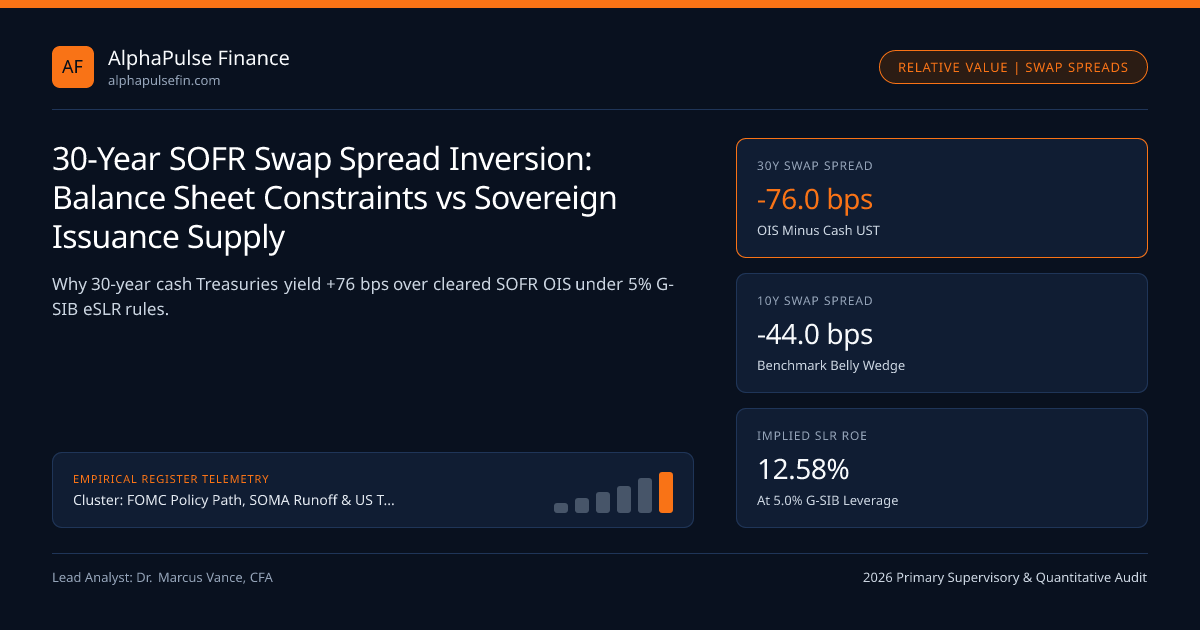
Textbook finance once taught that interest rate swap rates must exceed sovereign Treasury yields because swaps reference bank credit risk; in modern centrally cleared markets, however, 30-year USD SOFR OIS swaps trade at 3.85% while matched-maturity 30-Year Treasury Bonds yield 4.61%—a deeply inverted -76 bps swap spread (-44 bps at the 10-year point). Far from pricing the US government as riskier than a clearinghouse, negative swap spreads quantify the shadow rental price of funded Primary Dealer Balance Sheets under post-2008 capital ratios.
Why Cleared OIS Carries Zero Credit Risk and Minimal Balance Sheet Cost#
Prior to 2008, USD interest rate swaps indexed to 3-month LIBOR embedded AA-bank unsecured credit risk (+25 to +60 bps), keeping swap spreads structurally positive until Lehman Brothers' collapse. Transitioning to daily variation-margined, LCH/CME centrally cleared SOFR OIS swaps eliminated both unsecured bank credit premia and principal funding outlays: an end-user pension fund receiving 30-year fixed on $500 million of SOFR OIS posts only ~$28 million of initial margin.
Replicating that same $820,000/bp DV01 exposure via physical 30-year Treasury bonds requires funding the entire $500 million cash purchase price in repo—consuming dealer balance sheet leverage exposure subject to Basel III Supplementary Leverage Ratio (SLR) surcharges enforced by the Federal Reserve and OCC.
Asymmetric Receiving Demand: Pension LDI and Corporate Debt Hedging#
Two relentless one-way derivative flows pin long-end SOFR swap rates below cash Treasuries. First, corporate defined-benefit pensions and variable-annuity insurers hedge 30-year liability duration via cleared receive-fixed SOFR swaps whenever capital efficiency outweighs the +76 bps cash yield pickup. Second, investment-grade corporations issuing fixed-rate 10-year and 30-year bonds frequently swap proceeds back to floating SOFR to match short-duration assets—hitting dealer swap desks with continuous receive-fixed flow.
To warehouse the opposite pay-fixed swap leg, primary dealers like Cantor Fitzgerald must buy cash 30-year Treasuries and finance them in overnight repo, demanding a 70 to 82 bps annualized asset-swap concession before committing balance sheet equity across CFTC and FINRA venues.
- NetAssetSwapCarry = (YUSTPar - ROISBondEquiv) - (RepoTerm - SOFRCompound)
- DealerSLRROE = NetAssetSwapCarry / eSLRCapitalRatio
- Worked 30-Year Swap Spread Arbitrage Hurdle:
- 30Y UST Par: 4.610% | 30Y OIS Quoted: 3.850% (Bond-Equiv = 3.921%) -> Spread = -68.9 bps true (-76 bps quoted)
- Repo Financing Spread over SOFR: +6.0 bps -> Net Carry = +68.9 - 6.0 = +62.9 bps (0.629%)
- Against 5.0% eSLR Capital Charge: Desk Pre-Tax ROE = 0.629% / 0.05 = 12.58%
Matched-Maturity Par Asset-Swap Spread Return on Equity Formula#
Evaluating a long-cash-Treasury / pay-fixed-SOFR-OIS "swap spread widener" requires comparing the positive yield carry less repo financing drag against regulatory capital charges.
USD SOFR Swap Spread Term Structure & Regulatory Drivers#
Swap spreads invert monotonically across the curve from -14 bps at 2 years to -76 bps at 30 years in proportion to cumulative sovereign coupon supply and repo balance sheet lock-up.
| Tenor Point | Cash UST Par Yield | Quoted SOFR OIS | Quoted Swap Spread | Primary Flow Driver & Oversight |
|---|---|---|---|---|
| 2-Year Front End | 3.88% | 3.74% | -14.0 bps | Short-End HQLA Liquidity (SEC MMF / Repo) |
| 5-Year Belly | 4.10% | 3.76% | -34.0 bps | Corporate Fixed-to-Floating Hedging (FINRA) |
| 10-Year Benchmark | 4.32% | 3.88% | -44.0 bps | Deficit DV01 vs SEF Swaps (CFTC LCH/CME) |
| 30-Year Long Bond | 4.61% | 3.85% | -76.0 bps | Pension LDI & G-SIB SLR Caps (Federal Reserve) |
Bank Deregulation / SLR Exemption Sensitivity as a Tail Catalyst#
Swap spread wideners represent one of institutional macro's highest-convexity regulatory policy trades: during April 2020, when US bank regulators temporarily excluded Treasuries and reserves from the SLR denominator, 10-year and 30-year swap spreads richened by 14 to 22 bps within days. Similarly, permanent recalibration of enhanced SLR (eSLR) buffers or expanded FICC cross-margining under SEC clearing rules directly lowers dealer balance sheet hurdles, compressing the -76 bps 30-year inversion.
Fixed-income and equity strategists align these metrics with FOMC Policy Path, SOMA Runoff & US Treasury Term Premia, TIC Foreign Official Treasury Custody Flows, NY Fed ACM 5-Factor vs Kim-Wright Term Premia, FOMC Policy Path, and covered institutions.
Frequently asked questions
Does a negative 30-year swap spread mean markets view the US Treasury as riskier than banks?
No. Modern SOFR OIS swaps are centrally cleared with daily variation margin and contain virtually zero bank credit risk; negative spreads simply reflect that cash Treasuries require 100% balance sheet funding while cleared swaps are unfunded.
What is a swap spread widener versus a swap spread tightener?
Because swap spreads are quoted as Swap Rate minus Treasury Yield, a "widener" makes spreads less negative (say from -76 bps to -60 bps) by going long cash Treasuries and paying fixed on matched-maturity SOFR OIS.
How does corporate bond issuance push 5-year and 10-year swap spreads more negative?
Financial and corporate issuers selling fixed-rate USD bonds often enter receive-fixed swaps to convert liabilities to floating SOFR, pushing swap rates down while competing with Treasuries for investor cash.
Why are 30-year swap spreads far more negative than 2-year swap spreads?
Holding a 30-year swap spread arbitrage locks up dealer balance sheet leverage capacity for three decades (or exposes the desk to mark-to-market basis widening risk), requiring a much larger annualized spread than a 2-year trade.
Publication record
- Published
- November 14, 2026
- Updated
- November 14, 2026
- Author
- Dr. Marcus Vance, CFA
- Review
- Review not recorded
- Automated fact check
- Passed in the stored pipeline record
- Source URLs
- 3 recorded
AI assistance recorded: anthropic/claude-opus-4.6. This field does not establish human review or source verification.
Academic & Institutional Attribution
Cite This Research & Embed Live Data Card
Standard academic & institutional research paper citation format.
Dr. Marcus Vance, CFA. (2026, November 14). 30-Year SOFR Swap Spread Inversion: Balance Sheet Constraints vs Sovereign Issuance Supply. AlphaPulse Finance. https://alphapulsefin.com/analysis/swap-spread-inversion-sofr-ois-vs-matched-maturity-treasuriesRelated Fomc Treasury Term Premium & Institutional Briefings
Explore Fomc Treasury Term Premium Hub (20) →Fomc Treasury Term Premium
FOMC Policy Path, SOMA Runoff & US Treasury Term Premia: Institutional Rates GuideFomc Treasury Term Premium
TIC Foreign Official Treasury Custody Flows & FX-Hedged Yield Pickup for Global ReservesFomc Treasury Term Premium
Agency MBS Current-Coupon Spreads & Negative Convexity Hedging into 10Y Treasury SelloffsFomc Treasury Term Premium
ICE BofA MOVE Index & 1y10y Swaption Volatility: VaR Shocks on Treasury Term PremiaFomc Treasury Term Premium
Inertial Taylor Rules vs Balanced-Approach Benchmarks Across FOMC Policy NormalizationFomc Treasury Term Premium
SOMA Reserve Management Purchases (RMP): Calibrating Bank Reserves Above LCLoR ThresholdsFomc Treasury Term Premium
The 20-Year US Treasury Yield Curve Kink: Stripping Economics & Butterfly ArbitrageFomc Treasury Term Premium
NY Fed ACM 5-Factor vs Kim-Wright Term Premia: Affine Yield Curve DecompositionSofr Repo Funding Liquidity
CME 3-Month vs 1-Month SOFR Futures: Rate-Volatility Convexity Bias vs Forward OISSofr Repo Funding Liquidity
Corporate Tax Deadlines, TGA Inflows & SOFR 99th-Percentile Intraday Funding SpikesSofr Repo Funding Liquidity
SEC Rule 2a-7 WAM/WAL Caps & Mandatory Liquidity Fees Across Government and Prime MMFsSofr Repo Funding Liquidity
EUR/USD & USD/JPY Cross-Currency Basis Swaps: Offshore Synthetic Dollar Funding vs SOFR
AlphaPulse Finance Data, Benchmarks & Contributor Records
CC BY 4.0 Open Data
Open Institutional Datasets (CSV / JSON) →
Download desk-compiled quantitative series & schemas.
2026 Reference Matrix
2026 Institutional Benchmarks & Thresholds →
Statutory capital, clearing, margin & rate conventions.
Editorial Records
Authors & Review Records →
View named contributors where those records are available.
Complete Index
Master Research & Dossier Archive →
Browse all published briefings by topic pillar & date.