
SEC Rule 2a-7 WAM/WAL Caps & Mandatory Liquidity Fees Across Government and Prime MMFs
Amended SEC Rule 2a-7 liquidity buffers (25% daily, 50% weekly) and mandatory redemption fees triggered an institutional rotation into $5.7T+ of Government Money Market Funds.
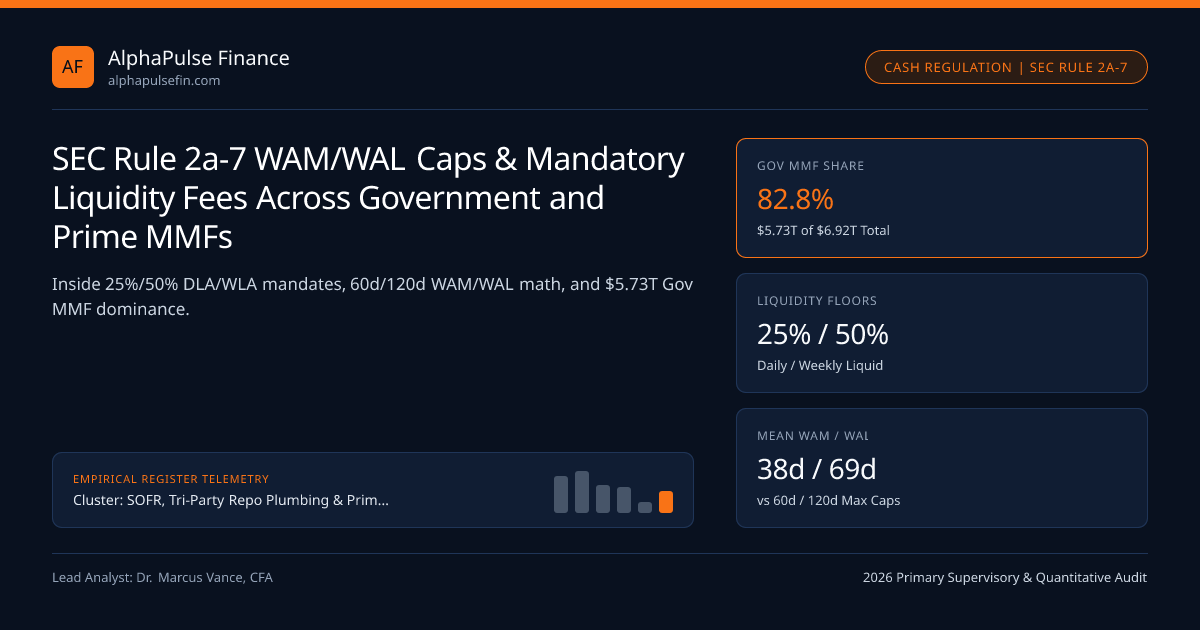
Housing over $6.92 trillion in assets under management, US Money Market Funds (MMFs) regulated under Investment Company Act SEC Rule 2a-7 serve as the dominant cash lender in SOFR Repo and the primary marginal buyer of short-term Treasury bills. Fully implemented across 2023-2024 and governing 2026 portfolios, the SEC's post-pandemic Rule 2a-7 overhaul raised minimum Daily Liquid Assets (DLA) to 25% and Weekly Liquid Assets (WLA) to 50%, eliminated redemption gates, and imposed mandatory liquidity fees on Institutional Prime and Tax-Exempt MMFs whenever daily net redemptions exceed 5%—driving over $450B of corporate cash permanently into Government MMFs.
Elimination of Redemption Gates vs Mandatory Institutional Prime Fees#
In March 2020, an unintended regulatory design flaw triggered a preemptive corporate run on Prime MMFs: under 2014 rules, if a Prime fund's Weekly Liquid Assets dipped below 30%, its board could freeze redemptions ("impose a gate"). Fearing being locked out of payroll cash, institutional treasurers stampeded for the exits the moment WLA approached 33%!
To cure that cliff effect, the SEC's final Rule 2a-7 amendments:
- Abolished redemption gates entirely from Rule 2a-7.
- Raised minimum Daily Liquid Assets from 10% to 25% and Weekly Liquid Assets from 30% to 50%.
- Imposed a mandatory liquidity fee on Institutional Prime/Tax-Exempt funds whenever daily net redemptions exceed 5% of net assets (unless de minimis <1 bps liquidity cost). Rather than face variable floating NAVs plus mandatory 5%-outflow fees, corporate treasurers converted Institutional Prime funds into CNAV $1.00 Government MMFs—expanding structural demand for T-bills and FICC repo while shrinking commercial paper (CP) funding for banks.
60-Day WAM vs 120-Day WAL Limits and Treasury FRN Duration Tricks#
Rule 2a-7 caps portfolio interest-rate risk at a 60-day maximum Weighted Average Maturity (WAM) and credit-spread/liquidity risk at a 120-day maximum Weighted Average Life (WAL):
- WAM (<= 60 days) measures days until the next interest rate reset.
- WAL (<= 120 days) measures days until final principal maturity without reset credit.
Watch how a 2-Year US Treasury Floating Rate Note (FRN) resetting weekly off the 13-week T-bill auction enters those two ratios: for WAM, a 2-year Treasury FRN counts as just 7 days (weekly reset!), letting MMFs earn the FRN spread (+12 bps) without using up their 60-day duration budget; for WAL, however, its remaining final maturity (up to 730 days) consumes the 120-day WAL cap, bounding total FRN allocation near 10%-15% of fund assets across platforms like Ally Invest and dealers like Cantor Fitzgerald.
- PortfolioWAL = SUMi (Weighti * DaystoFinalMaturity_i) <= 120.0 Days
- Worked $10B Government MMF Barbell Check (45% O/N Repo, 43% 75-Day Bills, 12% 1.5-Year UST FRNs):
- WAM = 0.45(1) + 0.43(75) + 0.12(7dayreset) = 0.45 + 32.25 + 0.84 = 33.54 Days (<= 60d PASS)
- WAL = 0.45(1) + 0.43(75) + 0.12(548daysleft) = 0.45 + 32.25 + 65.76 = 98.46 Days (<= 120d PASS)
- DLA = 45% (O/N UST Repo) + 43% (UST Bill) + 12% (UST FRN) = 100.0% Daily Liquid (>= 25% PASS)
Rule 2a-7 WAM, WAL, and Mandatory Liquidity Fee Threshold Math#
Monitoring aggregate industry Government MMF WAM (averaging 38 days in Q4 2026) signals whether $5.7T+ of cash funds are positioned long T-bill duration ahead of FOMC rate cuts or huddled overnight in repo.
Rule 2a-7 Fund Category Matrix: Government vs Retail Prime vs Inst Prime#
Regulatory distinctions across NAV rounding, mandatory fees, and eligible collateral dictate trillions in short-end allocation supervised by the SEC and FINRA.
| Rule 2a-7 Fund Type | NAV Convention | Mandatory >5% Outflow Fee? | Discretionary Board Fee? | Dominant Asset Pool |
|---|---|---|---|---|
| Government MMF ($5.73T) | $1.00 Stable CNAV | No (Exempt) | Optional Opt-In Only | T-Bills, SOFR Repo, Agencies |
| Treasury-Only MMF | $1.00 Stable CNAV | No (Exempt) | No | 100% Direct US Bills & Notes |
| Retail Prime MMF ($0.86T) | $1.00 Stable CNAV | No (Natural Persons) | Yes (If Best Interest) | Bank CDs, CP, Asset-Backed CP (FINRA) |
| Institutional Prime ($0.33T) | $1.0000 Floating NAV | Yes (>5% Net Outflow) | Yes (Board Discretion) | Tier-1 Foreign Bank Yankee CD / CP (SEC) |
Why ALL US Treasury Securities Count 100% as Daily Liquid Assets!#
One frequently overlooked clause in Rule 2a-7(a)(8) gives US Treasuries an insurmountable regulatory moat over agency debt and bank commercial paper: 100% of direct US Treasury securities—even a 12-month T-bill with 360 days to maturity—qualify immediately as Daily Liquid Assets (DLA) AND Weekly Liquid Assets (WLA)! By contrast, FHLB agency discount notes only count toward WLA when <=60 days to maturity, and commercial paper only counts when <=5 business days—cementing US T-bills as the irreplaceable core of the 25%/50% liquidity regime.
Desk replication notes span SOFR, Tri-Party Repo Plumbing & Primary Dealer Balance Sheets, EUR/USD & USD/JPY Cross-Currency Basis Swaps, and NY Fed Standing Repo Facility (SRF) Usage, organized across SOFR and verification registry.
Frequently asked questions
Why did the SEC eliminate money market fund redemption gates in its 2023 Rule 2a-7 reform?
Empirical post-mortems of March 2020 proved the mere possibility of a 30% WLA gate caused institutional investors to redeem preemptively as soon as WLA approached 34%—turning a defensive tool into a run accelerator.
When must an Institutional Prime MMF charge a mandatory liquidity fee under Rule 2a-7?
Whenever same-day net redemptions exceed 5% of net assets, an Institutional Prime or Institutional Tax-Exempt MMF must impose a fee reflecting stressed market spread/impact costs unless that cost is under 1 basis point (0.01%).
Do Government Money Market Funds ever float their $1.00 NAV or face mandatory redemption fees?
No. Government MMFs invest >=99.5% in cash, US government securities, and fully collateralized government repos; they use amortized-cost $1.00 CNAV pricing and are completely exempt from mandatory liquidity fees.
How does lengthening Government MMF WAM from 20 days to 45 days impact T-bill yields?
Shifting $5.73T of Government MMFs from 20-day to 45-day WAM pulls hundreds of billions of dollars out of overnight repo into 3-month and 6-month T-bills, richening term bill yields below OIS ahead of FOMC cuts.
Publication record
- Published
- November 13, 2026
- Updated
- November 14, 2026
- Author
- Dr. Marcus Vance, CFA
- Review
- Review not recorded
- Automated fact check
- Passed in the stored pipeline record
- Source URLs
- 3 recorded
AI assistance recorded: anthropic/claude-opus-4.6. This field does not establish human review or source verification.
Academic & Institutional Attribution
Cite This Research & Embed Live Data Card
Standard academic & institutional research paper citation format.
Dr. Marcus Vance, CFA. (2026, November 14). SEC Rule 2a-7 WAM/WAL Caps & Mandatory Liquidity Fees Across Government and Prime MMFs. AlphaPulse Finance. https://alphapulsefin.com/analysis/sec-rule-2a-7-wam-wal-liquidity-buckets-government-prime-mmfsRelated Sofr Repo Funding Liquidity & Institutional Briefings
Explore Sofr Repo Funding Liquidity Hub (20) →Sofr Repo Funding Liquidity
SOFR, Tri-Party Repo Plumbing & Primary Dealer Balance Sheets: Money Market GuideSofr Repo Funding Liquidity
EUR/USD & USD/JPY Cross-Currency Basis Swaps: Offshore Synthetic Dollar Funding vs SOFRSofr Repo Funding Liquidity
Fedwire Securities Settlement Timing, Daylight Overdrafts & Intraday LCR Buffer TrapsSofr Repo Funding Liquidity
Federal Reserve Discount Window Readiness: Pre-Positioned Collateral Valuation & HaircutsSofr Repo Funding Liquidity
ARRC CME Term SOFR Scope Restrictions: Compounded SOFR in Arrears vs Cash Loan ConventionsSofr Repo Funding Liquidity
SOFR vs EFFR & IORB Corridor Spreads: Measuring Reserve Demand Elasticity Near ScarcitySofr Repo Funding Liquidity
ON RRP Facility Drainage & Rule 2a-7 Money Market Fund Rotation into Short T-BillsSofr Repo Funding Liquidity
NY Fed Standing Repo Facility (SRF) Usage: Auction Timing, Tri-Party Settlement & StigmaCorporate Credit Spread Cycles
Rising-Star BB-Plus Upgrades: Anticipating Crossover Deleveraging Into Investment GradeCorporate Credit Spread Cycles
iBoxx Total Return Swaps vs CDX Payer Swaptions: Cash-Spread Basis & Tail Convexity HedgingCorporate Credit Spread Cycles
Out-of-Court Distressed Debt Exchanges vs Prepackaged Chapter 11: The 38% Re-Default TrapCorporate Credit Spread Cycles
Reverse Yankee Corporate Bond Issuance: EUR/USD Cross-Currency Basis & ECB-Fed Arbitrage
AlphaPulse Finance Data, Benchmarks & Contributor Records
CC BY 4.0 Open Data
Open Institutional Datasets (CSV / JSON) →
Download desk-compiled quantitative series & schemas.
2026 Reference Matrix
2026 Institutional Benchmarks & Thresholds →
Statutory capital, clearing, margin & rate conventions.
Editorial Records
Authors & Review Records →
View named contributors where those records are available.
Complete Index
Master Research & Dossier Archive →
Browse all published briefings by topic pillar & date.