
Corporate Credit Spread Cycles
Rising-Star BB-Plus Upgrades: Anticipating Crossover Deleveraging Into Investment Grade
Corporations upgraded from BB-plus into BBB-minus ("Rising Stars") compress -85 to -115 bps in option-adjusted spread as high-yield callability and security liens fall away into the 6.4x larger investment-grade buyer pool.
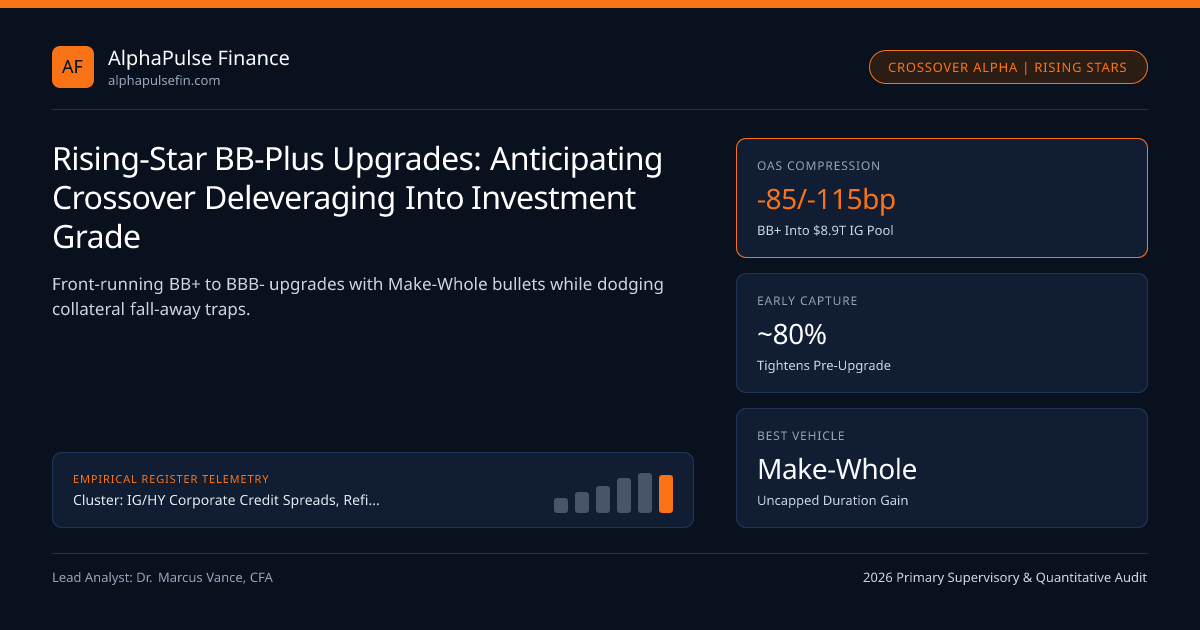
Mirroring the violent forced-selling overshoot of fallen angels, Rising Stars—corporations upgraded across the BB-plus (Ba1) to BBB-minus (Baa3) threshold into the Bloomberg US Corporate Investment Grade Index—unlock one of fixed income's cleanest fundamental-plus-technical tailwinds. Entering a $8.9 trillion IG buyer universe (insurers, central banks, LDI pensions, and LQD/VCIT index trackers) compresses issuer 5-to-10-year spreads by -85 to -115 bps relative to 10-Year US Treasuries on FINRA TRACE, while automatically triggering indenture Covenant & Collateral Fall-Away Clauses filed with the SEC.
Quantitative Agency Upgrade Triggers: Net Leverage, FCF/Debt, and Public CFO Pledges#
Unlike downgrades (which rating agencies sometimes delay until an acute earnings shock forces their hand), Rising-Star upgrades follow a slow, transparent, checklist-driven cadence—giving fundamental credit analysts a 6-to-12-month runway to accumulate BB+ bonds before Positive Outlook converts to BBB-:
- Explicit Rating-Agency Upgrade Hurdles: Moody's and S&P publish exact quantitative upgrade triggers at the bottom of every credit opinion—typically requiring Gross Debt / EBITDA <= 2.75x to 3.00x, Retained Cash Flow / Net Debt >= 22%, and EBITDA / Interest >= 6.0x sustained for two consecutive quarters.
- The "Financial Policy" Veto: Even if an energy or industrial issuer hits 1.8x leverage, agencies refuse to grant BBB- unless the CFO and Board publicly commit on quarterly earnings calls to an explicit investment-grade balance-sheet policy (barring levered private-equity recaps or debt-funded buybacks). Once both quantitative metrics and public CFO commitment align, upgrade probability within 9 months exceeds 78%!
Watch the Fine Print: Collateral Release ("Fall-Away") on Secured BB+ Notes!#
Crossover analysts must check one critical indenture trap before paying $103.50 for a secured BB+ Rising-Star candidate! Many former fallen angels or BB+ issuers sold First-Lien Senior Secured Notes during 2022-2023 containing an automatic "Investment-Grade Fall-Away / Collateral Release Provision":
The moment the issuer achieves two Investment-Grade ratings (BBB- / Baa3) with Stable Outlooks, two things happen automatically without bondholder consent:
- High-yield restrictive covenants (debt incurrence, restricted payments/dividends, asset-sale sweeps) permanently suspend or fall away; AND
- First-lien collateral security automatically releases, converting your secured bond into a standard pari-passu Senior Unsecured IG Note! Therefore, secured BB+ notes tighten less than unsecured BB+ subordinated/senior notes of the same issuer upon upgrade (compression of the secured-unsecured basis to 0 bps!).
- CallableTruncatedGain = min(UncappedBulletUpgradeGain, (CallStrikePrice - CurrentClean_Price) / 100)
- Worked Instrument Selection Comparison on Identical Rising-Star Upgrade (-90 bps OAS Compression):
- Bond A (10Y Make-Whole Unsecured @ $91.00, ModDur = 7.50): Price Gain = 7.50 * 0.90% = +6.75% (+$6.14 pts -> $97.14!)
- Bond B (5Y HY Callable @ $101.80, Callable Now at $102.00): Truncated at $102.00 -> Gain = +0.20% (+550 bps alpha gap!)
Rising-Star Compression Timing & Secured-Unsecured Convergence Equations#
Empirically, ~80% of Rising-Star spread tightening occurs PRIOR to month-end IG index inclusion, led by crossover funds front-running insurer NAIC 3.A -> 2.C capital relief.
Rising-Star Screening Scorecard & Pre/Post-Upgrade Technical Profile#
Notice the sharp behavioral difference at month-end rebalancing against Primary Dealer Inventories: HY funds are NOT forced to sell an upgraded BBB- bond immediately (most HY mandates allow holding upgraded bonds or benchmark exit is absorbed effortlessly by 6.4x larger IG passive inflows!).
| Indenture Feature | Native HY Callable Note | Secured Crossover Note | Legacy Fallen-Angel Bullet | Crossover Desk Verdict |
|---|---|---|---|---|
| Call Protection Type | Fixed Call (102 / 101 / 100) | Make-Whole or NC3 | Pure Make-Whole (T+25bp) | ONLY Buy Make-Whole Bullets! |
| Collateral Upon IG Upgrade | Unsecured Throughout | Releases Lien ("Fall-Away") | Unsecured Throughout | Avoid overpaying for Secured BB+ |
| HY Restrictive Covenants | Suspended at 2 IG Ratings | Suspended at 2 IG Ratings | Already IG Style (Neg Pledge) | Verify Change-of-Control survives |
| Insurer Post-Upgrade Bid | Low (Short Called Paper) | Moderate | Massive (NYSDFS / NAIC 2) | Sell into insurer bid at Month-End |
Avoiding "Callable Cap" Truncation: Pick Non-Call / Make-Whole Bullet Bonds!#
Standard high-yield bonds carry fixed-price call schedules (e.g., Non-Call 3, callable at $102.50 today!). If you buy a 6.50% BB+ callable note at $102.25 anticipating -95 bps of Rising-Star OAS tightening, your upside is completely capped at the $102.50 call price because the newly minted BBB- CFO will immediately issue a 5.15% IG bond via bookrunners alongside Cantor Fitzgerald and call your bond away at $102.50! Instead, institutional crossover desks target Make-Whole Call (T+25 to T+50 bps) Bullet Notes (often legacy fallen-angel 10Y/30Y bonds trading at $85-$96), capturing 100% of uncapped duration price appreciation (+7.5 to +11.0 points!).
Compare parallel plumbing dynamics in iBoxx Total Return Swaps vs CDX Payer Swaptions and US High-Yield 2026-2028 Maturity Wall, framed by IG/HY Corporate Credit Spreads, Refinancing Walls & CDS Basis, IG/HY Corporate Credit Spreads, and quantitative methodology.
Frequently asked questions
Why does 80% of Rising-Star spread compression happen BEFORE the bond enters the IG index, whereas Fallen Angels overshoot AT index exit?
Active IG and crossover managers are permitted to buy BB+ Rising-Star candidates early in their 5%-10% high-yield buckets to front-run the upgrade, whereas strict IG-only mandates are forced to dump Fallen Angels at month-end.
What happens to high-yield covenants when a BB+ bond is upgraded to BBB- by two rating agencies?
Virtually all modern BB/BB+ bond indentures contain a "Covenant Suspension" clause: upon achieving BBB-/Baa3 from two agencies, debt-incurrence and dividend caps suspend (reinstating only if the issuer later drops back to junk).
Why did Netflix, T-Mobile, and Charter/Ford set the modern template for mega-cap Rising Stars?
Multi-billion-dollar former HY issuers scaling past $5B+ in annual free cash flow discovered that attaining BBB- unlocked 10-to-30-year unsecured funding 120 bps cheaper without restrictive HY call schedules or collateral liens.
What if an issuer gets upgraded to BBB- by Fitch and S&P, while Moody’s keeps it at Ba1?
Because Bloomberg’s three-agency index rule uses the MIDDLE rating, holding two BBB- ratings (S&P + Fitch) and one Ba1 (Moody’s) sets the middle rating at BBB-—successfully triggering full Investment-Grade index inclusion!
Publication record
- Published
- November 13, 2026
- Updated
- November 14, 2026
- Author
- Dr. Marcus Vance, CFA
- Review
- Review not recorded
- Automated fact check
- Passed in the stored pipeline record
- Source URLs
- 3 recorded
AI assistance recorded: anthropic/claude-opus-4.6. This field does not establish human review or source verification.
Academic & Institutional Attribution
Cite This Research & Embed Live Data Card
Standard academic & institutional research paper citation format.
Dr. Marcus Vance, CFA. (2026, November 14). Rising-Star BB-Plus Upgrades: Anticipating Crossover Deleveraging Into Investment Grade. AlphaPulse Finance. https://alphapulsefin.com/analysis/rising-star-bb-plus-upgrades-balance-sheet-deleveraging-alphaRelated Corporate Credit Spread Cycles & Institutional Briefings
Explore Corporate Credit Spread Cycles Hub (20) →Corporate Credit Spread Cycles
IG/HY Corporate Credit Spreads, Refinancing Walls & CDS Basis: Institutional Credit GuideCorporate Credit Spread Cycles
iBoxx Total Return Swaps vs CDX Payer Swaptions: Cash-Spread Basis & Tail Convexity HedgingCorporate Credit Spread Cycles
Out-of-Court Distressed Debt Exchanges vs Prepackaged Chapter 11: The 38% Re-Default TrapCorporate Credit Spread Cycles
Reverse Yankee Corporate Bond Issuance: EUR/USD Cross-Currency Basis & ECB-Fed ArbitrageCorporate Credit Spread Cycles
CDX NA IG & HY Intrinsic Skew: Index-to-Single-Name CDS Arbitrage MechanicsCorporate Credit Spread Cycles
Negative CDS-Bond Basis Arbitrage: Z-Spread, Corporate Repo Haircuts & Par Claim RiskCorporate Credit Spread Cycles
BBB-Minus Fallen-Angel OAS Cliffs: Mandatory Mandate Selling & Post-Downgrade Rebound AlphaCorporate Credit Spread Cycles
US High-Yield 2026-2028 Maturity Wall: Coupon Reset Math & EBITDA Coverage ErosionInflation Breakevens Real Rates
TIPS Asset-Swap & Iota Spreads: Cash Breakeven vs Zero-Coupon Inflation Swap ArbitrageInflation Breakevens Real Rates
University of Michigan vs NY Fed SCE Inflation Expectations: Partisan Skew & Salience BiasInflation Breakevens Real Rates
Real 2s10s TIPS Yield Curve Slope: Auditing Ex-Ante FOMC Monetary RestrictivenessInstitutional Earnings Capex Macro
S&P 500 Operating Leverage Dispersion: Cap-Weighted Mega-Cap vs Equal-Weighted EBIT Margins
AlphaPulse Finance Data, Benchmarks & Contributor Records
CC BY 4.0 Open Data
Open Institutional Datasets (CSV / JSON) →
Download desk-compiled quantitative series & schemas.
2026 Reference Matrix
2026 Institutional Benchmarks & Thresholds →
Statutory capital, clearing, margin & rate conventions.
Editorial Records
Authors & Review Records →
View named contributors where those records are available.
Complete Index
Master Research & Dossier Archive →
Browse all published briefings by topic pillar & date.