
Corporate Credit Spread Cycles
Negative CDS-Bond Basis Arbitrage: Z-Spread, Corporate Repo Haircuts & Par Claim Risk
Persistent -12 to -35 bps negative CDS-bond basis across investment-grade corporates reflects bilateral corporate repo funding spreads over SOFR, 5%-8% collateral haircuts, and non-par bond price jump risk.
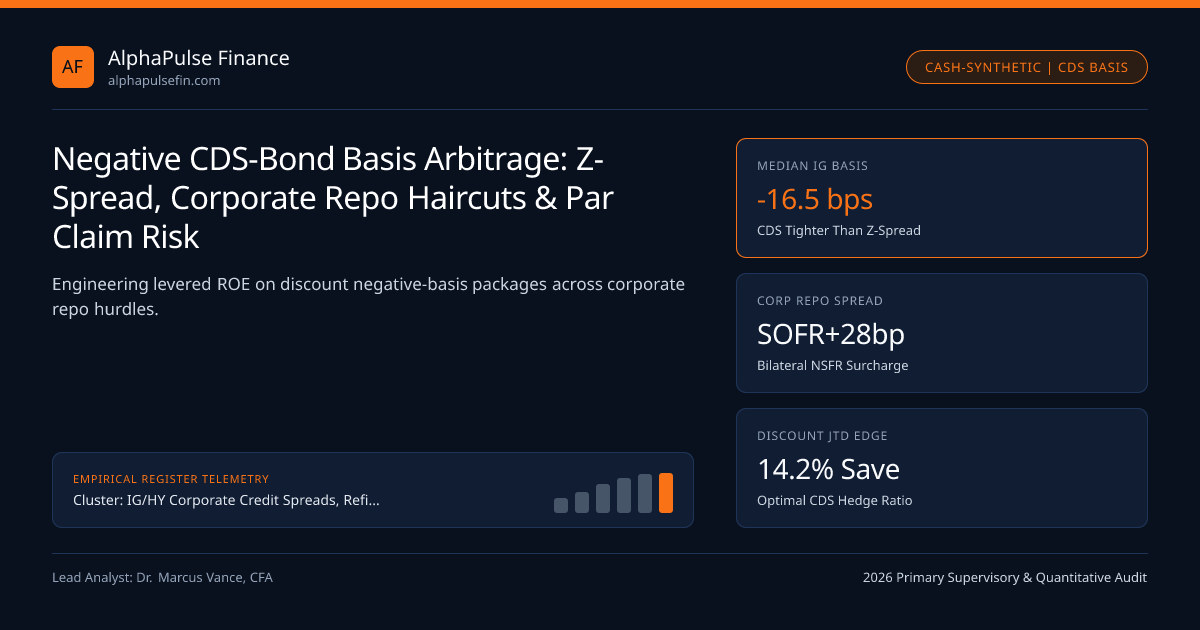
Textbooks teach that buying a 5-year senior unsecured corporate bond and simultaneously buying 5-year single-name Credit Default Swap (CDS) protection creates a synthetic risk-free floating-rate note that must yield Overnight SOFR (3.91%). Yet across 2026 FINRA TRACE and DTCC swaps tapes, 5-year CDS routinely trades 12 to 35 bps tighter than matched corporate cash Z-spreads—a persistent negative CDS-bond basis dictated by corporate repo balance-sheet surcharges on Primary Dealer Holdings, collateral haircuts, and dollar-price par-claim asymmetries.
Why Corporate Cash Bonds Cannot Be Funded at Risk-Free Overnight SOFR#
Unlike 10-Year US Treasuries that clear inside DTCC FICC at 3.91% SOFR with 1.5%-2.0% margin, cash corporate bonds are ineligible for FICC GSD netting and must be financed in non-centrally cleared bilateral repo (NCCBR) facing G-SIB prime brokers.
Prime brokers impose two punitive frictions on corporate bond repo:
- Balance-Sheet Repo Spread (SOFR + 22 to 45 bps): Because uncleared corporate reverse repos consume Basel III Leverage Exposure and Net Stable Funding Ratio (NSFR) weights (50% Required Stable Funding for non-HQLA corporate collateral), dealers charge SOFR + 28 bps on IG corporates and SOFR + 65 bps on HY.
- Unremunerated Haircut Equity Drag (5% to 12%): Posting an 8% haircut on an IG bond requires the hedge fund to fund 8% of the purchase with expensive unlevered fund equity (12%-15% hurdle rate), eating up another 10 to 15 bps of raw negative basis before trade entry!
Discount Dollar Price ($86) Bonus vs Premium Price ($108) Jump-to-Default Trap#
Standard Z-spread minus CDS subtraction breaks down whenever legacy low-coupon 2020-2021 corporate bonds trade at $86.00 per $100 par alongside 2023 high-coupon bonds trading at $107.50. Why? Because a standard CDS contract protects $100 par claim upon default (100 - Recovery), regardless of what clean price you paid for the bond!
- Discount Bond Convexity ($86 Price): Buying $10M par of an $86 bond costs only $8.6M cash (saving 14% on repo financing!), while $8.6M—or $10M par—of CDS pays 100 - Recovery on full par if a sudden jump-to-default occurs! Buying $10M par bond + $10M CDS nets an instant +$1.4M windfall gain on jump-to-default (($100 - R) CDS payout + R bond value - $86 cost = +$14!).
- Premium Bond Trap ($108 Price): Paying $108 for a high-coupon bond hedged with $100 par CDS loses $8.00 immediately on sudden default ($100 total recovery vs $108 cost), requiring a par-equivalent asset-swap (PECS) adjustment by desks at Cantor Fitzgerald and Atomic Capital.
- JTDNeutralCDSNotional = BondPar * ((CleanPrice - ExpectedRecovery) / (100 - Expected_Recovery))
- Worked $10M Discount BBB Negative Basis Package (Price = 91.50, Z = 118 bps, CDS = 90 bps, Recovery = 40%):
- Gross Basis = 118 - 90 = +28.0 bps | Repo Financing Drag = 0.915 * 28 bps = -25.6 bps (unlevered excess +2.4 bps)
- On 12.5% Total Equity Capital (8% Repo Haircut + 4.5% CDS IM): Base Return = 3.91% SOFR + (28 - 25.6)/0.125 = 5.83% + JTD Convexity
- JTD-Neutral CDS Sizing = $10M * ((91.50 - 40) / (100 - 40)) = $8.583M CDS (cuts CDS cost by 14.2%, boosting ROE to 14.1%!)
Funding-Adjusted Net Basis & Dollar-Price Hedge Ratio Equations#
Institutional basis desks rank 500+ single-name credits daily by Net Levered Carry-on-Equity rather than raw unadjusted basis.
Positive vs Negative Basis Drivers Across the Credit Cycle#
While IG basis averages -16 bps in normal regimes, orphan HY bonds and short-squeezed takeover targets flip into deeply positive basis (+40 to +120 bps) where CDS trades far wider than cash.
| Bond Dollar-Price Tier | Cash Coupon Vintage | Par-for-Par Jump-to-Default P&L | Repo Cash Financing Load | Preferred Institutional Trade |
|---|---|---|---|---|
| Deep Discount ($82 - $89) | 2020-2021 1.75%-2.50% IG | +$11 to +$18 Instant Gain! | 11%-18% Lower Cash Borrow | Overweight Negative Basis Long |
| Near Par ($98 - $101) | 2025-2026 5.00%-5.25% IG | ~$0 Neutral Par Alignment | 100% Par Cash Borrowed | Pure Z-Spread vs CDS Carry |
| High Premium ($106 - $112) | 2023 Peak 6.25%-6.75% IG | -$6 to -$12 Instant Loss! | 106%-112% Inflated Repo | Avoid or Short Positive Basis |
| Squeezed HY ($95 + Cheapest) | Orphan / LME Restructuring | CTD Delivery Optionality | Hard-to-Borrow (+150bp Special) | Positive Basis (Sell CDS / Short Bond) |
Sizing DV01 vs Jump-to-Default Ratios Across SEC & CFTC Margins#
Constructing a crash-proof negative-basis book under SEC Regulation SBSR and CFTC swap margin rules requires choosing between Par-for-Par hedging ($10M CDS vs $10M par bond, leaving residual interest-rate/spread DV01 mismatch on $86 discount bonds) and Market-Value hedging ($8.6M CDS vs $8.6M bond cost, eliminating repo excess but under-hedging default recovery if R < 100%). Best-practice desks weight CDS notional at NotionalCDS = BondPar * ((Price - Recovery) / (100 - Recovery)) to neutralize sudden jump-to-default P&L while hedging residual SOFR rate DV01 with cleared OIS swaps.
Broader structural context is documented in IG/HY Corporate Credit Spreads, Refinancing Walls & CDS Basis, with granular extensions in BBB-Minus Fallen-Angel OAS Cliffs and US BSL CLO Arbitrage across IG/HY Corporate Credit Spreads and institutional datasets.
Frequently asked questions
Why did the corporate CDS-bond basis blow out to -145 bps in March 2020 and -265 bps in October 2008?
During liquidity panics, mutual funds dump cash corporate bonds for T+1 cash while dealers refuse to expand uncleared repo balance sheets, causing cash Z-spreads to gap far wider than synthetic CDS until central bank facilities restore confidence.
Why is SOFR Z-spread preferred over Treasury G-spread when measuring CDS-bond basis?
Single-name CDS hazard curves are bootstrapped and discounted off the zero-coupon SOFR OIS swap curve; comparing cash bonds to Treasury G-spreads contaminates the credit basis with volatile Treasury-SOFR swap spreads.
How does Basel III Net Stable Funding Ratio (NSFR) widen bilateral corporate bond repo rates?
Under NSFR rules enforced by the Federal Reserve and OCC, non-HQLA corporate bond reverse repos require banks to hold 50% Required Stable Funding (1-year+ term debt), adding 20 to 35 bps of balance-sheet cost over Treasury GC.
What happens to a negative-basis trade if the corporate issuer calls the bond early via a make-whole call?
Make-whole calls pay Treasury + 15-25 bps (typically well above par or market price, generating a cash windfall), while the liquid single-name CDS can be unwound immediately in the secondary market with minimal friction.
Publication record
- Published
- November 13, 2026
- Updated
- November 14, 2026
- Author
- Dr. Marcus Vance, CFA
- Review
- Review not recorded
- Automated fact check
- Passed in the stored pipeline record
- Source URLs
- 3 recorded
AI assistance recorded: anthropic/claude-opus-4.6. This field does not establish human review or source verification.
Academic & Institutional Attribution
Cite This Research & Embed Live Data Card
Standard academic & institutional research paper citation format.
Dr. Marcus Vance, CFA. (2026, November 14). Negative CDS-Bond Basis Arbitrage: Z-Spread, Corporate Repo Haircuts & Par Claim Risk. AlphaPulse Finance. https://alphapulsefin.com/analysis/negative-cds-bond-basis-z-spread-repo-funding-mechanicsRelated Corporate Credit Spread Cycles & Institutional Briefings
Explore Corporate Credit Spread Cycles Hub (20) →Corporate Credit Spread Cycles
IG/HY Corporate Credit Spreads, Refinancing Walls & CDS Basis: Institutional Credit GuideCorporate Credit Spread Cycles
BBB-Minus Fallen-Angel OAS Cliffs: Mandatory Mandate Selling & Post-Downgrade Rebound AlphaCorporate Credit Spread Cycles
US High-Yield 2026-2028 Maturity Wall: Coupon Reset Math & EBITDA Coverage ErosionCorporate Credit Spread Cycles
Covenant-Lite Liability Management Exercises (LMEs): Uptiers, Drop-Downs & Recovery CompressionCorporate Credit Spread Cycles
IG Primary Bond New-Issue Concession (NIC): Orderbook Oversubscription & Syndicate CompressionCorporate Credit Spread Cycles
FINRA TRACE Block Dissemination Caps & Automated Credit Portfolio Trading MicrostructureCorporate Credit Spread Cycles
Fixed-Income Credit ETF Create/Redeem Arbitrage: Custom Baskets & Stale-NAV Liquidity DiscoveryCorporate Credit Spread Cycles
US BSL CLO Arbitrage: AAA Liability Spreads, 7.5% CCC Buckets & Junior OC Test DiversionInflation Breakevens Real Rates
BEA Core PCE vs BLS Core CPI Wedge: Scope, Weight & Fisher Substitution DecompositionInflation Breakevens Real Rates
TIPS Par Deflation Floor Convexity: Pricing Embedded 0% Put Options Across Issue VintagesInflation Breakevens Real Rates
10-Year TIPS Real Yields & S&P 500 Forward P/E Compression: Equity Duration RegimesInflation Breakevens Real Rates
NSA CPI 3-Month Indexation Lag & Front-End TIPS Seasonal Carry/Roll Mechanics
AlphaPulse Finance Data, Benchmarks & Contributor Records
CC BY 4.0 Open Data
Open Institutional Datasets (CSV / JSON) →
Download desk-compiled quantitative series & schemas.
2026 Reference Matrix
2026 Institutional Benchmarks & Thresholds →
Statutory capital, clearing, margin & rate conventions.
Editorial Records
Authors & Review Records →
View named contributors where those records are available.
Complete Index
Master Research & Dossier Archive →
Browse all published briefings by topic pillar & date.