
Corporate Credit Spread Cycles
IG Primary Bond New-Issue Concession (NIC): Orderbook Oversubscription & Syndicate Compression
US investment-grade syndicate desks launch morning Initial Price Thoughts +25 to +30 bps wide of interpolated secondary curves, utilizing 3.4x median orderbook oversubscription to compress final New-Issue Concessions to 2.8 bps.
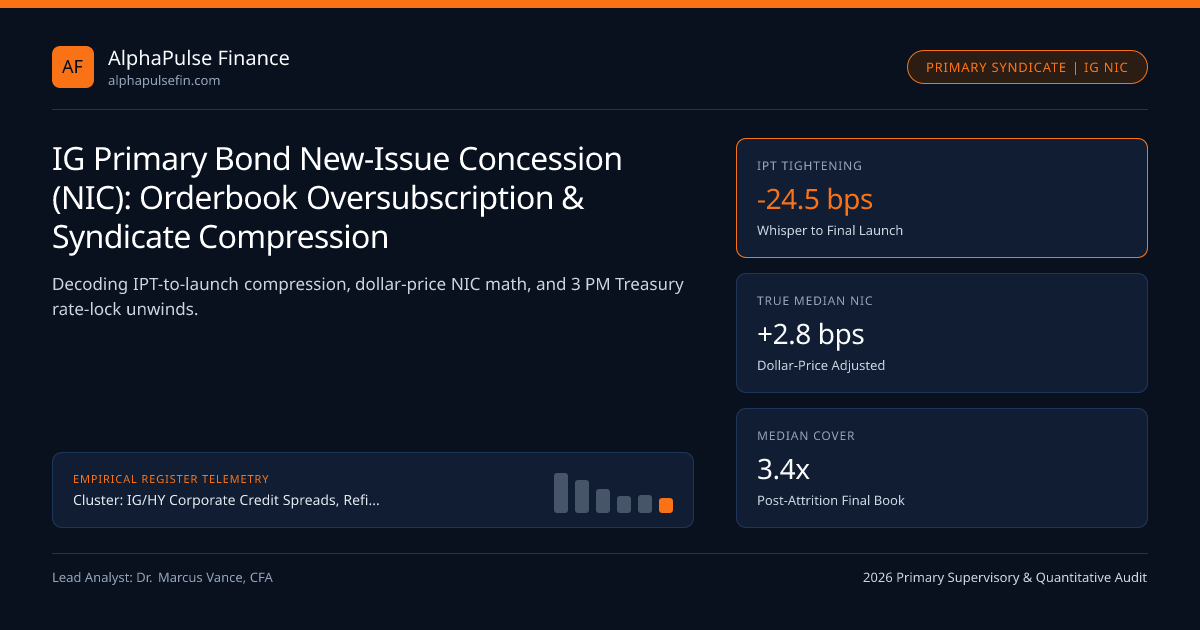
More than $1.52 trillion of gross US investment-grade corporate bonds price across Wall Street syndicate desks annually—frequently packing $35 billion to $55 billion into peak post-Labor Day and January issuance weeks. Every morning at 8:15 AM ET, active bookrunners release Initial Price Thoughts (IPTs) quoted in basis points over on-the-run 10-Year (4.32%) and 30-Year (4.61%) US Treasuries. Decoding how 3.4x median orderbook oversubscription compresses -24.5 bps from IPT to Final Launch, leaving a +2.8 bps New-Issue Concession (NIC) while triggering Treasury rate-lock unwinds across Primary Dealer Inventories, separates disciplined credit alpha from "orderbook inflation" traps.
From 8:15 AM IPT to 2:30 PM Launch: The Syndicate Price-Discovery Game#
Modern SEC-registered shelf takedowns (Form S-3 Automatic Shelf Registration filed with the SEC) execute intraday in four choreographed stages:
- 8:15 AM ET — Initial Price Thoughts (IPTs): Bookrunners whisper T + 115 bps area on a 10-year A-rated tranche whose interpolated secondary curve on FINRA TRACE sits at T + 88 bps—dangling an apparent +27 bps optical discount to lure momentum hedge funds ("flippers") alongside real-money pension accounts.
- 11:15 AM ET — Peak Orderbook ("Subject"): Peak demand hits $11.5 billion on a $2.5 billion tranche (4.6x book-to-cover).
- 12:30 PM ET — Guidance & Launch Tightening: Empowered by 4.6x cover, syndicate tightens pricing aggressively by -24 bps to launch at T + 91 bps. Roughly 32% of fast-money orders drop ("book attrition"), leaving a clean 3.1x final book and a +3.0 bps realized NIC.
- 3:30 PM ET — Treasury Rate Lock & Free-to-Trade ("Break"): Bookrunners spot the 10-Year Treasury yield, lift corporate rate-lock Treasury shorts via dealers like Cantor Fitzgerald, and free the bond for grey/TRACE secondary trading (typically tightening another 2-4 bps on the break).
Interpolating True Fair Value: G-Spread Curve + Dollar-Price Convexity Adjustment#
Computing accurate NIC is far trickier than subtracting an old bond's spread. Suppose an issuer's existing 2034 bond carries a 2.10% coupon trading at $83.40 (G-spread = +82 bps), while today's new 10-year 2036 par bond ($99.85) carries a 5.20% coupon.
Because institutional buyers value low-dollar-price $83 bonds for positive call/jump protection (worth ~4 to 7 bps tighter spread), a par $100 new issue fairly requires +5 bps higher spread purely for par dollar price, plus +3 bps for 2 years of curve extension (82 + 5 + 3 = 90 bps true fair value)! Naively comparing launch (91 bps) against 82 bps overstates NIC as +9 bps when true economic NIC is just +1.0 bps.
- RealizedNICbps = SFinalLaunch - FairParNewIssueSpread
- Worked 10-Year A-Rated Primary NIC Valuation:
- Existing 8.5Y 2035 Bond (2.25% Coupon, Clean Price = $84.00) Trades at G-Spread = +81.0 bps
- 1.5-Year Curve Slope (+2.4 bps) + Par Dollar-Price Penalty (0.30 bps/pt * 16 pts = +4.8 bps) -> Fair Par 10Y = 88.2 bps
- Syndicate Whisper IPT = +115 bps -> Tightens -24 bps to Launch at +91.0 bps -> True Realized NIC = 91.0 - 88.2 = +2.8 bps!
Dollar-Adjusted New-Issue Concession & Syndicate Compression Equations#
Empirical syndicate regressions link final NIC and break performance directly to Post-Tightening Attrition-Adjusted Book-to-Cover.
IG Syndicate Telemetry Across Market Regimes & Deal Sizes#
Jumbo $15B-$25B M&A acquisition financings behave completely differently from routine $1B refinancing takedowns: M&A deals offer +8 to +15 bps NICs to guarantee single-day absorption without repricing the issuer's existing debt.
| Syndicate Telemetry Signal | Bullish Credit Regime | Neutral / Balanced | Indigestion / Risk-Off Warning | Trading Desk Action |
|---|---|---|---|---|
| IPT-to-Launch Tightening | -26 to -34 bps | -20 to -25 bps | < -12 bps (Stuck near IPT) | Pass on primary if tightening <12bp & attrition >45% |
| Final Book-to-Cover Ratio | 4.2x - 6.5x | 2.8x - 3.8x | < 1.8x Cover | Buy Jumbo M&A deals at >3.5x cover + >8bp NIC |
| Dollar-Adjusted NIC | -2.0 to +1.5 bps | +2.5 to +4.5 bps | +10.0 to +22.0 bps | Reprices existing secondary curve wider on FINRA TRACE |
| Afternoon Break Performance | -3 to -6 bps Tighter | -1 to -2 bps Tighter | +3 to +8 bps Wider ("Hung") | Short CDX.NA.IG (CFTC) when 2+ deals break wider |
Spotting treasury Rate-Lock Unwind Rallies at 2:30-3:30 PM ET#
Ahead of heavy $20B+ IG issuance days, corporate treasurers and underwriters short 10-year and 30-year Treasury futures or cash notes to hedge interest-rate movement during bookbuilding. Once books go subject and real-money buyers fund new corporate purchases on swap/spread (selling existing Treasuries against the new corporate) vs outright cash (no Treasury sale!), dealers buy back the un-needed fraction of rate-lock shorts around 2:30-3:30 PM ET—generating a well-documented intraday afternoon Treasury futures bounce tracked by CFTC rates desks.
Related empirical studies—FINRA TRACE Block Dissemination Caps & plus ISDA Credit Event Auctions, Cheapest-to-Deliver Bonds—feed directly into IG/HY Corporate Credit Spreads, Refinancing Walls & CDS Basis, the IG/HY Corporate Credit Spreads hub, and regulatory bodies.
Frequently asked questions
Why do Wall Street syndicate desks start Initial Price Thoughts (IPTs) 25 bps wider than where deals actually price?
Generous morning IPTs create rapid early orderbook momentum ("fear of missing out"), allowing syndicate managers to broadcast "3x covered by 10 AM" headlines that anchor institutional confidence before ratcheting spreads tighter.
What is "orderbook inflation" in investment-grade corporate bond syndications?
Expecting to be scaled back to a 20%-30% allocation on hot deals, hedge funds and asset managers routinely submit $100M orders when they truly want $25M—causing rapid book attrition if syndicate tightens 3 bps too far.
Why do primary new-issue corporate bonds often settle T+2 or T+3 even after secondary TRACE moved to T+1?
While SEC Rule 15c6-1 shifted secondary corporate trades to T+1 in May 2024, underwritten primary offerings frequently utilize extended T+2 to T+5 settlement under Rule 15c6-1(c)/(d) to complete legal opinions and global investor funding.
How does heavy G-SIB bank bond issuance right after quarterly earnings affect IG spreads?
Big Six US banks exit earnings blackout simultaneously each quarter and issue $25B-$40B of TLAC senior HoldCo debt in a 10-day window, temporarily widening financial OAS by 4 to 7 bps before mean-reverting.
Publication record
- Published
- November 13, 2026
- Updated
- November 14, 2026
- Author
- Dr. Marcus Vance, CFA
- Review
- Review not recorded
- Automated fact check
- Passed in the stored pipeline record
- Source URLs
- 3 recorded
AI assistance recorded: anthropic/claude-opus-4.6. This field does not establish human review or source verification.
Academic & Institutional Attribution
Cite This Research & Embed Live Data Card
Standard academic & institutional research paper citation format.
Dr. Marcus Vance, CFA. (2026, November 14). IG Primary Bond New-Issue Concession (NIC): Orderbook Oversubscription & Syndicate Compression. AlphaPulse Finance. https://alphapulsefin.com/analysis/ig-primary-bond-new-issue-concession-orderbook-oversubscriptionRelated Corporate Credit Spread Cycles & Institutional Briefings
Explore Corporate Credit Spread Cycles Hub (20) →Corporate Credit Spread Cycles
IG/HY Corporate Credit Spreads, Refinancing Walls & CDS Basis: Institutional Credit GuideCorporate Credit Spread Cycles
FINRA TRACE Block Dissemination Caps & Automated Credit Portfolio Trading MicrostructureCorporate Credit Spread Cycles
Fixed-Income Credit ETF Create/Redeem Arbitrage: Custom Baskets & Stale-NAV Liquidity DiscoveryCorporate Credit Spread Cycles
US BSL CLO Arbitrage: AAA Liability Spreads, 7.5% CCC Buckets & Junior OC Test DiversionCorporate Credit Spread Cycles
Private Credit Unitranche PIK Toggles & BDC Non-Accrual Dispersion: Shadow Default AuditCorporate Credit Spread Cycles
Merton Structural Distance-to-Default: Equity Put Skew Leading Corporate Credit SpreadsCorporate Credit Spread Cycles
US IG Corporate 10s30s Credit Curve Flattening: Insurer Annuity Demand & Dollar-Price ConvexityCorporate Credit Spread Cycles
ISDA Credit Event Auctions, Cheapest-to-Deliver Bonds & Orphan CDS Risk After LMEsInflation Breakevens Real Rates
Cleveland Fed Trimmed-Mean & Median CPI vs Dallas Fed Trimmed PCE: Outlier-Filtered SignalsInflation Breakevens Real Rates
1Y & 2Y Zero-Coupon Inflation Swaps: RBOB Gasoline Crack Spreads & WTI Pass-ThroughInflation Breakevens Real Rates
D’Amico-Kim-Wei (DKW) Model: Separating TIPS Liquidity Premia From Inflation Risk PremiaInflation Breakevens Real Rates
Core PCE Imputed Financial Services & Portfolio Management Fees: S&P 500 Equity Beta in Inflation
AlphaPulse Finance Data, Benchmarks & Contributor Records
CC BY 4.0 Open Data
Open Institutional Datasets (CSV / JSON) →
Download desk-compiled quantitative series & schemas.
2026 Reference Matrix
2026 Institutional Benchmarks & Thresholds →
Statutory capital, clearing, margin & rate conventions.
Editorial Records
Authors & Review Records →
View named contributors where those records are available.
Complete Index
Master Research & Dossier Archive →
Browse all published briefings by topic pillar & date.