
Inflation Breakevens Real Rates
D’Amico-Kim-Wei (DKW) Model: Separating TIPS Liquidity Premia From Inflation Risk Premia
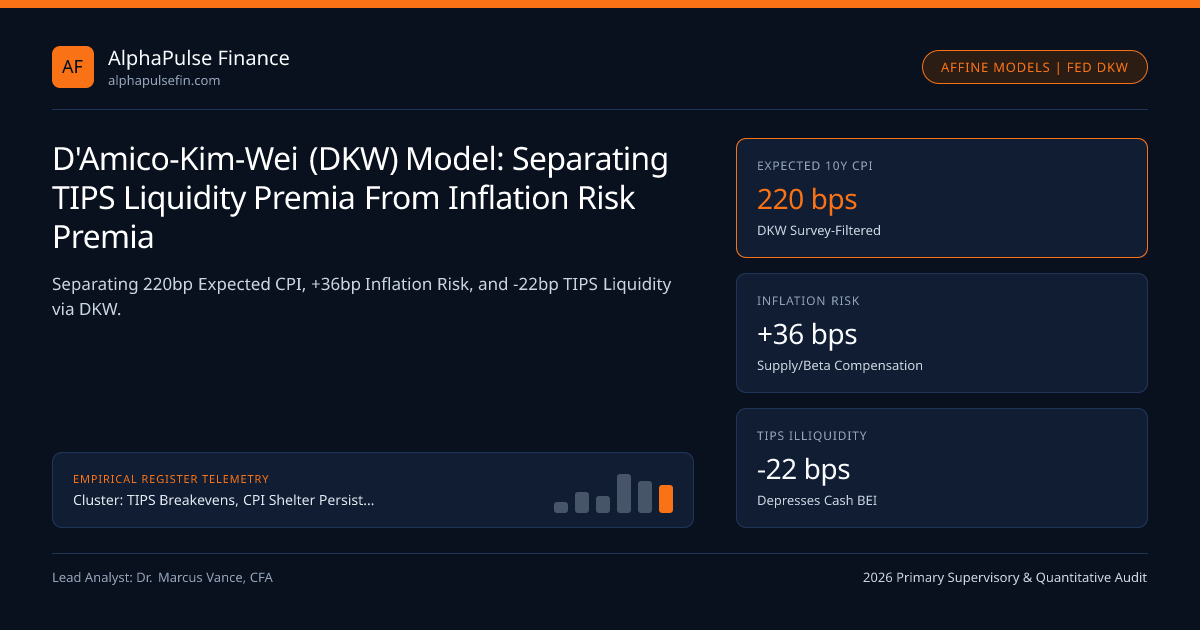
Updated continuously by Federal Reserve Board economists, the D’Amico-Kim-Wei (DKW) latent-factor model decomposes raw 234-bps 10-year TIPS breakevens into 220 bps expected CPI, +36 bps inflation risk premium, and -22 bps TIPS illiquidity.
Ask two macro strategists what a 234-bps cash breakeven between 10-Year Nominal Notes (4.32%) and 10-Year TIPS Real Yields (1.98%) means, and one will claim "the market expects 2.34% inflation" while the other warns "breakevens are depressed by TIPS illiquidity." To give the FOMC an exact econometric referee across the 2s10s Curve, Federal Reserve Board economists Stefania D'Amico, Don Kim, and Min Wei built the DKW Joint Nominal-TIPS-Inflation-Swap Affine Model—isolating four distinct latent curves every week: Expected Real Rates, Real Term Premia, Expected CPI, Inflation Risk Premia (IRP), and the TIPS Liquidity Premium (L_TIPS)!
Why Four Factors Are Required: The Identification Problem in Raw Breakevens#
Observe the core econometric dilemma: you have only two cash bond yields (Nominal Yield y^N and TIPS Yield y^R), yet their difference (BEI = y^N - y^R) is driven by three separate unknowns: ExpectedCPI + InflationRiskPremium - TIPSLiquidity_Discount! Without additional observable data, separating a positive Inflation Risk Premium (+36 bps) from a positive TIPS Illiquidity Discount (-22 bps) is mathematically under-identified!
D'Amico, Kim, and Wei (JFQA 2018 / Fed FEDS Working Paper 2014-71) solved identification by combining four simultaneous Kalman-filter observation blocks:
- Nominal GSW zero-coupon Treasury yields (3M to 10Y);
- Cash TIPS yields (5Y to 10Y);
- Survey of Professional Forecasters (SPF) & Blue Chip CPI/Rate Forecasts (anchoring physical P-measure expectations); AND
- Zero-Coupon Inflation Swaps (ZCIS) + TIPS Turnover/Asset-Swap Spreads (isolating pure TIPS Liquidity L_t as a fourth orthogonal latent factor independent of the 3 Gaussian macro yield factors!).
How the Sign of the Inflation Risk Premium Flipped From -25 Bps (2016) to +36 Bps (2026)#
DKW historical estimates from 1999 to 2026 reveal a dramatic regime flip in the 10-Year Inflation Risk Premium (IRP) directly tied to stock-bond return correlation:
- 2012-2020 Demand-Shock Regime (IRP = -15 to -32 bps!): During low-inflation secular stagnation, inflation fell precisely when recessions hit (2008, 2015, 2020)! Because nominal Treasuries rallied hardest in deflationary busts (negative stock-bond beta), investors willingly accepted a negative Inflation Risk Premium on nominal bonds!
- 2022-2026 Supply/Fiscal-Shock Regime (IRP = +30 to +48 bps!): Once supply-chain, fiscal-deficit, and tariff shocks made high inflation coincide with falling stock and bond prices (positive +0.42 stock-bond beta!), nominal Treasuries became risky inflation losers—forcing nominal yields to carry a +36 bps positive IRP over expected inflation!
- Observed10YCashBEI = Et[CPI10Y] + IRP10Y - LTIPS10Y
- Worked Q4 2026 Complete Nominal & Real Term Structure Reconciliation:
- 10Y TIPS Real Yield (1.98%) = 1.44% Expected Avg Real Short Rate + 0.32% Real Term Premium + 0.22% TIPS Illiquidity!
- 10Y Nominal Yield (4.32%) = 1.44% Real Path + 2.20% Exp CPI + 0.32% Real TP + 0.36% Inflation Risk Premium (+0.68% Pure Nom TP)
- Check Cash Breakeven: 4.32% - 1.98% = 2.20% + 0.36% - 0.22% = 2.34% (234 bps exact!)
DKW Four-Factor Affine State-Space & Breakeven Decomposition Equations#
Notice how adding Real Term Premium (+32 bps) + Inflation Risk Premium (+36 bps) inside DKW reconciles cleanly back to the Nominal Term Premium (+46 bps ACM / KW after TIPS liquidity adjustment!).
Historical Evolution of DKW 10-Year Breakeven Components Across Cycles#
Tracking the DKW TIPS Liquidity Factor (L_10Y) gives multi-strategy relative-value funds executing across FINRA TRACE and dealers like Cantor Fitzgerald an institutional valuation Z-score for cash TIPS richness or cheapness.
| DKW Model Output Component | Q4 2026 Level | 2015-2019 Mean | Macro Economic Driver | Portfolio Signal When Extreme |
|---|---|---|---|---|
10Y Expected CPI (pi^e) | 220 bps | 208 bps | FOMC Credibility & SPF Anchor | Hike/Cut trigger if moves > +/-25bp |
10Y Inflation Risk (IRP) | +36 bps | -21 bps | Cov(Inflation, Consumption / Stocks) | Positive IRP favors Nominal carry over TIPS |
10Y TIPS Illiquidity (L_TIPS) | +22 bps (-22bp BEI) | +31 bps | Dealer Repo Capacity & SOMA Share | Buy Cash TIPS vs ZCIS (CFTC) if > +40bp! |
10Y Real Term Premium (RTP) | +32 bps | -38 bps | Fiscal Deficit Supply & Real Vol | Lock in 1.98% 10Y TIPS real yield for LDI |
Portfolio Allocation Rule: Buy Nominal vs Buy TIPS Using DKW IRP minus L_TIPS#
Look at the exact tactical allocation rule for a sovereign wealth or pension fund indifferent to short-term mark-to-market: compare IRP10Y (+36 bps) against TIPSLiquidity_Premium (+22 bps)!
- When IRP > TIPS_Liquidity (+36 > +22 -> net +14 bps in Q4 2026), Nominal Treasuries pay +14 bps MORE risk-compensated yield than TIPS (provided inflation averages 2.20%!), whereas when TIPS_Liquidity spikes > IRP (like March 2020 when L_TIPS hit +95 bps!), Cash TIPS are a generational table-pounding buy over Nominals!
Execution desks cross-check these sensitivities via Core PCE Imputed Financial Services & Portfolio Management Fees, Gold Spot Divergence From 10-Year TIPS Real Yields, and TIPS Breakevens, CPI Shelter Persistence & Forward Real Rates, curated on TIPS Breakevens and covered institutions.
Frequently asked questions
Why did US TIPS look like a "terrible investment" to Treasury taxpayers during 1997-2003 before DKW explained it?
When Treasury launched TIPS in 1997, secondary market illiquidity forced Treasury to pay a massive +80 to +120 bps TIPS Liquidity Premium (real yields > 4.0%!), costing taxpayers billions relative to Nominals until liquidity deepened.
Where can institutional analysts download the official Federal Reserve DKW model series?
Federal Reserve Board economists Don Kim, Cait Walsh, and Min Wei publish regularly updated CSV datasets alongside FEDS Note "Tips from TIPS: Update and Discussions" directly on federalreserve.gov!
How does the Cleveland Fed Inflation Expectations Model differ from the Fed Board’s DKW model?
The Cleveland Fed model (Haubrich-Pennacchi-Ritchken) uses Zero-Coupon Inflation Swaps, nominal yields, survey data, and lagged CPI *without* cash TIPS prices—avoiding cash TIPS illiquidity completely from the outset!
What happens to the DKW TIPS Liquidity Premium when the Federal Reserve buys TIPS in Quantitative Easing?
During 2020-2021 when SOMA absorbed >24% of the entire marketable TIPS stock, DKW’s TIPS liquidity premium turned NEGATIVE (-15 bps)—meaning cash TIPS actually traded richer than frictionless model value!
Publication record
- Published
- November 13, 2026
- Updated
- November 14, 2026
- Author
- Dr. Marcus Vance, CFA
- Review
- Review not recorded
- Automated fact check
- Passed in the stored pipeline record
- Source URLs
- 3 recorded
AI assistance recorded: anthropic/claude-opus-4.6. This field does not establish human review or source verification.
Academic & Institutional Attribution
Cite This Research & Embed Live Data Card
Standard academic & institutional research paper citation format.
Dr. Marcus Vance, CFA. (2026, November 14). D’Amico-Kim-Wei (DKW) Model: Separating TIPS Liquidity Premia From Inflation Risk Premia. AlphaPulse Finance. https://alphapulsefin.com/analysis/damico-kim-wei-dkw-three-factor-tips-liquidity-inflation-riskRelated Inflation Breakevens Real Rates & Institutional Briefings
Explore Inflation Breakevens Real Rates Hub (20) →Inflation Breakevens Real Rates
TIPS Breakevens, CPI Shelter Persistence & Forward Real Rates: Institutional GuideInflation Breakevens Real Rates
Core PCE Imputed Financial Services & Portfolio Management Fees: S&P 500 Equity Beta in InflationInflation Breakevens Real Rates
30-Year TIPS Real Yield Auctions: February/August Supply Liquidity & Real-Annuity LDI DemandInflation Breakevens Real Rates
BLS CPI Health Insurance Retained-Earnings Method: October Resets vs BEA PPI Medical CareInflation Breakevens Real Rates
Import Tariff Pass-Through Into Core Goods: Price-Level Step Jumps & 2s10s Breakeven InversionInflation Breakevens Real Rates
Zero-Coupon vs Year-on-Year Inflation Caps & Floors: Tail Volatility Smiles & Regime ProbabilitiesInflation Breakevens Real Rates
Employment Cost Index (ECI) vs Average Hourly Earnings & Atlanta Fed Wage TrackerInflation Breakevens Real Rates
Gold Spot Divergence From 10-Year TIPS Real Yields: EM Central Bank Reserve ReallocationInstitutional Earnings Capex Macro
Russell 2000 Floating SOFR Debt Wall vs S&P 500 Fixed Coupons: Small-Cap Earnings CompressionInstitutional Earnings Capex Macro
Corporate Cash Conversion Cycle (DSO, DIO, DPO): Working Capital Forensics & ASC 405-50 DebtInstitutional Earnings Capex Macro
DXY Dollar Strength & S&P 500 Foreign Revenue: FX Translation vs ASC 815 Cash-Flow HedgingInstitutional Earnings Capex Macro
GAAP vs Non-GAAP S&P 500 EPS Wedge (+14.5%): SEC Regulation G & Item 10(e) Enforcement
AlphaPulse Finance Data, Benchmarks & Contributor Records
CC BY 4.0 Open Data
Open Institutional Datasets (CSV / JSON) →
Download desk-compiled quantitative series & schemas.
2026 Reference Matrix
2026 Institutional Benchmarks & Thresholds →
Statutory capital, clearing, margin & rate conventions.
Editorial Records
Authors & Review Records →
View named contributors where those records are available.
Complete Index
Master Research & Dossier Archive →
Browse all published briefings by topic pillar & date.