
Inflation Breakevens Real Rates
Import Tariff Pass-Through Into Core Goods: Price-Level Step Jumps & 2s10s Breakeven Inversion
Broad import tariff hikes act as a one-time 6-to-12-month price-level step shock to Core Goods while taxing real household disposable income—driving sharp 2s10s TIPS breakeven curve inversions (+45 bps in 2Y vs flat 5y5y).
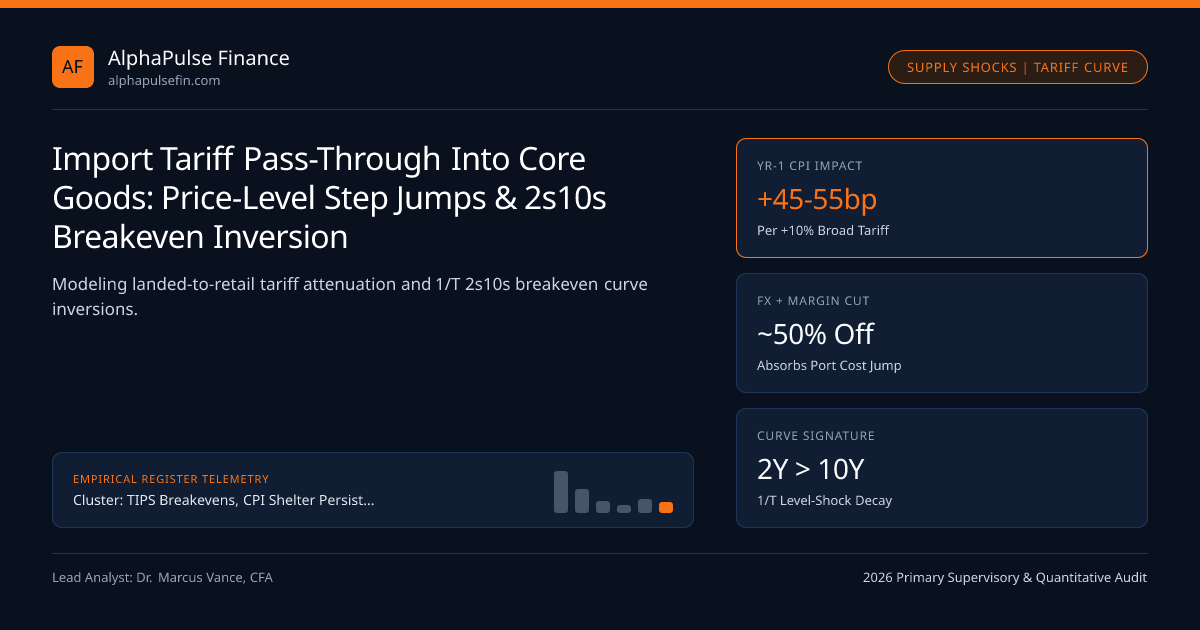
Nothing separates textbook monetary theory from bond-desk P&L sharper than Import Tariff Shocks. Economically, raising the effective US statutory tariff rate by +10 percentage points across $3.2 trillion of imported goods does not permanently raise 10-year trend inflation—it creates a one-time upward step jump in the Core Goods price level spread over 2 to 4 quarters, while simultaneously acting as a fiscal consumption tax that slows real GDP growth! In inflation derivatives and cash TIPS Markets (1.98% 10Y Real), that dual impulse triggers a signature trade: violent 1s5s and 2s10s Breakeven Curve Inversion (front-end 1Y/2Y breakevens surge +45 to +75 bps while 5y5y forward swaps stay flat or dip) as the FOMC weighs "looking through" the level shift in Core PCE!
Tracing $1.00 of Import Tariffs Through Four Attenuation Cushions Into CPI/PCE#
Naive back-of-the-envelope estimates multiply 11% Goods Import Share of GDP * +10% Tariff = +1.10% CPI—overstating realized first-year consumer inflation by roughly 2.2x! Micro-level customs and BLS Import Price Index (MXP) studies from the 2018-2019 Section 301 tariffs (Amiti-Redding- Weinstein; Cavallo-Gopinath-Neiman-Tang) and 2025-2026 trade rounds document four empirical buffers between the port of Los Angeles and the CPI checkout scanner:
- Import Content of Core PCE/CPI (~10.5% Direct + Intermediate Share): Services (75% of Core CPI, 67% of Core PCE) carry minimal imported physical inputs (mostly medical devices, auto parts, and IT hardware).
- Bilateral FX Appreciation Offset (20% to 35% Cushion): Exporting currencies (CNH, MXN, EUR, CAD, KRW) typically depreciate -3% to -6% against the Dollar upon tariff announcements across FX venues monitored by CFTC and cross-border rails like Airwallex, absorbing nearly a third of the USD landed-cost jump!
- Transshipment, Origin Switching & Wholesaler/Retailer Margin Compression (20% to 30% Cushion): Big-box retailers absorb part of the shock in gross margin (hitting S&P Retail EPS!) rather than losing unit volume.
- Distribution/Marketing Markup Dilution: A $10 landed shirt selling for $30 at retail (67% domestic rent/wage retail margin!) paying a $1 (+10%) tariff needs only a +3.3% ($1 / $30) retail sticker hike to recover 100% of the dollar tariff!
Price-Level Shock vs Persistent Inflation: Why 2s10s Breakevens Invert!#
Suppose net consumer pass-through lifts Year-1 CPI by +0.55% (+55 bps) and then stops (returning to 2.25%/yr in Years 2..10 because a constant 15% tariff stops rising in Year 2!). Look at the exact math across the Zero-Coupon Breakeven Curve:
- 1-Year Breakeven: Jumps +55.0 bps (2.25% -> 2.80%)!
- 2-Year Breakeven: Jumps +27.5 bps (55 bps averaged over 2 years = +27.5 bps/yr)!
- 10-Year Breakeven: Jumps ONLY +5.5 bps (55 bps averaged over 10 years = +5.5 bps/yr)—and often jumps 0 bps because slower real consumer demand cools Years 2-5 service wages!
Result: 2YBEI - 10YBEI inverts sharply to +25 to +55 bps (2Y higher than 10Y!) across primary dealer TIPS books at Cantor Fitzgerald and FINRA TRACE!
- DeltaTenorTBreakevenbps = (DeltaRetailCPILevelbps / TYears) + GrowthSlowdownBetaT
- Worked +10% Broad Tariff Shock Valuation Across 2Y vs 10Y TIPS Breakevens:
- Landed Import Cost Share of Consumer Basket (~10.5%) * +10% Tariff * 0.70 (after FX) * 0.72 (after retail margin) = +0.53% (+53 bps)
- 2-Year Breakeven Shift = (+53 bps / 2) - 3 bps demand drag = +23.5 bps
- 10-Year Breakeven Shift = (+53 bps / 10) - 5 bps demand drag = +0.3 bps -> 2s10s Breakeven Curve Inverts -23.2 bps!
Landed-to-Retail Tariff Pass-Through & Term Breakeven Decay Equations#
Watch the one scenario where the FOMC (Federal Reserve Tealbook "Alternative Scenarios") refuses to "look through" a one-time tariff jump: if household inflation expectations are already elevated after multi-year >3% inflation, unions and service businesses may demand second-round wage catch-up!

CPI/PCE Category Exposure to Import Tariffs & Historical Pass-Through Matrix#
Notice Domestic Umbrella Pricing: during 2018 washing-machine tariffs, domestic Whirlpool factories raised US prices right alongside taxed Korean imports—amplifying category inflation beyond direct import share!
| CPI / PCE Goods Category | Import Penetration | Retail Margin Buffer | Observed Consumer Pass-Through | Lag From Customs Effective Date |
|---|---|---|---|---|
| Apparel, Footwear & Toys | 82% - 91% Imported | High (62% Gross Margin) | 25% - 35% of Tariff % | 3 - 5 Months (Seasonal Catalog) |
| Consumer Electronics / PCs | 78% - 88% Imported | Thin (18% Gross Margin!) | 65% - 80% of Tariff %! | 30 - 60 Days (Fast Inventory Turn) |
| New & Used Motor Vehicles | 48% (Parts + Assembly) | Dealer Incentive Cut | 45% + Used-Car Umbrella! | 45 - 90 Days (Dealer Lot Stock) |
Domestic Services (70% CPI) | < 4% Imported Inputs | N/A (Wage Driven) | ~0% (Or Negative Demand!) | Cools in Quarters 3-5 on real income hit |
Trading 2s10s Breakeven Curve Flatteners/Inverters Around Trade Deadlines#
Institutional macro pods express tariff asymmetry via DV01-Neutral 2s10s Zero-Coupon CPI Swap Flatteners (Pay 2Y ZCIS / Receive 10Y ZCIS):
- If tariffs escalate: 2Y ZCIS surges +45 bps while 10Y ZCIS moves +6 bps (+39 bps curve inversion win!).
- If tariffs trigger a consumer recession: 10Y ZCIS drops alongside real growth while existing customs duties keep 1Y-2Y goods prices sticky (still wins!).
Fixed-income and equity strategists align these metrics with TIPS Breakevens, CPI Shelter Persistence & Forward Real Rates, Zero-Coupon vs Year-on-Year Inflation Caps & Floors, 5y5y Forward Inflation Swaps vs TIPS Breakevens, TIPS Breakevens, and macro benchmarks.
Frequently asked questions
Why do central bank textbooks say the FOMC should "look through" a one-time tariff price-level jump, yet officials hesitate in 2025-2026?
In 2018-2019, inflation had sat below 2.0% for a decade, so households ignored modest tariff bumps; after 2021-2024’s cumulative +22% price surge, FOMC officials fear another +0.5% visible goods jump could un-anchor wage and 5-year household expectations!
What is "Domestic Producer Umbrella Pricing" during an import tariff episode?
Documented famously in Fed/NBER studies of 2018 appliance and steel tariffs, shielded US domestic manufacturers raise their own domestic prices by 50%-80% of the tariff rate under the competitive "umbrella" of taxed foreign rivals!
Why does CPI Core Goods lag tariff announcements by 2 to 4 months?
US importers aggressively front-load ocean container shipments into West Coast bonded warehouses 60-90 days ahead of announced tariff deadlines, selling pre-tariff inventory first before raising wholesale list prices.
What happens to YoY CPI exactly 12 months after a tariff takes effect?
Unless tariff rates are raised AGAIN in Year 2, the high tariffed price enters the base denominator in Month 13—causing Year-over-Year Core Goods inflation to drop mechanically by the exact +50 bps it jumped a year earlier!
Publication record
- Published
- November 13, 2026
- Updated
- November 14, 2026
- Author
- Dr. Marcus Vance, CFA
- Review
- Review not recorded
- Automated fact check
- Passed in the stored pipeline record
- Source URLs
- 3 recorded
AI assistance recorded: anthropic/claude-opus-4.6. This field does not establish human review or source verification.
Academic & Institutional Attribution
Cite This Research & Embed Live Data Card
Standard academic & institutional research paper citation format.
Dr. Marcus Vance, CFA. (2026, November 14). Import Tariff Pass-Through Into Core Goods: Price-Level Step Jumps & 2s10s Breakeven Inversion. AlphaPulse Finance. https://alphapulsefin.com/analysis/import-tariff-pass-through-core-goods-breakeven-curve-inversionRelated Inflation Breakevens Real Rates & Institutional Briefings
Explore Inflation Breakevens Real Rates Hub (20) →Inflation Breakevens Real Rates
TIPS Breakevens, CPI Shelter Persistence & Forward Real Rates: Institutional GuideInflation Breakevens Real Rates
Zero-Coupon vs Year-on-Year Inflation Caps & Floors: Tail Volatility Smiles & Regime ProbabilitiesInflation Breakevens Real Rates
Employment Cost Index (ECI) vs Average Hourly Earnings & Atlanta Fed Wage TrackerInflation Breakevens Real Rates
Gold Spot Divergence From 10-Year TIPS Real Yields: EM Central Bank Reserve ReallocationInflation Breakevens Real Rates
TIPS Asset-Swap & Iota Spreads: Cash Breakeven vs Zero-Coupon Inflation Swap ArbitrageInflation Breakevens Real Rates
University of Michigan vs NY Fed SCE Inflation Expectations: Partisan Skew & Salience BiasInflation Breakevens Real Rates
Real 2s10s TIPS Yield Curve Slope: Auditing Ex-Ante FOMC Monetary RestrictivenessInflation Breakevens Real Rates
5y5y Forward Inflation Swaps vs TIPS Breakevens: Stripping Out Oil & Liquidity NoiseInstitutional Earnings Capex Macro
Hyperscaler Incremental AI ROIC vs WACC: The $600B Cloud & Enterprise Monetization HurdleInstitutional Earnings Capex Macro
Implied S&P 500 Equity Risk Premium: Cash-Payout FCF Yield vs 10-Year TIPS Real YieldsInstitutional Earnings Capex Macro
Debt-Funded M&A Accretion Hurdle Rates vs Share Buyback IRR: Exposing the EPS Accretion FallacyInstitutional Earnings Capex Macro
Earnings-Day Single-Stock Implied Straddles & S&P 500 Dispersion Volatility Mechanics
AlphaPulse Finance Data, Benchmarks & Contributor Records
CC BY 4.0 Open Data
Open Institutional Datasets (CSV / JSON) →
Download desk-compiled quantitative series & schemas.
2026 Reference Matrix
2026 Institutional Benchmarks & Thresholds →
Statutory capital, clearing, margin & rate conventions.
Editorial Records
Authors & Review Records →
View named contributors where those records are available.
Complete Index
Master Research & Dossier Archive →
Browse all published briefings by topic pillar & date.