
Inflation Breakevens Real Rates
BLS CPI Health Insurance Retained-Earnings Method: October Resets vs BEA PPI Medical Care
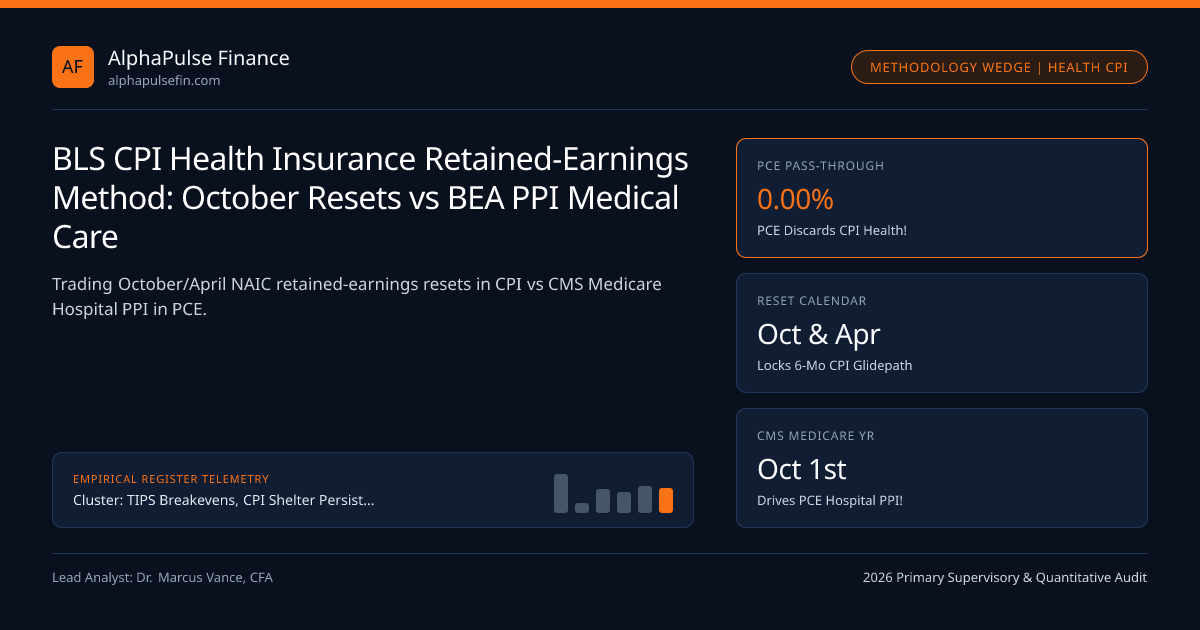
BLS measures CPI Health Insurance indirectly from lagged NAIC insurer retained earnings rather than consumer premiums—creating deterministic October step-changes that swing CPI while leaving BEA Core PCE completely untouched.
Imagine a CPI sub-index that runs at +28% YoY for twelve straight months, suddenly flips on a single October morning to -37% YoY for the next twelve months, and then flips positive again the following October—all while actual hospital bills and employer health premiums grow steadily at +5%! Welcome to BLS CPI Health Insurance (~0.55% to 0.85% of CPI-U), one of the most counterintuitive statistical artifacts in macroeconomics—and a zero-noise arbitrage edge for TIPS traders against BEA Core PCE watched by the Federal Reserve.
Why BLS Cannot Price Health Insurance Policies Directly ("Retained Earnings Method")#
Why doesn't the Bureau of Labor Statistics just survey monthly BlueCross/UnitedHealth family insurance premiums? Because if an insurer raises monthly premiums by +8% solely because utilization of MRIs and GLP-1 drugs rose +8% (quality/quantity change) or because deductibles changed, BLS cannot hold policy quality constant—AND BLS already prices doctors, hospitals, and prescription drugs separately in Medical Care!
Since 1964, BLS therefore prices ONLY the intermediation margin kept by health insurers (Retained Earnings = Premiums Collected minus Medical Benefits Paid Out), pulled once/twice a year from lagged statutory filings (NAIC & California DMHC)!
- Look at what happened during COVID (2020 -> 2022-2023): In 2020, patients skipped elective surgeries during lockdowns, so insurer profits (Retained Earnings) exploded -> 18 months later (Oct 2021 - Sep 2022), CPI Health Insurance printed +2.2% EVERY SINGLE MONTH (+28.2% YoY)! Then in 2021 surgeries rebounded, profits normalized -> Oct 2022 - Sep 2023 CPI Health Insurance plunged -3.5% EVERY SINGLE MONTH (-37.3% YoY)!
The October 2023 BLS Reform: Semi-Annual NAIC Data + 2-Year Moving-Average Smoothing#
To stop violent +/-35% annual October whiplash from distorting Core CPI (even alongside 36.2% CPI Shelter!), BLS implemented a permanent methodological overhaul starting with the October 2023 CPI release:
- Semi-Annual NAIC Ingestion (October AND April Resets!): Instead of relying strictly on 10-month-lagged annual filings once every October, BLS now ingests both Annual (updated in October) and Second-Quarter (updated in April) NAIC health insurer financial statements.
- Two-Year Geometric Moving-Average Smoothing: Retained-earnings ratios are now smoothed across a four-half-year (24-month) moving window, cutting October/April step-function volatility by roughly 65%—while still leaving a completely predictable 6-month trend glidepath locked in the day October and April CPI print!
- = (1 - IndustryMLR) / IndustryMLR
- Smoothed6MoCPIHealthPace = GeometricMean2Yr(NAICRetainedRatioChange) + MedicalServiceQualityTrend
- Worked October Reset Arbitrage Check:
- Suppose Industry MLR rises from 85.0% to 87.2% (GLP-1 & outpatient utilization surge in SEC 10-Qs):
- Retained Ratio drops from (0.15 / 0.85 = 0.1765) -> (0.128 / 0.872 = 0.1468) = -16.8% raw margin contraction!
- Paradox: HIGHER real-world medical costs RAISE MLR, which LOWERS CPI Health Insurance (-0.4% MoM for 6 straight months)!
Zero Spillover Into FOMC Core PCE: PPI Hospitals + Net Insurance Bridge#
Here is the single most valuable fact for STIR and TIPS swap traders on CFTC and FINRA venues: BEA Core PCE completely discards BLS CPI Health Insurance (0.00% pass-through)! Instead, BEA prices actual medical treatment via BLS PPI Hospitals & Physicians (~18.5% of Core PCE) and prices private health insurance administration via dedicated PPI net insurance indexes.
Medical Inflation Methodology Split: BLS CPI vs BEA Core PCE Matrix#
Whenever an October or April CPI print beats consensus by +0.04% MoM purely because CPI Health Insurance inflected from -0.4% MoM to +0.6% MoM, buy-the-dip in SOFR futures (zero FOMC PCE impact!) while holding front-end TIPS (earns real NSA CPI cash!)!
| Healthcare Inflation Metric | Index Weight | Underlying Price Method | Sensitivity to Medicare Rates | Trading Desk Relevance |
|---|---|---|---|---|
| BLS CPI Health Insurance | ~0.64% CPI-U | Lagged NAIC (1 - MLR) Margin | Indirect (MA Utilization) | Pure Oct/Apr TIPS fixing edge; 0% PCE! |
| BLS CPI Hospital Services | ~2.35% CPI-U | Self-Pay & Commercial Chargemaster | Excludes Direct Medicare Part A! | Feeds CPI only; swapped out in PCE |
BLS PPI Hospitals (PCU622) | Feeds ~9.5% PCE | Actual Revenue (Medicare + Comm) | HIGH (CMS Oct Fiscal Reset!) | Moves FOMC Core PCE directly! |
BLS CPI Rx Drugs (GLP-1s) | ~1.38% CPI-U | Retail Out-of-Pocket Co-Pays | Moderate (IRA Negotiations) | Shared input into both CPI & PCE |
Pre-Forecasting October & April Resets Using Public NAIC / Statutory Filings#
Because state insurance regulators (such as NYSDFS and California DMHC) and publicly traded managed-care 10-Q/10-K Medical Loss Ratios (MLR = Benefits / Premiums; Retained Margin = 1 - MLR) filed with the SEC publish months ahead of BLS's October and April resets, healthcare-linked inflation desks at dealers like Cantor Fitzgerald compute 1 - Industry_MLR in August to forecast October's CPI Health Insurance trajectory before autumn CPI fixings reprice!
Additional stress-test parameters appear in TIPS Breakevens, CPI Shelter Persistence & Forward Real Rates, Import Tariff Pass-Through Into Core Goods, and Real 2s10s TIPS Yield Curve Slope within the TIPS Breakevens dossier and quantitative methodology.
Frequently asked questions
Why does CPI Health Insurance go DOWN when hospital surgeries and prescription drug costs surge?
Because BLS defines the "price" of health insurance as the insurer’s retained administrative/profit margin (Premiums - Claims). When patient claims jump unexpectedly before insurers can hike next year’s premiums, retained margins shrink—printing as "deflation" in CPI!
Why does October still matter for BOTH CPI Health Insurance AND Core PCE Healthcare, for completely different reasons?
In CPI, October incorporates annual NAIC insurer retained-earnings filings; in Core PCE, October 1st is the start of the Federal Government fiscal year when CMS resets Medicare Inpatient Hospital Prospective Payment System (IPPS) reimbursement rates in PPI!
How did the Affordable Care Act (ACA) 80%/85% Medical Loss Ratio rule bound long-run CPI Health Insurance?
Under ACA rules, insurers must spend >=80% (individual/small group) or >=85% (large group/Medicare Advantage) of premiums on medical care or pay rebates—bounding 1 - MLR inside a tight structural corridor over multi-year cycles.
Can you see October’s CPI Health Insurance direction months early in UnitedHealth, Elevance, and CVS 10-Q filings?
Yes! Aggregating statutory and SEC 10-Q/10-K Medical Benefit Ratios across the major commercial and Medicaid/Medicare Advantage carriers during Q1-Q2 gives an accurate preview of the NAIC data BLS loads in October.
Publication record
- Published
- November 13, 2026
- Updated
- November 15, 2026
- Author
- Dr. Marcus Vance, CFA
- Review
- Review not recorded
- Automated fact check
- Passed in the stored pipeline record
- Source URLs
- 3 recorded
AI assistance recorded: anthropic/claude-opus-4.6. This field does not establish human review or source verification.
Academic & Institutional Attribution
Cite This Research & Embed Live Data Card
Standard academic & institutional research paper citation format.
Dr. Marcus Vance, CFA. (2026, November 15). BLS CPI Health Insurance Retained-Earnings Method: October Resets vs BEA PPI Medical Care. AlphaPulse Finance. https://alphapulsefin.com/analysis/bls-cpi-health-insurance-retained-earnings-october-reset-pceRelated Inflation Breakevens Real Rates & Institutional Briefings
Explore Inflation Breakevens Real Rates Hub (20) →Inflation Breakevens Real Rates
TIPS Breakevens, CPI Shelter Persistence & Forward Real Rates: Institutional GuideInflation Breakevens Real Rates
Import Tariff Pass-Through Into Core Goods: Price-Level Step Jumps & 2s10s Breakeven InversionInflation Breakevens Real Rates
Zero-Coupon vs Year-on-Year Inflation Caps & Floors: Tail Volatility Smiles & Regime ProbabilitiesInflation Breakevens Real Rates
Employment Cost Index (ECI) vs Average Hourly Earnings & Atlanta Fed Wage TrackerInflation Breakevens Real Rates
Gold Spot Divergence From 10-Year TIPS Real Yields: EM Central Bank Reserve ReallocationInflation Breakevens Real Rates
TIPS Asset-Swap & Iota Spreads: Cash Breakeven vs Zero-Coupon Inflation Swap ArbitrageInflation Breakevens Real Rates
University of Michigan vs NY Fed SCE Inflation Expectations: Partisan Skew & Salience BiasInflation Breakevens Real Rates
Real 2s10s TIPS Yield Curve Slope: Auditing Ex-Ante FOMC Monetary RestrictivenessInstitutional Earnings Capex Macro
GAAP vs Non-GAAP S&P 500 EPS Wedge (+14.5%): SEC Regulation G & Item 10(e) EnforcementInstitutional Earnings Capex Macro
Hyperscaler Incremental AI ROIC vs WACC: The $600B Cloud & Enterprise Monetization HurdleInstitutional Earnings Capex Macro
Implied S&P 500 Equity Risk Premium: Cash-Payout FCF Yield vs 10-Year TIPS Real YieldsInstitutional Earnings Capex Macro
Debt-Funded M&A Accretion Hurdle Rates vs Share Buyback IRR: Exposing the EPS Accretion Fallacy
AlphaPulse Finance Data, Benchmarks & Contributor Records
CC BY 4.0 Open Data
Open Institutional Datasets (CSV / JSON) →
Download desk-compiled quantitative series & schemas.
2026 Reference Matrix
2026 Institutional Benchmarks & Thresholds →
Statutory capital, clearing, margin & rate conventions.
Editorial Records
Authors & Review Records →
View named contributors where those records are available.
Complete Index
Master Research & Dossier Archive →
Browse all published briefings by topic pillar & date.