
Corporate Credit Spread Cycles
Private Credit Unitranche PIK Toggles & BDC Non-Accrual Dispersion: Shadow Default Audit
Across SEC-registered Business Development Companies (BDCs), Payment-in-Kind (PIK) interest now exceeds 8.4% of net investment income as direct lenders amend cash-strapped unitranche borrowers to defer headline non-accruals.
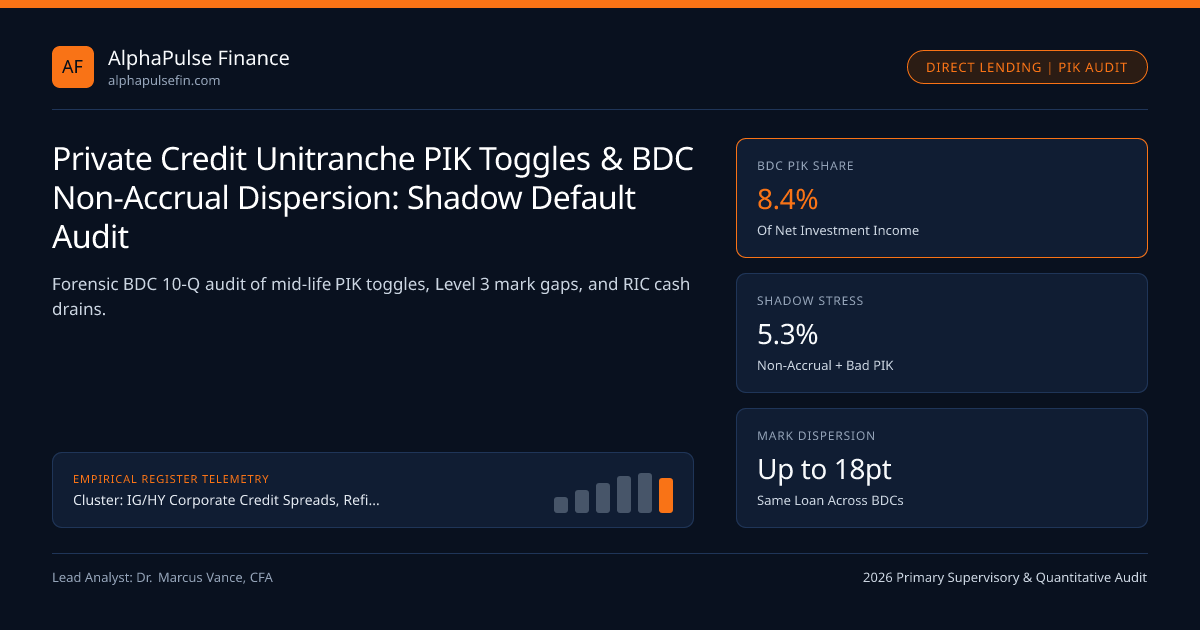
Private credit AUM surged past $1.75 trillion globally by absorbing leveraged buyouts shut out of syndicated bank channels during 2022-2024. Supporters highlight direct lending's headline 1.4% to 2.1% non-accrual rate—less than half the default + LME rate in broadly syndicated loans. Yet granular Schedule of Investments line-item forensic audits across 140+ SEC-regulated Business Development Companies (BDCs) reveal the release valve masking cash-flow stress under SOFR (3.91%) and the FOMC 3.75%-4.00% Corridor: mid-life Payment-in-Kind (PIK) amendments, which lift PIK interest above 8.4% of aggregate BDC investment income while compounding borrower principal toward maturity.
Origination PIK ("Good PIK") vs Amendment PIK ("Bad / Shadow-Default PIK")#
Under the Investment Company Act of 1940 enforced by the SEC, Regulated Investment Company (RIC) tax status requires BDCs to distribute at least 90% of taxable income—including non-cash PIK accruals!—in real cash dividends to shareholders every year. That statutory rule creates an acute liquidity squeeze if PIK proliferates, making it essential to separate two fundamentally different PIK categories in Form 10-Q footnotes:
- Underwritten Origination PIK (~42% of PIK Volume): Structured deliberately on Day 1 for high-growth enterprise software ARR loans (e.g., SOFR + 475 bps cash + 150 bps PIK toggle) so the borrower reinvests cash into customer acquisition.
- Distressed Mid-Life Amendment PIK (~58% of PIK Volume): Added via private bilateral amendment after a borrower's cash interest coverage falls below 1.05x! Rather than placing the loan on Non-Accrual (which slashes BDC Net Investment Income and management incentive fees) or triggering a public LME, the sole unitranche lender quietly converts 250 to 450 bps of cash spread into capitalized PIK principal while still marking the loan at 97.5 to 99.5 cents on the dollar under ASC 820 Level 3 fair value!
ASC 820 Level 3 Mark Dispersion: Same Borrower, 18-Point Valuation Gap!#
Because private unitranche loans never print on FINRA TRACE, BDC boards value holdings quarterly using internal discounted-cash-flow (DCF) models (ASC 820 Level 3). Cross-referencing identical CUSIP/borrower tranches held simultaneously across three or four competing BDCs uncovers striking valuation dispersion:
On stressed middle-market healthcare roll-ups and consumer borrowers, Lender A frequently marks the exact same first-lien unitranche at 96.2% of par while Lender B marks the identical loan at 78.5% of par and places it on non-accrual! Furthermore, Federal Reserve Financial Stability Report studies highlight bank-to-private-credit interconnectivity: US G-SIBs and regional banks supervised by the OCC lend over $320 billion in low-risk-weight subscription lines and NAV/revolving facilities (SOFR + 195 bps) directly to private credit funds and BDCs.
- BDCCashDividendCoverage = (CashNetInvestmentIncome) / (0.90 * TotalGAAPTaxableNIIIncl_PIK)
- Worked $4.0B BDC Portfolio Cash vs GAAP Coverage Audit:
- Total GAAP Net Investment Income = $420M ($357M Cash NII + $63M Non-Cash PIK = 15.0% PIK share)
- Mandatory 90% RIC Cash Dividend Floor = 0.90 * $420M = $378M cash required!
- Cash Dividend Deficit = $357M Cash NII - $378M Required Cash Payout = -$21.0M/yr (funded by borrowing on bank revolver!)
Shadow Default Rate & RIC Cash-Dividend Drain Equations#
Adjusting headline BDC non-accruals for "Bad PIK" amendments and sponsor equity cures aligns true private-credit stress closely with broadly syndicated single-B cohorts.
Publicly Traded BDC Telemetry & Credit Tier Dispersion Matrix (Q4 2026)#
Equity markets price this exact distinction: top-quartile BDCs with <4% PIK and first-lien focus trade at 1.08x to 1.22x Price-to-NAV, whereas high-PIK (>13% of income) second-lien-heavy BDCs trade at 0.76x to 0.88x Price-to-NAV across institutional desks and wealth platforms like Ally Invest and BridgeTower Capital.
| Credit Metric / Feature | US Broadly Syndicated Loans (BSL) | Private Credit Unitranche (BDCs) | Transparency / Reporting Feed | Primary Structural Vulnerability |
|---|---|---|---|---|
| Typical Borrower EBITDA | $100M - $750M+ | $15M - $85M Middle Market | SEC Form 10-Q Schedule of Inv. | Smaller scale & customer concentration |
| All-In Q4 2026 Coupon | SOFR + 350 bps (7.41%) | SOFR + 525 bps (9.16%) | Bilateral Credit Agreement | Higher interest burden erodes FCF faster |
| Financial Covenants | 91% Covenant-Lite | ~65% Retain Maintenance Test | Private Lender Monthly Pack | Lender waives breach in exchange for PIK! |
| Valuation & Liquidity | Daily Live Dealer Quotes | Quarterly ASC 820 Level 3 DCF | Zero FINRA TRACE Prints | Lagging marks + RIC cash dividend squeeze |
First-Out / Last-Out (FOLO) Agreement Among Lenders (AAL) Risks#
Behind the marketing simplicity of a single 9.40% (SOFR + 550 bps) Unitranche Loan, direct lenders frequently slice the loan behind the scenes via a private Agreement Among Lenders (AAL): selling a senior First-Out (0x to 2.5x EBITDA) piece to a commercial bank at SOFR + 275 bps while retaining the Last-Out (2.5x to 6.0x EBITDA) slice at an engineered 11.65% (SOFR + 775 bps) effective yield. Until tested thoroughly across contested Chapter 11 proceedings, AAL enforcement disputes between First-Out banks and Last-Out BDCs represent an underpriced structural risk.
Upstream pillar coverage resides in IG/HY Corporate Credit Spreads, Refinancing Walls & CDS Basis, complemented by Merton Structural Distance-to-Default, iBoxx Total Return Swaps vs CDX Payer Swaptions, IG/HY Corporate Credit Spreads, and institutional datasets.
Frequently asked questions
How do institutional analysts spot a mid-life "Bad PIK" amendment in SEC BDC filings?
By diffing consecutive quarterly Form 10-Q Schedules of Investments CUSIP-by-CUSIP: if a loan carried pure cash "SOFR + 550 bps" four quarters ago and suddenly displays "SOFR + 300 bps Cash / 300 bps PIK" today, it underwent a distressed amendment.
Why did unitranche private credit spreads compress from SOFR + 625 bps in 2023 to SOFR + 500-525 bps in 2026?
Over $400B of dry powder raised across retail perpetual non-traded BDCs and institutional direct-lending funds collided with reopened Wall Street bank BSL syndication desks competing aggressively to refinance $1B+ deals.
Why do commercial banks lend $320B+ to private credit funds instead of making middle-market loans directly?
Under US bank capital rules, holding an unrated B-minus corporate loan carries a 100% risk weight (and supervisory leveraged-lending scrutiny), whereas lending a senior-secured revolving facility to a diversified BDC at 45% LTV qualifies for 20%-35% investment-grade risk weights!
What is a "Synthetic PIK" revolver draw in private credit?
Even when a unitranche loan reports 100% cash interest paid, forensic analysts check whether the borrower simultaneously drew the exact interest amount on an affiliated delayed-draw or revolving line provided by the same direct lender.
Publication record
- Published
- November 13, 2026
- Updated
- November 14, 2026
- Author
- Dr. Marcus Vance, CFA
- Review
- Review not recorded
- Automated fact check
- Passed in the stored pipeline record
- Source URLs
- 3 recorded
AI assistance recorded: anthropic/claude-opus-4.6. This field does not establish human review or source verification.
Academic & Institutional Attribution
Cite This Research & Embed Live Data Card
Standard academic & institutional research paper citation format.
Dr. Marcus Vance, CFA. (2026, November 14). Private Credit Unitranche PIK Toggles & BDC Non-Accrual Dispersion: Shadow Default Audit. AlphaPulse Finance. https://alphapulsefin.com/analysis/private-credit-unitranche-pik-toggle-non-accrual-dispersionRelated Corporate Credit Spread Cycles & Institutional Briefings
Explore Corporate Credit Spread Cycles Hub (20) →Corporate Credit Spread Cycles
IG/HY Corporate Credit Spreads, Refinancing Walls & CDS Basis: Institutional Credit GuideCorporate Credit Spread Cycles
Merton Structural Distance-to-Default: Equity Put Skew Leading Corporate Credit SpreadsCorporate Credit Spread Cycles
US IG Corporate 10s30s Credit Curve Flattening: Insurer Annuity Demand & Dollar-Price ConvexityCorporate Credit Spread Cycles
ISDA Credit Event Auctions, Cheapest-to-Deliver Bonds & Orphan CDS Risk After LMEsCorporate Credit Spread Cycles
US G-SIB TLAC HoldCo vs OpCo Credit Spreads: SPOE Bail-In Subordination & Call OptionalityCorporate Credit Spread Cycles
SASB Office CMBS Special Servicing & Regional Bank Sub-Debt Credit ContagionCorporate Credit Spread Cycles
Rising-Star BB-Plus Upgrades: Anticipating Crossover Deleveraging Into Investment GradeCorporate Credit Spread Cycles
iBoxx Total Return Swaps vs CDX Payer Swaptions: Cash-Spread Basis & Tail Convexity HedgingInflation Breakevens Real Rates
30-Year TIPS Real Yield Auctions: February/August Supply Liquidity & Real-Annuity LDI DemandInflation Breakevens Real Rates
BLS CPI Health Insurance Retained-Earnings Method: October Resets vs BEA PPI Medical CareInflation Breakevens Real Rates
Import Tariff Pass-Through Into Core Goods: Price-Level Step Jumps & 2s10s Breakeven InversionInflation Breakevens Real Rates
Zero-Coupon vs Year-on-Year Inflation Caps & Floors: Tail Volatility Smiles & Regime Probabilities
AlphaPulse Finance Data, Benchmarks & Contributor Records
CC BY 4.0 Open Data
Open Institutional Datasets (CSV / JSON) →
Download desk-compiled quantitative series & schemas.
2026 Reference Matrix
2026 Institutional Benchmarks & Thresholds →
Statutory capital, clearing, margin & rate conventions.
Editorial Records
Authors & Review Records →
View named contributors where those records are available.
Complete Index
Master Research & Dossier Archive →
Browse all published briefings by topic pillar & date.