
Corporate Credit Spread Cycles
US G-SIB TLAC HoldCo vs OpCo Credit Spreads: SPOE Bail-In Subordination & Call Optionality
Representing over 24% of the US investment-grade bond market, G-SIB Holding Company TLAC senior debt trades +24 to +34 bps wider than Operating Bank notes due to Single Point of Entry structural subordination and 1-year pre-maturity call mechanics.
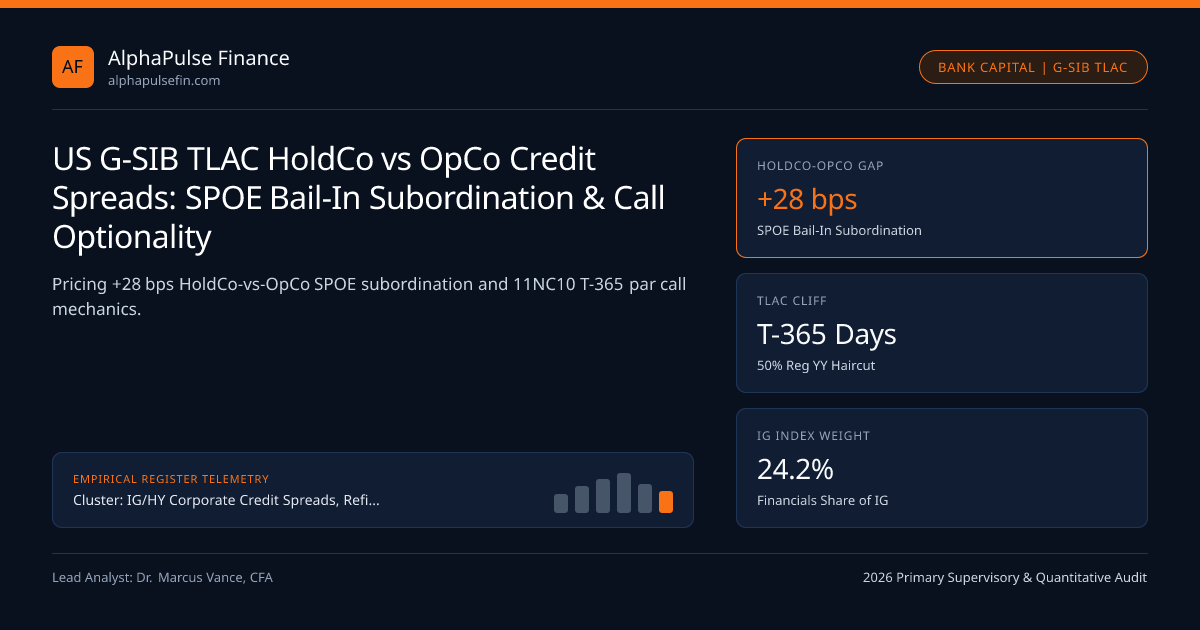
Financial institutions account for nearly one-quarter of the entire $8.9 trillion US investment-grade corporate bond index, led by the eight US Global Systemically Important Banks (G-SIBs). Unlike an industrial company where all senior unsecured bonds rank pari-passu, a US G-SIB issues debt out of two legally separated balance-sheet tiers governed by Federal Reserve Regulation YY Total Loss-Absorbing Capacity (TLAC) and FDIC Title II Single Point of Entry (SPOE) resolution rules: Parent Holding Company (HoldCo) Senior Notes (which absorb bail-in losses!) and Operating Bank Subsidiary (OpCo) Senior Notes (which stay open and unimpaired over a resolution weekend)—driving a structural +24 to +34 bps HoldCo-versus-OpCo credit spread over 10-Year US Treasuries and SOFR.
Single Point of Entry (SPOE) Bail-In: Why HoldCo Takes 100% of Losses Before OpCo#
Under Dodd-Frank Title II Orderly Liquidation Authority (OLA) co-designed by the Federal Reserve, FDIC, and OCC, if a mega-bank suffers catastrophic losses, regulators place ONLY the top-tier Parent Bank Holding Company (HoldCo) into receivership on Friday night!
Over that resolution weekend:
- Operating Subsidiaries Stay Open (OpCo): The insured commercial bank (N.A.) and SEC/FINRA-registered broker-dealer open Monday morning at 9:00 AM with 100% of deposits, derivatives, repo, and OpCo Senior Debt unimpaired—recapitalized via pre-positioned internal support from the parent!
- HoldCo TLAC Debt Absorbs the Wipeout: HoldCo equity is wiped out and HoldCo Senior Unsecured Debt is converted into equity ("bailed in") of a newly formed Bridge Holding Company! Moreover, Federal Reserve "Clean Holding Company" rules strictly forbid the HoldCo from issuing short-term debt (<365 days), entering external derivatives, or guaranteeing OpCo liabilities—ensuring fast, litigation-free HoldCo bail-in.
Why Every TLAC HoldCo Bond Uses "11NC10" or "6NC5" Fixed-to-Floating Callables!#
Look closely at any US G-SIB new issue on Bloomberg: banks almost never issue bullet 5-year or 10-year HoldCo bonds! Instead, they issue 6-Year Non-Call 5 (6NC5) or 11-Year Non-Call 10 (11NC10) Fixed-to-Floating Rate Notes (fixed coupon for 10 years, then resetting to Compounded SOFR + initial credit spread for Year 11 if uncalled, with a par call option exactly 1 year before final maturity).
Why that exact 1-year-prior call date? Under Federal Reserve Regulation YY (12 CFR 252.62), the moment a HoldCo bond has less than 365 days remaining to maturity, it suffers a 50% TLAC haircut (and 0% TLAC credit inside 365 days if regulatory rules tighten or capital amortizes)! By calling the bond at Par ($100.00) on the exact T - 365 day call date, the bank avoids paying SOFR + initial spread on dead weight that no longer counts 100% toward TLAC!
- RegYYTLACEligibleValue = 1.00 * Par (if Rem_Maturity >= 365d) | 0.50 * Par (if 183d..365d -> 50% haircut!)
- Worked 6NC5 Fixed-to-Floating Call vs Extension Decision at Year 5:
- Bond Reset = SOFR + 70 bps | New 6NC5 TLAC Issuance Cost = SOFR + 105 bps (100% TLAC credit for 5 years)
- Effective Cost of Extending 1 Year for ONLY 50% TLAC Credit:
- Implied Marginal Cost per $1 of TLAC = SOFR + 70 + (105 - 0) = SOFR + 140 bps > SOFR + 105 bps -> BANK STILL CALLS AT PAR!
Pricing Extension Convexity on G-SIB 6NC5 / 11NC10 Callable TLAC Bonds#
What happens if a bank's credit spread widens above the bond's original back-end SOFR + Reset Spread on the Year-5/Year-10 call date? Economically, extending for 1 year at the old tighter spread would be cheaper than issuing a brand-new 6NC5 bond—creating Call-Extension Convexity Risk priced via a 1-year credit swaption!
US Bank Capital & Debt Loss-Absorbing Hierarchy (OpCo -> HoldCo -> AT1)#
Following the March 2023 regional bank failures and the Federal Reserve's proposed Long-Term Debt (LTD) Rule for Category II-IV Regional Banks ($100B+ assets), HoldCo/OpCo spread tiering expanded far beyond the Big Six G-SIBs.
| Bank Liability Layer | Issuing Legal Entity | Counts as Reg YY TLAC? | Title II SPOE Resolution Fate | Primary Investor Base |
|---|---|---|---|---|
| Insured / Uninsured Deposits | Operating Bank (N.A.) | No (Protected OpCo) | 100% Open Monday Morning | Corporates & Retail (FDIC) |
| OpCo Bank Senior Notes | Operating Bank (N.A.) | No (Excluded OpCo Debt) | Unimpaired Operating Liability | Money Funds & Short IG Accounts |
| HoldCo 6NC5 / 11NC10 Senior | Parent BHC (Corp / Inc) | Yes (100% if >= 1Yr Rem.) | Bailed In -> Converted to Equity | Core IG Benchmarks (FINRA TRACE) |
Preferred Stock ($25 / $1000) | Parent BHC (DRD Eligible) | Tier 1 Regulatory Capital | 100% Wiped Out Alongside Common | Preferred ETFs & Tax-Advantaged Corp |
Trading HoldCo-OpCo Compression vs Post-Earnings TLAC Supply Waves#
Institutional bank-credit specialists trade two high-conviction relative-value patterns via venues alongside Cantor Fitzgerald and Atomic Capital: (1) Buying HoldCo vs OpCo (Compression) right after Big Six banks finish dumping $32B of post-earnings TLAC supply in January/April/July/October (when HoldCo-OpCo widens to +34 bps), and (2) Avoiding low-reset 2021 6NC5/11NC10 vintages carrying tiny SOFR + 65 bps back-end resets unless priced to final maturity rather than Yield-to-Call.
Downstream transmission channels are modeled in SASB Office CMBS Special Servicing & and Negative CDS-Bond Basis Arbitrage, synthesized in IG/HY Corporate Credit Spreads, Refinancing Walls & CDS Basis and cataloged at IG/HY Corporate Credit Spreads (regulatory bodies).
Frequently asked questions
Why did Credit Suisse’s March 2023 AT1 write-down shock European bondholders while US G-SIB hierarchy stayed calm?
Swiss FINMA write-down clauses wiped out $17B of Credit Suisse AT1 bonds while paying equity shareholders $3.2B; by contrast, US Dodd-Frank Title II and Bankruptcy Code absolute priority strictly wipe out 100% of Common and Preferred equity BEFORE touching HoldCo TLAC debt.
Why do US banks issue huge waves of bonds immediately after reporting quarterly earnings?
SEC insider-trading blackout policies bar banks from issuing public securities from two weeks before quarter-end until earnings release; the day after reporting 10-Q/10-K results, all six US G-SIBs simultaneously tap the primary market.
Would a US G-SIB ever skip calling a 6NC5 TLAC bond at Year 5 if credit spreads widened by +45 bps?
Rarely! Once inside 365 days to maturity, the bond loses 50% of its Reg YY TLAC eligibility—meaning the bank pays 100% interest for only 50% regulatory credit, making a par call + fresh 6NC5 replacement cheaper unless spreads blew out >120 bps.
How does the Federal Reserve’s regional bank Long-Term Debt (LTD) proposal change regional bank spreads?
Requiring Category II-IV banks ($100B-$700B assets) to maintain HoldCo long-term bail-in debt (~6% of RWA) protects the FDIC Deposit Insurance Fund after SVB/Signature, shifting supply from OpCo bank deposits/notes into wider-spread HoldCo TLAC.
Publication record
- Published
- November 13, 2026
- Updated
- November 15, 2026
- Author
- Dr. Marcus Vance, CFA
- Review
- Review not recorded
- Automated fact check
- Passed in the stored pipeline record
- Source URLs
- 3 recorded
AI assistance recorded: anthropic/claude-opus-4.6. This field does not establish human review or source verification.
Academic & Institutional Attribution
Cite This Research & Embed Live Data Card
Standard academic & institutional research paper citation format.
Dr. Marcus Vance, CFA. (2026, November 15). US G-SIB TLAC HoldCo vs OpCo Credit Spreads: SPOE Bail-In Subordination & Call Optionality. AlphaPulse Finance. https://alphapulsefin.com/analysis/us-gsib-tlac-holdco-opco-senior-bail-in-credit-spreadsRelated Corporate Credit Spread Cycles & Institutional Briefings
Explore Corporate Credit Spread Cycles Hub (20) →Corporate Credit Spread Cycles
IG/HY Corporate Credit Spreads, Refinancing Walls & CDS Basis: Institutional Credit GuideCorporate Credit Spread Cycles
SASB Office CMBS Special Servicing & Regional Bank Sub-Debt Credit ContagionCorporate Credit Spread Cycles
Rising-Star BB-Plus Upgrades: Anticipating Crossover Deleveraging Into Investment GradeCorporate Credit Spread Cycles
iBoxx Total Return Swaps vs CDX Payer Swaptions: Cash-Spread Basis & Tail Convexity HedgingCorporate Credit Spread Cycles
Out-of-Court Distressed Debt Exchanges vs Prepackaged Chapter 11: The 38% Re-Default TrapCorporate Credit Spread Cycles
Reverse Yankee Corporate Bond Issuance: EUR/USD Cross-Currency Basis & ECB-Fed ArbitrageCorporate Credit Spread Cycles
CDX NA IG & HY Intrinsic Skew: Index-to-Single-Name CDS Arbitrage MechanicsCorporate Credit Spread Cycles
Negative CDS-Bond Basis Arbitrage: Z-Spread, Corporate Repo Haircuts & Par Claim RiskInflation Breakevens Real Rates
Employment Cost Index (ECI) vs Average Hourly Earnings & Atlanta Fed Wage TrackerInflation Breakevens Real Rates
Gold Spot Divergence From 10-Year TIPS Real Yields: EM Central Bank Reserve ReallocationInflation Breakevens Real Rates
TIPS Asset-Swap & Iota Spreads: Cash Breakeven vs Zero-Coupon Inflation Swap ArbitrageInflation Breakevens Real Rates
University of Michigan vs NY Fed SCE Inflation Expectations: Partisan Skew & Salience Bias
AlphaPulse Finance Data, Benchmarks & Contributor Records
CC BY 4.0 Open Data
Open Institutional Datasets (CSV / JSON) →
Download desk-compiled quantitative series & schemas.
2026 Reference Matrix
2026 Institutional Benchmarks & Thresholds →
Statutory capital, clearing, margin & rate conventions.
Editorial Records
Authors & Review Records →
View named contributors where those records are available.
Complete Index
Master Research & Dossier Archive →
Browse all published briefings by topic pillar & date.