
Corporate Credit Spread Cycles
Reverse Yankee Corporate Bond Issuance: EUR/USD Cross-Currency Basis & ECB-Fed Arbitrage
US S&P 500 multinationals issued over €110B of euro-denominated "Reverse Yankee" corporate bonds in 2025-2026 to lock in 2.95%-3.45% euro coupons and arbitrage EUR/USD cross-currency basis swap spreads against domestic US IG supply.
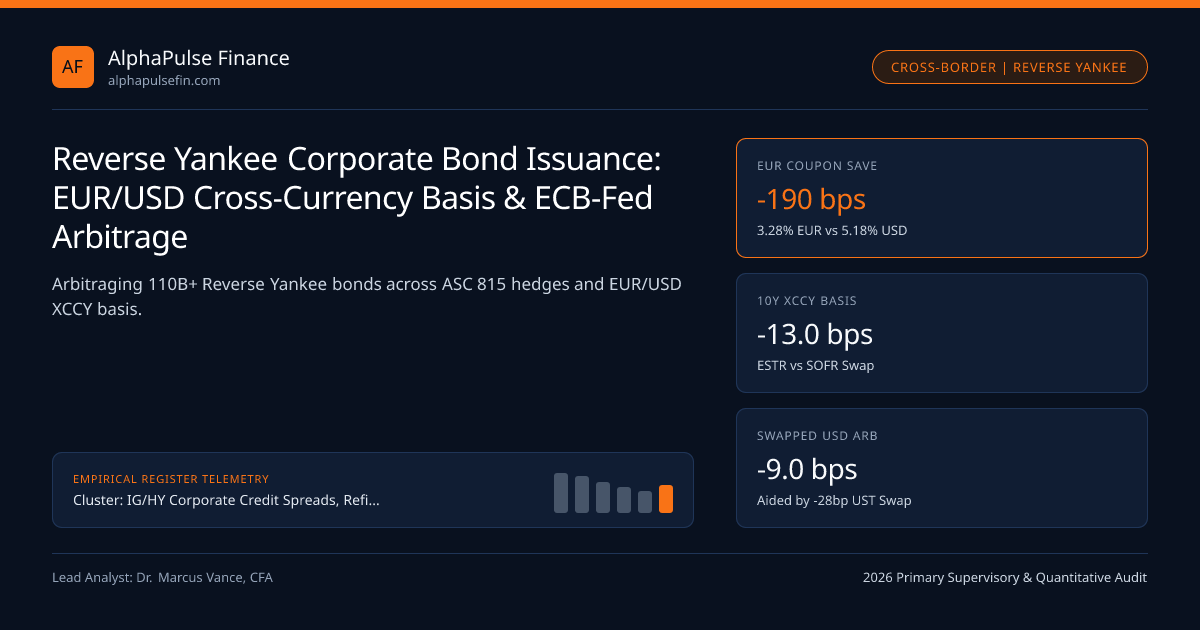
Whenever you notice US household-name multinationals (Apple, Eli Lilly, Alphabet, Booking Holdings, Verizon) bypassing Wall Street USD syndicates to issue €110 billion+ per year of Euro-denominated "Reverse Yankee" corporate bonds, two powerful cross-border macro engines are firing simultaneously. First, European operating subsidiaries with natural Euro cash flows lock in 3.10% to 3.55% all-in EUR coupons (nearly 190 bps below 5.20% USD coupons anchored to 10-Year US Treasuries (4.32%) and the FOMC 3.75%-4.00% Corridor) and designate the debt as an ASC 815 Net Investment Hedge! Second, even issuers swapping proceeds 100% back into USD via EUR/USD Cross-Currency Basis Swaps (ESTR vs SOFR) harvest 8 to 22 bps of funding savings while relieving supply pressure on domestic US IG spreads!
Covered Interest Parity Violation: How EUR/USD Cross-Currency Basis Works#
In a 10-Year EUR/USD Cross-Currency Basis Swap (XCCY) cleared or executed bilaterally under CFTC / EMIR margin rules, two counterparties exchange €1.00 billion of principal for $1.08 billion of USD principal on Day 1 at spot FX, pay quarterly floating 3M ESTR + XCCY Basis (alpha) versus 3M Compounded SOFR flat, and re-exchange the exact initial principal at Year 10!
Because global European insurers and Japanese lifers structurally crave USD assets more than US investors crave EUR assets, the EUR/USD cross-currency basis (alpha) persistently prints negative (-11 to -18 bps). Watch who wins that negative basis:
- Reverse Yankee US Issuer (Issues €1B Bond -> Swaps EUR Proceeds Into USD!): By delivering EUR and borrowing USD in the XCCY swap, the US issuer pays the negative basis (receives ESTR - 13 bps vs paying SOFR), costing ~13 bps. Therefore, for a swapped Reverse Yankee to beat a domestic USD bond, the issuer's Euro credit spread over EUR Mid-Swaps must sit more than 13 bps tighter (plus USD Treasury-SOFR swap-spread differential!) than its domestic USD spread on FINRA TRACE!
Why Unswapped ASC 815 "Net Investment Hedges" Dominate S&P 500 CFO Math!#
In reality, over 65% of S&P 500 Reverse Yankee issuers do NOT swap the Euros back into Dollars at all! Under US GAAP ASC 815-35 (Net Investment Hedging) disclosed in SEC Form 10-K footnotes, a US multinational holding €8 billion of European factories, IP, and operating equity designates its €3 billion 3.25% Reverse Yankee bond as a Net Investment Hedge.
Look at the dual accounting miracle:
- Zero FX Volatility in GAAP Net Income: Spot EUR/USD translation swings on the €3B bond go straight into Other Comprehensive Income (OCI) on the balance sheet, perfectly offsetting the €3B European subsidiary equity translation!
- +195 bps Immediate GAAP EPS Interest Savings: On the GAAP Income Statement, the CFO books a 3.25% EUR interest expense instead of a 5.20% USD interest expense—saving $58.5 million per year pre-tax on €3B of debt without touching cross-currency derivatives!
- DomesticUSDSpreadoverSOFR = GSpreadoverUST + (Yield10YUST - Rate10YSOFROIS)
- Worked 10-Year A+ Pharma Domestic USD vs Swapped EUR Reverse Yankee Comparison:
- Domestic 10Y USD Issue: T + 84 bps + (+28 bps UST cheapness over SOFR OIS!) = SOFR OIS + 112.0 bps!
- Reverse Yankee 10Y EUR Issue: ESTR + 90 bps - (-13.0 bps XCCY Basis) = SOFR OIS + 103.0 bps!
- Net Swapped Funding Arbitrage = 112.0 - 103.0 = -9.0 bps CHEAPER in Euros (mainly because US Treasuries trade 28bp cheap to OIS!)
Swapped Reverse Yankee All-In USD Arbitrage & Yankee Inbound Equations#
Exact cross-currency syndicate screens run both directions continuously—comparing Reverse Yankees (US -> EUR) against *Inbound Yankees (European/Canadian banks issuing in USD via OSFI / SEC shelves and swapping USD back to EUR/CAD to collect* the +13 bps XCCY basis bonus!)**.
Cross-Border Corporate Issuance Arbitrage Matrix (USD vs EUR vs GBP, Q4 2026)#
Notice the symbiotic equilibrium: European and Canadian banks issue USD Yankee bonds (collecting the XCCY basis!), while US tech/pharma Industrials issue EUR Reverse Yankee bonds (scarcity-bid by European ESG/IG funds starved of AA non-financial names!)—mediated by global cross-border FX and dealer desks alongside Airwallex and Cantor Fitzgerald.
| Cross-Border Issuer Type | Bond Currency Issued | XCCY Basis Direction | Accounting / Hedging Goal | Primary Counterparty Flow |
|---|---|---|---|---|
US S&P 500 Tech/Pharma (Unswapped) | EUR (Reverse Yankee) | None (ASC 815 NIH) | Slash GAAP interest -190bp; hedge EU ops | European Real-Money IG Funds |
US Telecom / Auto (Swapped) | EUR -> Swapped to USD | Pays -13bp XCCY Cost | Diversify past tapped-out USD investor caps | CFTC XCCY Dealers (Cantor) |
| EU / Canadian G-SIB Banks | USD (Yankee) -> EUR/CAD | COLLECTS +13bp XCCY! | Deepest 6NC5/11NC10 TLAC market in world | US IG Funds (OSFI / SEC) |
| Japanese Lifers / Banks | USD Hedged Back to JPY | Pays FX/XCCY Roll | Match XCCY issuer flow on 5Y-10Y tenors | Two-Way XCCY Clearing Balance |
How €110B+ of Reverse Yankee Diversion Tightens Domestic US IG OAS#
Macro credit strategists track the EUR-vs-USD IG Credit Spread Differential as a direct supply valve for domestic US spreads: every €100 billion (~$108B) of US corporate refinancing diverted into Frankfurt/London Euro books removes 25% of annual net US IG non-financial supply from New York syndicate calendars—directly helping hold domestic US non-financial IG OAS down near 78 bps!
Historical calibration series link CDX NA IG & HY Intrinsic Skew, FINRA TRACE Block Dissemination Caps &, and IG/HY Corporate Credit Spreads, Refinancing Walls & CDS Basis directly to IG/HY Corporate Credit Spreads and verification registry.
Frequently asked questions
How does the negative US 10-year Treasury-SOFR swap spread (-28 bps) encourage US companies to issue in Euros?
Because US cash bonds price as a positive spread OVER cheapened US Treasuries (4.32%) while cross-currency swaps reference tighter SOFR OIS (~4.04%), a US company issuing T+84 bps in Dollars is actually paying SOFR + 112 bps—making swapped Euro debt very competitive!
Why do European institutional bond funds pay tighter credit spreads for US Apple or Eli Lilly than for European peers?
The domestic Eurozone corporate bond index is heavily concentrated in banks, autos, and utilities, with very few AA/A mega-cap technology or pharmaceutical issuers—giving US Reverse Yankees immense sector-diversification scarcity value!
What happens on the GAAP Income Statement if the Euro surges +10% on an unswapped ASC 815 Reverse Yankee bond?
Zero FX gain or loss hits GAAP Net Income! Under ASC 815-35, as long as the US parent owns >=€1.5B of net European subsidiary assets, the +10% currency translation increase on the €1.5B debt goes straight to Other Comprehensive Income (OCI).
Why do Reverse Yankee deals frequently trigger massive intraday moves in the 10-year EUR/USD cross-currency basis?
When a jumbo €4B multi-tranche US M&A Reverse Yankee prices in London morning hours and swaps 100% into USD, dealers must simultaneously pay USD SOFR and receive EUR ESTR across 5Y/10Y/20Y XCCY swaps, pushing basis -1.5 to -3.0 bps more negative intraday.
Publication record
- Published
- November 13, 2026
- Updated
- November 14, 2026
- Author
- Dr. Marcus Vance, CFA
- Review
- Review not recorded
- Automated fact check
- Passed in the stored pipeline record
- Source URLs
- 3 recorded
AI assistance recorded: anthropic/claude-opus-4.6. This field does not establish human review or source verification.
Academic & Institutional Attribution
Cite This Research & Embed Live Data Card
Standard academic & institutional research paper citation format.
Dr. Marcus Vance, CFA. (2026, November 14). Reverse Yankee Corporate Bond Issuance: EUR/USD Cross-Currency Basis & ECB-Fed Arbitrage. AlphaPulse Finance. https://alphapulsefin.com/analysis/reverse-yankee-eur-usd-cross-currency-basis-corporate-issuanceRelated Corporate Credit Spread Cycles & Institutional Briefings
Explore Corporate Credit Spread Cycles Hub (20) →Corporate Credit Spread Cycles
IG/HY Corporate Credit Spreads, Refinancing Walls & CDS Basis: Institutional Credit GuideCorporate Credit Spread Cycles
CDX NA IG & HY Intrinsic Skew: Index-to-Single-Name CDS Arbitrage MechanicsCorporate Credit Spread Cycles
Negative CDS-Bond Basis Arbitrage: Z-Spread, Corporate Repo Haircuts & Par Claim RiskCorporate Credit Spread Cycles
BBB-Minus Fallen-Angel OAS Cliffs: Mandatory Mandate Selling & Post-Downgrade Rebound AlphaCorporate Credit Spread Cycles
US High-Yield 2026-2028 Maturity Wall: Coupon Reset Math & EBITDA Coverage ErosionCorporate Credit Spread Cycles
Covenant-Lite Liability Management Exercises (LMEs): Uptiers, Drop-Downs & Recovery CompressionCorporate Credit Spread Cycles
IG Primary Bond New-Issue Concession (NIC): Orderbook Oversubscription & Syndicate CompressionCorporate Credit Spread Cycles
FINRA TRACE Block Dissemination Caps & Automated Credit Portfolio Trading MicrostructureInstitutional Earnings Capex Macro
S&P 500 Operating Leverage Dispersion: Cap-Weighted Mega-Cap vs Equal-Weighted EBIT MarginsInstitutional Earnings Capex Macro
Hyperscaler AI GPU Useful-Life Accounting: 4-to-6-Year Server Depreciation Cliffs & EBIT RiskInstitutional Earnings Capex Macro
SEC Rule 10b5-1 Buyback Amendments & Quarterly Earnings Blackout Liquidity WindowsInstitutional Earnings Capex Macro
The S&P 500 Net Interest Expense Paradox: 3.1% Fixed Bonds vs 3.9% T-Bill Cash Shields
AlphaPulse Finance Data, Benchmarks & Contributor Records
CC BY 4.0 Open Data
Open Institutional Datasets (CSV / JSON) →
Download desk-compiled quantitative series & schemas.
2026 Reference Matrix
2026 Institutional Benchmarks & Thresholds →
Statutory capital, clearing, margin & rate conventions.
Editorial Records
Authors & Review Records →
View named contributors where those records are available.
Complete Index
Master Research & Dossier Archive →
Browse all published briefings by topic pillar & date.