
Corporate Credit Spread Cycles
Covenant-Lite Liability Management Exercises (LMEs): Uptiers, Drop-Downs & Recovery Compression
With over 91% of institutional US leveraged loans carrying covenant-lite documentation, distressed sponsors deploy IP drop-downs, non-pro-rata uptiers, and double-dip financings that compress legacy first-lien recoveries below 50%.
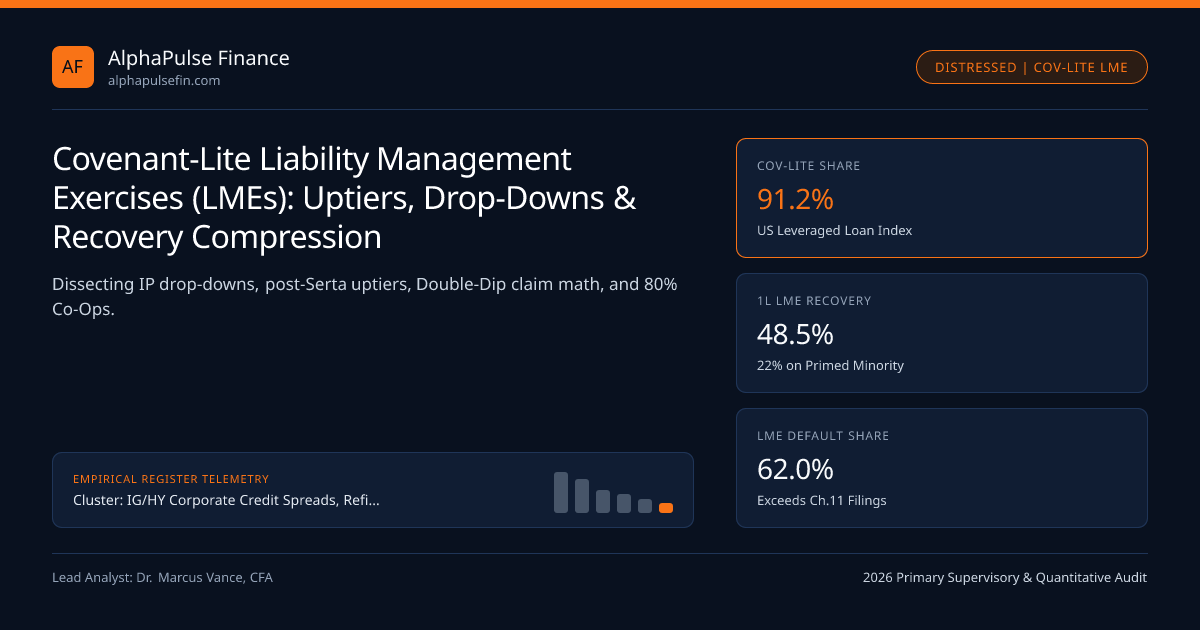
More than 91% of the $1.42 trillion US broadly syndicated leveraged loan (BSL) market now carries covenant-lite ("cov-lite") credit agreements lacking quarterly maintenance financial tests. When borrowers running 6.5x leverage collide with SOFR (3.91%) floating interest inside the FOMC 3.75%-4.00% Corridor, private-equity sponsors rarely hand keys to first-lien lenders at historic 68% to 72% recoveries. Instead, restructuring advisors engineer aggressive Liability Management Exercises (LMEs)—collateral drop-downs, non-pro-rata majority uptiers, and double-dip intercompany structures—splitting syndicate creditors into warring factions and depressing non-participating first-lien recoveries toward 18% to 38%.
Three Core LME Blueprints: Drop-Down, Non-Pro-Rata Uptier, and Double-Dip#
Distressed credit committees dissect credit agreements disclosed in SEC Form 8-K exhibits across three distinct value-stripping mechanisms:
- Unrestricted Subsidiary "Drop-Down" (J.Crew / Chewy / Envision): Exploiting stacked Permitted Investment baskets ("builder baskets" plus general investment grower baskets), the borrower transfers crown-jewel Intellectual Property or operating divisions into a newly designated Unrestricted Subsidiary outside the collateral lien, then raises fresh super-priority debt secured exclusively by those stripped assets.
- Non-Pro-Rata Majority "Uptier" (Serta Simmons / Mitel / Incora): Assembling a 50.1% Required Lenders majority, the sponsor amends the credit agreement to subordinate liens before exchanging only the majority group's loans at a discount into new 1st-Out Super-Priority debt—leaving the 49.9% excluded minority ("primed" into 2nd-Out/3rd-Out status) with devastated recovery prospects (though Fifth Circuit appellate rulings on Serta’s "open market purchase" clause forced major 2025-2026 contract redesigns!).
- The "Double-Dip" (At Home / Wheel Pros / Sabre): A newly formed non-guarantor subsidiary issues new debt and lends the cash back to the parent via a secured intercompany loan plus a parent guarantee—giving new-money lenders two independent pari-passu $1.00 claims in bankruptcy for every $1.00 lent!
Creditor Defense: 80%+ Co-Op Agreements and Post-Serta Appellate Guardrails#
Two counter-forces reshaped the LME battlefield across 2025-2026:
First, the *U.S. Court of Appeals for the Fifth Circuit (In re Serta Simmons Bedding, Dec 2024)* struck down Serta's reliance on the "open market purchase" pro-rata exception for privately negotiated uptiers—exposing participating majority lenders to massive breach-of-contract damages and steering sponsors toward pro-rata tiered exchanges (where excluded lenders get worse economics rather than zero offer) or Double-Dips.
Second, CLO managers and distressed funds overseen by the SEC and bank regulators (OCC / Federal Reserve) preemptively sign legally binding Cooperation Agreements ("Co-Ops") locking up 75% to 90% of the syndicate for 6-12 months so no 50.1% defector coalition can form.
- DoubleDipDilutedShare = Legacy1LPar / (Legacy1LPar + (2.0 * NewDoubleDipPar))
- Worked $1,000M First-Lien Syndicate Hit by $250M Double-Dip at $600M Enterprise Value:
- Without Double-Dip ($250M Standard Pari-Passu): Legacy 1L Claim Share = 1000 / 1250 = 80.0% -> $480M (48.0% recovery)
- With 2.0x Double-Dip ($250M Interco + $250M Guarantee = $500M Claim):
- Legacy 1L Claim Share = 1000 / (1000 + 500) = 66.7% -> $400M (40.0% recovery); Double-Dip recovers $200M on $250M (80.0%!)
Uptier & Double-Dip Recovery Waterfall Dilution Algebra#
Modeling post-LME recovery requires separating Enterprise Value (EV) claims across 1st-Out New Money, 2nd-Out Participating Roll-Up, and 3rd-Out Excluded Minority tranches.
LME Structure Comparison, Legal Blockers, and Empirical Recovery Splits#
Named contract "blockers" (J.Crew, Serta, Chewy, Pluralsight, Envision) plug specific holes one by one—yet sponsors continually combine residual baskets.
| LME Architecture | Required Lender Vote | Contract Loophole Exploited | Named Market Blocker | 2026 Legal & Market Status |
|---|---|---|---|---|
| IP / Asset Drop-Down | 0% (Board Action Only) | Unrestricted Sub Investment Baskets | J.Crew / Pluralsight Blocker | Active via non-loan-party sub transfers (SEC 8-K) |
| Non-Pro-Rata Uptier | 50.1% Required Lenders | "Open Market Purchase" Pro-Rata Carveout | Serta Sacred-Right Blocker | Curbed by 5th Cir Serta ruling; shifted to tiered pro-rata |
| Double-Dip / Pari-Plus | 0% - 50.1% Depending | Non-Guarantor Debt + Interco Lien + Guarantee | At Home / Double-Dip Cap | Fastest-growing 2025-2026 structure across BSLs |
| Release of All Guarantors | 50.1% Equity Spin Trick | 99%->49% JV Transfer Releases Guarantee | Chewy / PetSmart Blocker | Standardized in new OCC-reviewed syndications |
CLO Manager Constraints in LMEs vs Opportunistic Credit Hedge Funds#
Why do BSL CLOs frequently end up on the losing minority side of LMEs against distressed hedge funds trading via desks like Cantor Fitzgerald and Alpine Woods? Traditional CLO indentures restrict managers from advancing fresh cash ("new money") after the reinvestment period expires unless strict Loss Mitigation Loan / Workout Obligation buckets exist—allowing agile credit opportunity funds to underwrite the lucrative +450 bps 1st-Out new-money tranche and capture majority voting control.
Relative-value traders benchmark these signals against IG/HY Corporate Credit Spreads, Refinancing Walls & CDS Basis, IG Primary Bond New-Issue Concession (NIC), and US IG Corporate 10s30s Credit Curve Flattening, supplemented by IG/HY Corporate Credit Spreads and covered institutions.
Frequently asked questions
How did the Fifth Circuit Court of Appeals Serta Simmons decision change LME structuring in 2025-2026?
The Fifth Circuit ruled that a privately negotiated debt exchange with a 50.1% lender group is NOT an "open market purchase," invalidating the primary loophole used to bypass pro-rata sharing and exposing participating lenders to damages.
How does a "Double-Dip" LME create two bankruptcy claims from a single dollar of new financing?
A non-guarantor subsidiary issues $250M of notes (guaranteed by the parent = Claim #1) and lends that $250M upstream to the parent via a pari-passu first-lien intercompany loan pledged to those noteholders (= Claim #2), doubling recovery weight.
What is the difference between a J.Crew blocker and a Pluralsight loophole?
A J.Crew blocker bars loan parties from transferring material IP directly to Unrestricted Subsidiaries, whereas Pluralsight bypassed its J.Crew blocker by transferring IP to a Restricted Non-Guarantor Subsidiary instead—which still sits outside existing collateral liens!
Why do 38% of borrowers that complete an LME re-default within 36 months?
Most LMEs inject high-coupon super-priority debt to extend liquidity runway by 18-24 months without cutting total gross leverage or fixing core operating margins, leading to "Chapter 22" style repeat restructurings.
Publication record
- Published
- November 13, 2026
- Updated
- November 14, 2026
- Author
- Dr. Marcus Vance, CFA
- Review
- Review not recorded
- Automated fact check
- Passed in the stored pipeline record
- Source URLs
- 3 recorded
AI assistance recorded: anthropic/claude-opus-4.6. This field does not establish human review or source verification.
Academic & Institutional Attribution
Cite This Research & Embed Live Data Card
Standard academic & institutional research paper citation format.
Dr. Marcus Vance, CFA. (2026, November 14). Covenant-Lite Liability Management Exercises (LMEs): Uptiers, Drop-Downs & Recovery Compression. AlphaPulse Finance. https://alphapulsefin.com/analysis/covenant-lite-liability-management-uptier-dropdown-recoveryRelated Corporate Credit Spread Cycles & Institutional Briefings
Explore Corporate Credit Spread Cycles Hub (20) →Corporate Credit Spread Cycles
IG/HY Corporate Credit Spreads, Refinancing Walls & CDS Basis: Institutional Credit GuideCorporate Credit Spread Cycles
IG Primary Bond New-Issue Concession (NIC): Orderbook Oversubscription & Syndicate CompressionCorporate Credit Spread Cycles
FINRA TRACE Block Dissemination Caps & Automated Credit Portfolio Trading MicrostructureCorporate Credit Spread Cycles
Fixed-Income Credit ETF Create/Redeem Arbitrage: Custom Baskets & Stale-NAV Liquidity DiscoveryCorporate Credit Spread Cycles
US BSL CLO Arbitrage: AAA Liability Spreads, 7.5% CCC Buckets & Junior OC Test DiversionCorporate Credit Spread Cycles
Private Credit Unitranche PIK Toggles & BDC Non-Accrual Dispersion: Shadow Default AuditCorporate Credit Spread Cycles
Merton Structural Distance-to-Default: Equity Put Skew Leading Corporate Credit SpreadsCorporate Credit Spread Cycles
US IG Corporate 10s30s Credit Curve Flattening: Insurer Annuity Demand & Dollar-Price ConvexityInflation Breakevens Real Rates
NSA CPI 3-Month Indexation Lag & Front-End TIPS Seasonal Carry/Roll MechanicsInflation Breakevens Real Rates
Cleveland Fed Trimmed-Mean & Median CPI vs Dallas Fed Trimmed PCE: Outlier-Filtered SignalsInflation Breakevens Real Rates
1Y & 2Y Zero-Coupon Inflation Swaps: RBOB Gasoline Crack Spreads & WTI Pass-ThroughInflation Breakevens Real Rates
D’Amico-Kim-Wei (DKW) Model: Separating TIPS Liquidity Premia From Inflation Risk Premia
AlphaPulse Finance Data, Benchmarks & Contributor Records
CC BY 4.0 Open Data
Open Institutional Datasets (CSV / JSON) →
Download desk-compiled quantitative series & schemas.
2026 Reference Matrix
2026 Institutional Benchmarks & Thresholds →
Statutory capital, clearing, margin & rate conventions.
Editorial Records
Authors & Review Records →
View named contributors where those records are available.
Complete Index
Master Research & Dossier Archive →
Browse all published briefings by topic pillar & date.