
Corporate Credit Spread Cycles
Fixed-Income Credit ETF Create/Redeem Arbitrage: Custom Baskets & Stale-NAV Liquidity Discovery
Under SEC Rule 6c-11 custom basket flexibility, Authorized Participants arbitrage corporate bond ETF premiums and discounts using 80-to-150-CUSIP representative subsets rather than all 2,800 index bonds.
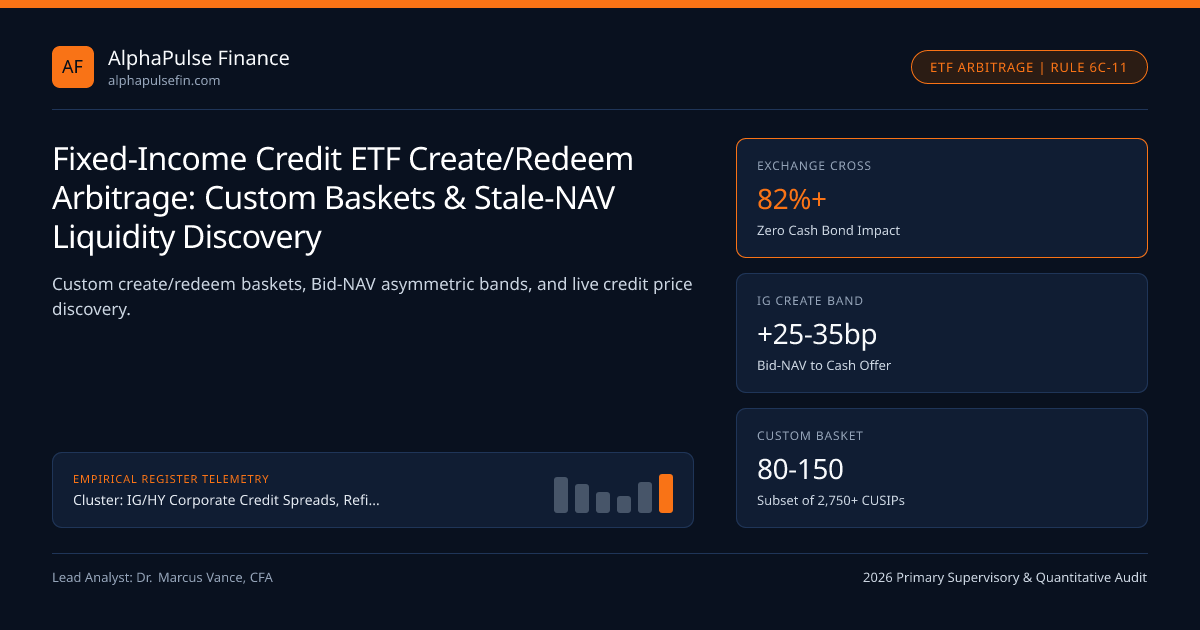
On volatile FOMC or payroll afternoons, major US corporate bond ETFs (LQD, VCIT, HYG, JNK) trade $8 billion to $14 billion of secondary equity-exchange shares—turning over 8x to 15x faster than their underlying cash bond baskets! Whenever an ETF's exchange share price diverges by -45 bps or +55 bps from its published Net Asset Value (NAV), casual observers claim the ETF is "broken." Microstructure research by the SEC and Federal Reserve proves the exact opposite: intraday ETF price is live executable credit value, whereas published NAV reflects stale 4:00 PM matrix marks on illiquid bonds—linked continuously by SEC Rule 6c-11 Custom Creation/Redemption Baskets run across Primary Dealer Inventories.
Why SEC Rule 6c-11 "Custom Baskets" Revolutionized Fixed-Income Arbitrage#
In an S&P 500 equity ETF, an Authorized Participant (AP) can effortlessly buy all 500 stocks in milliseconds to create ETF shares. In a broad investment-grade corporate bond ETF holding 2,750 distinct CUSIPs, 60% of those bonds do not even trade once on FINRA TRACE on a given Tuesday—making strict pro-rata 2,750-bond physical delivery impossible!
Adopted by the SEC, Rule 6c-11 formally codified Custom Creation and Redemption Baskets for fixed-income ETFs. Instead of delivering all 2,750 bonds, an AP such as a G-SIB desk or Cantor Fitzgerald negotiates a 75-to-150-CUSIP "Custom Basket" with the ETF sponsor that matches the fund's exact duration, sector, rating (A/BBB), and dollar-price profile within tight tracking-error tolerances. Custom baskets turned fixed-income APs into automated warehouse conduits linking Portfolio Trading directly to exchange-listed ETF liquidity!
Creation/Redemption Arbitrage Bands vs Bid-Ask NAV Accounting Asymmetric Skew#
Why do corporate bond ETFs normally trade at a +15 to +35 bps structural premium to NAV during steady inflows, yet swing to -60 to -150 bps optical discounts during risk-off outflows—without APs immediately arbitraging the gap to zero?
- Bid-Valuation NAV Convention: Most bond ETFs strike daily 4:00 PM NAV at the Bid Side of underlying bonds! During steady inflows, to create new ETF shares, an AP must buy underlying bonds in cash markets at the Offer Side (Bid + 28 bps in IG, Bid + 55 bps in HY). Therefore, the ETF must trade at a +28 to +55 bps premium over Bid-NAV before creation arbitrage even breaks even!
- Stale Matrix Marks in Panics: During a 3:30 PM credit selloff, ETF shares reprice instantaneously on NYSE Arca/Nasdaq while 70% of cash bonds still carry stale morning evaluator marks—meaning the apparent -120 bps "discount" actually forecasts tomorrow morning's TRACE markdowns!
- NoArbLowerRedemptionBound = NAVBid - APRedemptionLiquidationCost - APRedemptionFee
- Worked IG Corporate Bond ETF Arbitrage Band (NAV_Bid = $108.00, Cash Bid-Offer = 28 bps = $0.302):
- Upper Creation Threshold = $108.00 + $0.302 + $0.02 = $108.322 (+29.8 bps structural premium before APs create!)
- Lower Redemption Threshold = $108.00 - $0.06 - $0.02 = $107.920 (-7.4 bps below Bid-NAV triggers AP redemptions)
- Asymmetric Band Width = [-7.4 bps, +29.8 bps] around Bid-marked NAV!
Asymmetric ETF No-Arbitrage Band & Stale-NAV Lead-Lag Equations#
Separating the mechanical Bid-Offer Creation Band from genuine Liquid Price-Discovery Residual turns ETF premium/discount series into a quantitative cash-bond trading signal.
Structural Mechanics Across IG vs HY Corporate ETF Arbitrage Tiers#
Roughly 82% of secondary corporate ETF trades match buyer-to-seller directly on stock exchanges without touching a single underlying cash bond—insulating cash credit from transient macro churn!
| Regime / ETF State | Observed Price vs Bid-NAV | Underlying Cash Market Flow | Authorized Participant Action | Signal for Cash Bond PMs |
|---|---|---|---|---|
| Steady Inflow Equilibrium | +25 bps (IG) / +50 bps (HY) | Balanced to Net Buying | APs Create via Custom PT Baskets | Neutral; merely reflects Bid-to-Offer spread |
| Aggressive Risk-On Surge | +55 bps (IG) / +95 bps (HY) | Cash Offers Lifted Rapidly | Heavy Custom Creation + Create-to-Hold | Cash TRACE OAS will tighten -3 to -6 bps T+1 |
| Mild Outflow / Neutral | -5 bps to +5 bps vs Bid-NAV | Exchange Self-Clearing (82%+) | Zero Primary Create/Redeem Needed | ETF bid-ask (1 cent) absorbs macro noise |
| Acute Risk-Off Shock | -65 bps (IG) / -140 bps (HY) | Cash Bids Pulled; Evaluators Stale | APs Redeem Custom Liquid Baskets | Do NOT buy "stale" cash marks; demand ETF-implied OAS! |
Shorting Credit ETFs vs Borrowing Cash Bonds ("Create-to-Lend")#
Shorting an individual high-yield cash bond in bilateral securities lending is notoriously fragile (subject to T+1 recall squeezes). By contrast, institutional credit pods routinely borrow and short liquid HY/IG ETF shares at 15 to 45 bps borrow fee. Even more remarkably, during peak hedging demand, APs execute "Create-to-Lend": buying a custom basket of cash HY bonds purely to create new ETF shares and lend those newly minted ETF shares into the short-borrow pool—transmitting short synthetic hedging flow cleanly into cash bond supply!
For end-to-end regime mapping, consult IG/HY Corporate Credit Spreads, Refinancing Walls & CDS Basis, sibling briefs US BSL CLO Arbitrage and SASB Office CMBS Special Servicing &, IG/HY Corporate Credit Spreads, and quantitative methodology.
Frequently asked questions
Why does a corporate bond ETF routinely trade at a +0.30% premium to NAV during normal bull markets?
Bond ETFs calculate official NAV using the BID price of their underlying bonds, whereas an Authorized Participant creating new shares must buy cash bonds at the OFFER price (~0.30% higher). Thus +0.30% above Bid-NAV equals 0.00% above Offer-NAV.
Did fixed-income ETFs cause the March 2020 corporate bond market selloff when they traded at -4% discounts to NAV?
Post-mortem studies by the SEC, Fed, and BIS concluded the opposite: ETF shares provided the ONLY live continuous T+1 liquidity at true market-clearing prices while cash bond evaluator marks lagged 2 to 4 days behind reality.
How do ETF sponsors prevent Authorized Participants fromcherry-picking only "junk" bonds in a Custom Creation Basket?
Under SEC Rule 6c-11 written policies, custom baskets are vetted algorithmically by the ETF portfolio manager against strict DTS (Duration Times Spread), sector, issuer, maturity, and liquidity-score tolerances before approval.
What is "Create-to-Lend" in high-yield corporate bond ETFs?
When hedge fund demand to borrow and short HY ETF shares pushes stock-loan fees above 100-200 bps, APs buy cash HY bonds to create new ETF shares exclusively to lend them out for securities-lending revenue.
Publication record
- Published
- November 13, 2026
- Updated
- November 14, 2026
- Author
- Dr. Marcus Vance, CFA
- Review
- Review not recorded
- Automated fact check
- Passed in the stored pipeline record
- Source URLs
- 3 recorded
AI assistance recorded: anthropic/claude-opus-4.6. This field does not establish human review or source verification.
Academic & Institutional Attribution
Cite This Research & Embed Live Data Card
Standard academic & institutional research paper citation format.
Dr. Marcus Vance, CFA. (2026, November 14). Fixed-Income Credit ETF Create/Redeem Arbitrage: Custom Baskets & Stale-NAV Liquidity Discovery. AlphaPulse Finance. https://alphapulsefin.com/analysis/fixed-income-credit-etf-create-redeem-nav-premium-arbitrageRelated Corporate Credit Spread Cycles & Institutional Briefings
Explore Corporate Credit Spread Cycles Hub (20) →Corporate Credit Spread Cycles
IG/HY Corporate Credit Spreads, Refinancing Walls & CDS Basis: Institutional Credit GuideCorporate Credit Spread Cycles
US BSL CLO Arbitrage: AAA Liability Spreads, 7.5% CCC Buckets & Junior OC Test DiversionCorporate Credit Spread Cycles
Private Credit Unitranche PIK Toggles & BDC Non-Accrual Dispersion: Shadow Default AuditCorporate Credit Spread Cycles
Merton Structural Distance-to-Default: Equity Put Skew Leading Corporate Credit SpreadsCorporate Credit Spread Cycles
US IG Corporate 10s30s Credit Curve Flattening: Insurer Annuity Demand & Dollar-Price ConvexityCorporate Credit Spread Cycles
ISDA Credit Event Auctions, Cheapest-to-Deliver Bonds & Orphan CDS Risk After LMEsCorporate Credit Spread Cycles
US G-SIB TLAC HoldCo vs OpCo Credit Spreads: SPOE Bail-In Subordination & Call OptionalityCorporate Credit Spread Cycles
SASB Office CMBS Special Servicing & Regional Bank Sub-Debt Credit ContagionInflation Breakevens Real Rates
D’Amico-Kim-Wei (DKW) Model: Separating TIPS Liquidity Premia From Inflation Risk PremiaInflation Breakevens Real Rates
Core PCE Imputed Financial Services & Portfolio Management Fees: S&P 500 Equity Beta in InflationInflation Breakevens Real Rates
30-Year TIPS Real Yield Auctions: February/August Supply Liquidity & Real-Annuity LDI DemandInflation Breakevens Real Rates
BLS CPI Health Insurance Retained-Earnings Method: October Resets vs BEA PPI Medical Care
AlphaPulse Finance Data, Benchmarks & Contributor Records
CC BY 4.0 Open Data
Open Institutional Datasets (CSV / JSON) →
Download desk-compiled quantitative series & schemas.
2026 Reference Matrix
2026 Institutional Benchmarks & Thresholds →
Statutory capital, clearing, margin & rate conventions.
Editorial Records
Authors & Review Records →
View named contributors where those records are available.
Complete Index
Master Research & Dossier Archive →
Browse all published briefings by topic pillar & date.