
Corporate Credit Spread Cycles
ISDA Credit Event Auctions, Cheapest-to-Deliver Bonds & Orphan CDS Risk After LMEs
When corporate borrowers drop assets into unrestricted subsidiaries or guarantee debt at new HoldCos, legacy single-name CDS can become worthless "Orphan CDS" lacking deliverable obligations despite corporate distress.
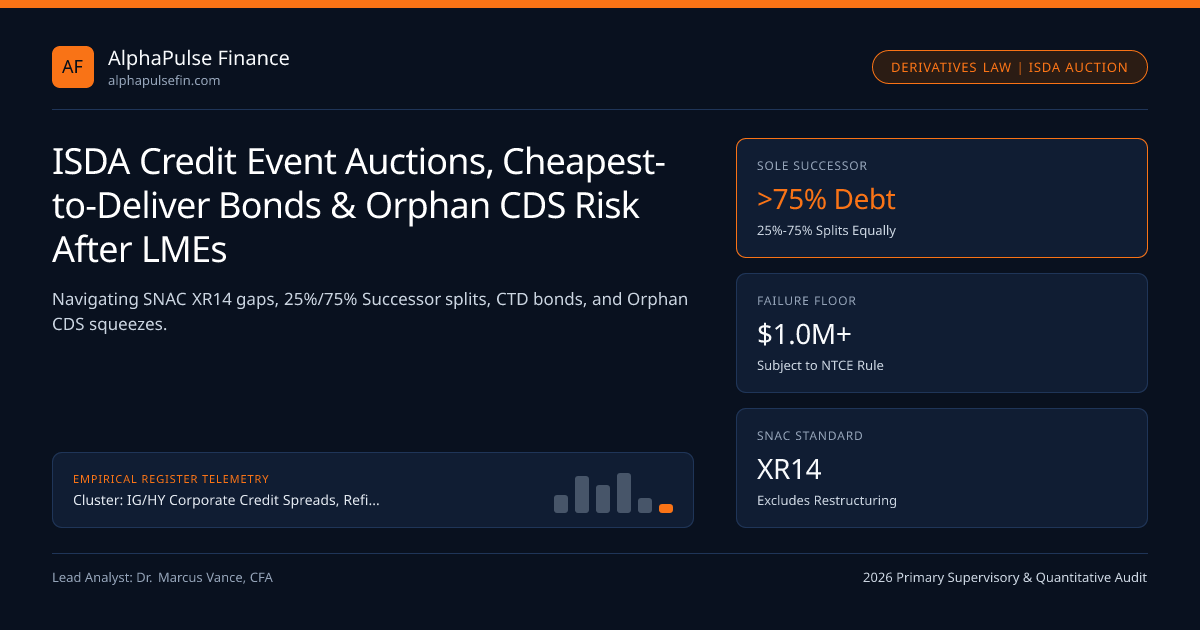
Buying 5-year single-name Credit Default Swap (CDS) protection does not insure against generic "company trouble"—it pays off strictly if an ISDA Credit Derivatives Determinations Committee (DC) certifies a contractually defined Credit Event (Bankruptcy or Failure to Pay under North American SNAC No-Restructuring conventions) AND deliverable senior unsecured obligations exist at that exact legal Reference Entity! Across modern LME restructurings overseen by SEC and CFTC swaps regimes, misreading Orphan CDS traps, ISDA 25%/50% Successor thresholds, or Two-Stage Credit Event Auction Cheapest-to-Deliver (CTD) mechanics has cost credit desks hundreds of millions against Primary Dealer Counterparties.
Why North American SNAC CDS Excludes "Restructuring" (XR14) & Creates LME Blind Spots#
In European corporate CDS (Mod-Mod-R / MM14), an out-of-court maturity extension or coupon haircut binding all holders triggers a Restructuring Credit Event (capped at 2.5Y/5Y/10Y maturity buckets). By contrast, standard North American Corporate (SNAC / XR14) CDS trades WITHOUT Restructuring!
Consequently, if a distressed US issuer executes a coercive out-of-court Distressed Debt Exchange (DDE) or Uptier LME where 92% of bondholders voluntarily swap into subordinated PIK notes—so long as the issuer keeps paying coupons on the tiny 8% unexchanged stub (avoiding a >=$1 million Failure to Pay) and stays out of Chapter 11—SNAC CDS triggers ZERO payout! Even worse, if the LME retires >75% of debt into a different subsidiary while leaving the Reference Entity as an empty debt-free shell, the contract becomes an "Orphan CDS": protection sellers keep collecting 500 bps/yr on a contract whose payout at maturity is guaranteed to be $0.00!
Inside Creditex/Markit Two-Stage ISDA Credit Event Auctions & CTD Optionality#
When an actual Chapter 11 or Failure to Pay triggers an ISDA auction administered by Creditex and OSTTRA Markit across participating dealers including Cantor Fitzgerald, final cash recovery (100 - Final_Price) is discovered in two stages:
- Stage 1 (9:45 AM ET): Inside Market Midpoint (IMM) & Net Open Interest (NOI): Dealers submit two-way physical markets (max 2.0-pt spread) plus customer physical settlement requests. If protection buyers submit more bonds to deliver than sellers want (Net Open Interest to SELL physical bonds), Stage 2 becomes a Dutch auction capped at IMM + Cap; if buyers lack physical bonds and submit Net Open Interest to BUY bonds (common in short squeezes!), the auction clears above fair cash value!
- Cheapest-to-Deliver (CTD) Bonus: Protection buyers can deliver any pari-passu senior bond up to 30 years maturity (excluding contingent/convertible quirks). Because a distressed 30-year 2.90% bond trading at $36.00 (due to zero accrued interest / structural litigation lag) is cheaper than a 1-year 8.50% note at $43.00, every CDS contract settles off the $36.00 CTD bond ($64.00 payout!)!
- CTDOptionValue = FundamentalWeightedRecovery - Min{j in Deliverable}(MarketPrice_j)
- Worked $25M CDS Settlement With CTD & NOI Squeeze Comparison (Fundamental Recovery = 45.0%):
- Case A (CTD 2050 Bond Clears at 38.50): Protection Buyer Payout = $25M * (1 - 0.385) = $15.375M (+$1.625M CTD bonus!)
- Case B (Deliverable Bond Squeeze; Only $80M Stub vs $600M CDS -> Clears at 72.00):
- Protection Buyer Payout = $25M * (1 - 0.720) = $7.000M (-$6.750M squeeze loss despite bankruptcy!)
ISDA Successor Split Rules (25% / 50%) & CTD Delivery Option Value#
Under 2014 ISDA Credit Derivatives Definitions, a Reference Entity transfers or splits CDS contracts to a new entity only if >=75% of Relevant Obligations move to one entity (sole successor) or >25% move to each of multiple entities (split CDS)!
ISDA Credit Event & Successor Threshold Reference Matrix#
Corporate spin-offs, M&A mergers, and unrestricted-subsidiary debt exchanges deliberately target the 24.9% / 74.9% ISDA Successor boundaries—making prospectus covenant review mandatory before sizing single-name CDS.
| Corporate Debt Action | % of Relevant Debt Moved | ISDA Successor Outcome | Impact on Protection Buyer | Impact on Protection Seller |
|---|---|---|---|---|
| Wholly-Owned Sub Refis 82% Debt | 82% (> 75% Threshold) | 100% Transfers to New Sub | Safe; CDS follows debt! | Normal risk transfer |
| Spin-Off Splits Debt 60% / 40% | Both > 25% Threshold | Splits 50% / 50% Equal CDS! | Owns half on IG Spin, half on HY RemainCo | Must re-hedge asymmetric split |
| Coercive Exchange Leaves 4% Stub | 96% Cancelled / Equity | Remains at Old Entity | Dangerous if 4% stub paid in full! | Collects 500bp coupon ("Orphan") |
| 22% Debt Drop-Down to Unrest. Sub | 22% (< 25% Threshold) | 0% Transfers; Stays at Parent | Loses collateral value without CDS split | Protected vs sub default (SEC) |
Manufactured Credit Events & CFTC/SEC Anti-Manipulation Enforcement#
Following infamous 2017-2019 "Manufactured Credit Events" (Hovnanian deliberate 1-day missed intercompany payment in exchange for cheap financing; Windstream lease technical default), ISDA adopted the 2019 Narrowly Tailored Credit Event (NTCE) Supplement alongside strict joint statements from the SEC, CFTC, and UK FCA. Under NTCE (standard in all 2020+ SNAC trades), a Failure to Pay no longer triggers CDS unless it results from—or causes—a genuine deterioration in the creditworthiness or financial condition of the Reference Entity, extinguishing engineered technical defaults!
Fixed-income and equity strategists align these metrics with IG/HY Corporate Credit Spreads, Refinancing Walls & CDS Basis, US G-SIB TLAC HoldCo vs OpCo Credit Spreads, CDX NA IG & HY Intrinsic Skew, IG/HY Corporate Credit Spreads, and covered institutions.
Frequently asked questions
Why does an ISDA 60%-40% corporate debt spin-off split existing CDS 50%-50% rather than 60%-40%?
Under the 2014 ISDA Definitions, whenever two or more entities each succeed to >25% of Relevant Obligations (and none exceeds 75%), the original CDS contract divides into N EQUAL-notional contracts (e.g., 50%/50% for 2 entities)—creating big M&A arbitrage moves!
How can a bankrupt company’s ISDA Credit Event Auction clear at $75 when its enterprise value is zero?
If an LME retired 95% of senior unsecured bonds before Chapter 11, leaving only $40M of deliverable cash bonds against $800M of physical-settlement requests from CDS sellers, desperate buyers bid the scarce $40M stub up to $75 in the auction!
What is the 60-day Credit Event Lookback Period in ISDA CDS contracts?
To ensure every cleared and bilateral CDS contract is 100% fungible regardless of trade date, a Credit Event notice covers events occurring up to 60 calendar days prior to the DC request date (90 days for Successor determinations).
Why did US regulators scrutinize "Manufactured Credit Events" like Hovnanian in 2018?
The CFTC and SEC warned that paying a distressed issuer cheap financing to intentionally miss an intercompany bond coupon solely to trigger an oversized CDS windfall risked violating federal anti-manipulation statutes, prompting ISDA’s 2019 NTCE rule.
Publication record
- Published
- November 13, 2026
- Updated
- November 14, 2026
- Author
- Dr. Marcus Vance, CFA
- Review
- Review not recorded
- Automated fact check
- Passed in the stored pipeline record
- Source URLs
- 3 recorded
AI assistance recorded: anthropic/claude-opus-4.6. This field does not establish human review or source verification.
Academic & Institutional Attribution
Cite This Research & Embed Live Data Card
Standard academic & institutional research paper citation format.
Dr. Marcus Vance, CFA. (2026, November 14). ISDA Credit Event Auctions, Cheapest-to-Deliver Bonds & Orphan CDS Risk After LMEs. AlphaPulse Finance. https://alphapulsefin.com/analysis/isda-credit-event-auction-cheapest-to-deliver-orphan-cdsRelated Corporate Credit Spread Cycles & Institutional Briefings
Explore Corporate Credit Spread Cycles Hub (20) →Corporate Credit Spread Cycles
IG/HY Corporate Credit Spreads, Refinancing Walls & CDS Basis: Institutional Credit GuideCorporate Credit Spread Cycles
US G-SIB TLAC HoldCo vs OpCo Credit Spreads: SPOE Bail-In Subordination & Call OptionalityCorporate Credit Spread Cycles
SASB Office CMBS Special Servicing & Regional Bank Sub-Debt Credit ContagionCorporate Credit Spread Cycles
Rising-Star BB-Plus Upgrades: Anticipating Crossover Deleveraging Into Investment GradeCorporate Credit Spread Cycles
iBoxx Total Return Swaps vs CDX Payer Swaptions: Cash-Spread Basis & Tail Convexity HedgingCorporate Credit Spread Cycles
Out-of-Court Distressed Debt Exchanges vs Prepackaged Chapter 11: The 38% Re-Default TrapCorporate Credit Spread Cycles
Reverse Yankee Corporate Bond Issuance: EUR/USD Cross-Currency Basis & ECB-Fed ArbitrageCorporate Credit Spread Cycles
CDX NA IG & HY Intrinsic Skew: Index-to-Single-Name CDS Arbitrage MechanicsInflation Breakevens Real Rates
Zero-Coupon vs Year-on-Year Inflation Caps & Floors: Tail Volatility Smiles & Regime ProbabilitiesInflation Breakevens Real Rates
Employment Cost Index (ECI) vs Average Hourly Earnings & Atlanta Fed Wage TrackerInflation Breakevens Real Rates
Gold Spot Divergence From 10-Year TIPS Real Yields: EM Central Bank Reserve ReallocationInflation Breakevens Real Rates
TIPS Asset-Swap & Iota Spreads: Cash Breakeven vs Zero-Coupon Inflation Swap Arbitrage
AlphaPulse Finance Data, Benchmarks & Contributor Records
CC BY 4.0 Open Data
Open Institutional Datasets (CSV / JSON) →
Download desk-compiled quantitative series & schemas.
2026 Reference Matrix
2026 Institutional Benchmarks & Thresholds →
Statutory capital, clearing, margin & rate conventions.
Editorial Records
Authors & Review Records →
View named contributors where those records are available.
Complete Index
Master Research & Dossier Archive →
Browse all published briefings by topic pillar & date.