
Corporate Credit Spread Cycles
iBoxx Total Return Swaps vs CDX Payer Swaptions: Cash-Spread Basis & Tail Convexity Hedging
Portfolio managers hedging cash corporate bond books choose between iBoxx Total Return Swaps (zero cash-CDS basis risk, linear delta) and CDX payer swaptions (convex jump protection with defined upfront theta cost).
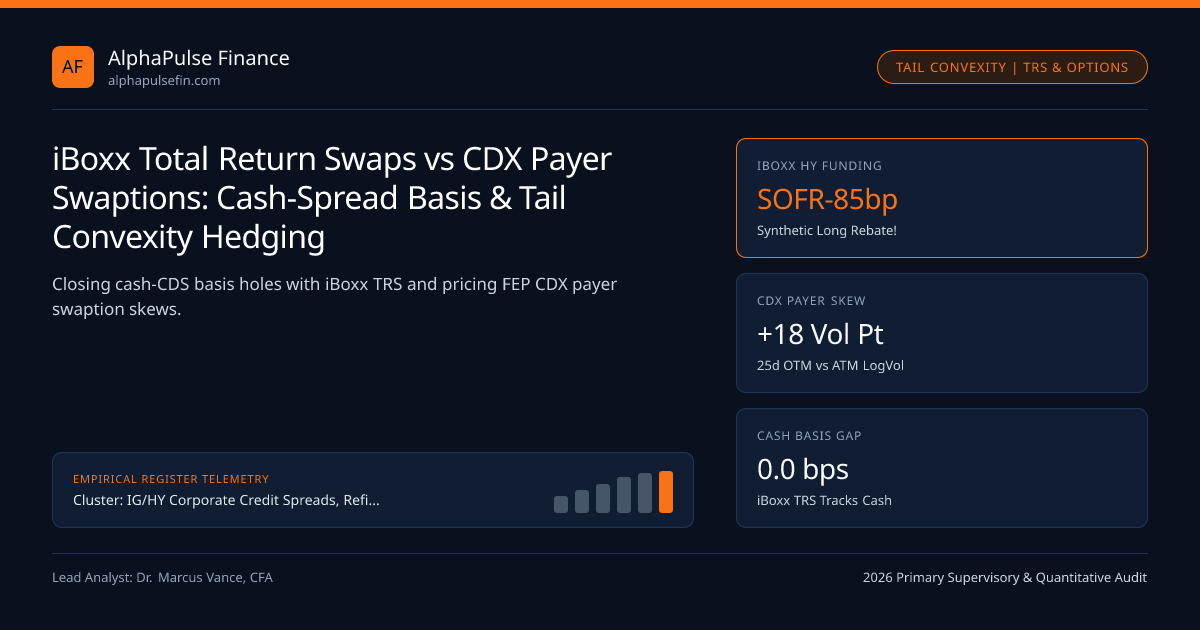
March 2020 taught cash corporate bond portfolio managers a painful lesson: hedging a $2 billion investment-grade cash bond portfolio solely with CDX.NA.IG left a massive basis hole when cash IG OAS widened +275 bps while cleared CDX widened only +110 bps! To eliminate cash-versus-synthetic basis mismatch or engineer asymmetric crash protection, institutional credit overlays combine OSTTRA Markit iBoxx Total Return Swaps (iBoxx IG / HY TRS) funded off Overnight SOFR (3.91%) with Cleared/SEF CDX Payer Swaptions (options to buy CDX protection at fixed strike spreads) across CFTC and SEC derivatives desks on Primary Dealer Balance Sheets.
How iBoxx USD Liquid IG & HY Total Return Swaps Eliminate Cash-CDS Basis Risk#
An iBoxx Total Return Swap (TRS) exchanges the exact total return (coupons + clean price changes + defaults) of a broad cash corporate bond index (iBoxx $ Liquid Investment Grade ~2,700 bonds, or iBoxx $ Liquid High Yield ~1,200 bonds) against a floating financing leg of Compounded SOFR +/- TRS Financing Spread over standardized quarterly/monthly IMM maturities (March, June, September, December).
Compare an iBoxx TRS hedge against a CDX hedge:
- Zero Cash-Synthetic Basis Mismatch: Because iBoxx settles directly to the cash bond index NAV (tracking the exact same universe as LQD / HYG!), if cash corporate bonds suffer a liquidity freeze and blow out -100 bps against CDX, the Total Return Payer (Short iBoxx) captures 100% of the cash bond markdown!
- Embedded Rate Duration: Warning—unlike CDX (which isolates pure credit spread), raw iBoxx TRS includes full 10-Year US Treasury interest-rate duration (~8.3 years on iBoxx IG)! If you want to hedge only cash credit spreads via iBoxx TRS without shorting Treasury duration, you must simultaneously go Long DV01-matched Treasury Futures or Receiver SOFR OIS!
CDX Payer Swaptions & 1x2 Payer Spreads: Convexity With Knockout Knock-In Care#
Linear hedges (Short iBoxx TRS or Long CDX Protection) bleed negative running carry every calm month (~52.5 bps/yr in IG, ~328 bps/yr in HY). To cut carry bleed by 65% while retaining 4x-to-7x crash convexity, volatility desks at Cantor Fitzgerald and Capitals Gain structure 3-Month Out-of-the-Money CDX Payer Swaptions (the right to buy 5Y CDX.NA.IG protection at a 75-bps strike).
Crucially, ISDA standard CDX Swaptions are "Front-End Protection (FEP) Included": if a constituent company defaults before your 3-month swaption expires, exercising the payer swaption at expiration automatically delivers the defaulted constituent's ISDA auction payout on top of the widened surviving index! Furthermore, because credit spread log-normal volatility exhibits a massive upward-sloping right-tail volatility skew (75-bps IG payer vol trades at 62% log-normal vol vs 44% ATM!), selling 2x further-OTM 95-bps payers (a 75/95 1x2 Payer Spread or Collar against 45-bps Receivers) monetizes extreme skew to fund near-zero-cost hedges.
- SyntheticLongHYAlphabps = RTBillCollateral - (RSOFR + SpreadiBoxxHYTRS)
- Worked Synthetic Long iBoxx HY Funding Advantage vs Physical Cash Bond Fund:
- Physical Cash HY Fund Yield = 7.24% (minus ~18 bps trading/cash drag = 7.06%)
- T-Bill + Long iBoxx HY TRS @ (SOFR - 85 bps):
- Earns 3.90% T-Bill + [7.24% iBoxx Total Return - (3.91% SOFR - 0.85%)] = 8.08% (+84 bps riskless financing alpha!)
iBoxx Implied Financing Spread & Front-End-Protected CDX Swaption Payoff Equations#
Notice how heavy hedge-fund shorting demand often drives the iBoxx HY TRS Financing Leg down to SOFR - 65 to -140 bps—a synthetic "rebate" bonus for real-money pension funds going Long iBoxx TRS instead of buying cash bonds!
Institutional Credit Hedge Toolkit Comparison Matrix (Q4 2026)#
Choosing the optimal overlay instrument depends on whether the threat is a rates-led liquidity basis shock (2020/2022 -> iBoxx TRS) or a macro growth/default jump (2008 -> CDX Payer Swaptions).
| Credit Hedge Overlay | Tracks Cash Basis? | Interest-Rate Duration | Running Carry / Theta Drag | Recall / Squeeze Risk |
|---|---|---|---|---|
| 5Y Cleared CDX.NA.IG / HY | No (Synthetic Skew) | 0.0 Years (Pure Spread) | -52.5bp IG / -328bp HY Linear | Zero (CFTC ICE Clear) |
| Rate-Hedged iBoxx IG/HY TRS | Yes (100% Cash NAV) | Hedged via UST Futures | Cash OAS +/- TRS Funding Spread | Zero until IMM Roll |
Short Corporate ETF (LQD/HYG) | Yes (+ Live Intraday) | Must Hedge UST Leg | Coupon Yield + Borrow Fee | Moderate (SEC Reg SHO Recall) |
| CDX 3M OTM Payer Swaption | Indirect (Convex Vol) | 0.0 Years (Pure Spread) | -12 to -18 bps Upfront Premium | Zero (Defined Max Loss) |
Harvesting Negative iBoxx HY Financing Rebates ("Synthetic Cash Enhancement")#
Flip the trade around from the asset owner's perspective: because hedge funds chronically want to Pay Total Return (Short HY) via iBoxx HY TRS (avoiding ETF borrow recall risk), dealers clear the iBoxx HY financing leg near SOFR - 85 bps (3.06% funding cost vs 3.91% SOFR!). Consequently, an institutional sovereign wealth or pension fund that holds 3.91% T-bills and Receives iBoxx HY Total Return at SOFR - 85 bps outperforms a physical cash HY bond fund by +85 bps annualized every single year before a single security selection trade!
Multi-asset CIOs synthesize this factor alongside IG/HY Corporate Credit Spreads, Refinancing Walls & CDS Basis, Out-of-Court Distressed Debt Exchanges vs Prepackaged Chapter 11, and Covenant-Lite Liability Management Exercises (LMEs) via IG/HY Corporate Credit Spreads and macro benchmarks.
Frequently asked questions
Why did hedging cash IG corporate bonds with CDX.NA.IG fail partially during the March 2020 COVID crash?
Mutual fund redemptions forced T+1 fire sales of off-the-run cash corporate bonds (+275 bps OAS widening), whereas synthetic CDX—free of repo balance-sheet constraints—widened only +110 bps, leaving a -165 bps negative-basis loss on hedged books!
What is "Front-End Protection" (FEP) in a CDX High-Yield or Investment-Grade Payer Swaption?
Without FEP, if three HY constituents defaulted in Month 2 and the remaining 97 names rallied back tight by Month 3 expiry, your option could expire worthless despite 3 defaults! FEP adds SUM(1 - Recovery_i) directly into the option exercise value.
Why does the financing leg on iBoxx High Yield Total Return Swaps trade BELOW SOFR (e.g., SOFR - 85 bps)?
Dealers hedging massive customer "Short iBoxx HY" flow must short underlying cash HY bonds or ETFs (which cost 75-150 bps to borrow in securities lending); dealers pass that short-borrow rebate straight to anyone willing to go Long iBoxx HY TRS!
How do credit option desks monetize the steep 18-vol-point right-tail skew in CDX options?
Instead of buying an expensive outright 65-bps Payer Swaption, desks buy a 65-bps/85-bps 1x2 or 1x1 Payer Spread (selling the ultra-high-implied-vol 85-bps wing), slashing upfront premium by 40%-55%.
Publication record
- Published
- November 13, 2026
- Updated
- November 14, 2026
- Author
- Dr. Marcus Vance, CFA
- Review
- Review not recorded
- Automated fact check
- Passed in the stored pipeline record
- Source URLs
- 3 recorded
AI assistance recorded: anthropic/claude-opus-4.6. This field does not establish human review or source verification.
Academic & Institutional Attribution
Cite This Research & Embed Live Data Card
Standard academic & institutional research paper citation format.
Dr. Marcus Vance, CFA. (2026, November 14). iBoxx Total Return Swaps vs CDX Payer Swaptions: Cash-Spread Basis & Tail Convexity Hedging. AlphaPulse Finance. https://alphapulsefin.com/analysis/iboxx-total-return-swaps-cdx-payer-swaption-tail-hedgingRelated Corporate Credit Spread Cycles & Institutional Briefings
Explore Corporate Credit Spread Cycles Hub (20) →Corporate Credit Spread Cycles
IG/HY Corporate Credit Spreads, Refinancing Walls & CDS Basis: Institutional Credit GuideCorporate Credit Spread Cycles
Out-of-Court Distressed Debt Exchanges vs Prepackaged Chapter 11: The 38% Re-Default TrapCorporate Credit Spread Cycles
Reverse Yankee Corporate Bond Issuance: EUR/USD Cross-Currency Basis & ECB-Fed ArbitrageCorporate Credit Spread Cycles
CDX NA IG & HY Intrinsic Skew: Index-to-Single-Name CDS Arbitrage MechanicsCorporate Credit Spread Cycles
Negative CDS-Bond Basis Arbitrage: Z-Spread, Corporate Repo Haircuts & Par Claim RiskCorporate Credit Spread Cycles
BBB-Minus Fallen-Angel OAS Cliffs: Mandatory Mandate Selling & Post-Downgrade Rebound AlphaCorporate Credit Spread Cycles
US High-Yield 2026-2028 Maturity Wall: Coupon Reset Math & EBITDA Coverage ErosionCorporate Credit Spread Cycles
Covenant-Lite Liability Management Exercises (LMEs): Uptiers, Drop-Downs & Recovery CompressionInflation Breakevens Real Rates
University of Michigan vs NY Fed SCE Inflation Expectations: Partisan Skew & Salience BiasInflation Breakevens Real Rates
Real 2s10s TIPS Yield Curve Slope: Auditing Ex-Ante FOMC Monetary RestrictivenessInstitutional Earnings Capex Macro
S&P 500 Operating Leverage Dispersion: Cap-Weighted Mega-Cap vs Equal-Weighted EBIT MarginsInstitutional Earnings Capex Macro
Hyperscaler AI GPU Useful-Life Accounting: 4-to-6-Year Server Depreciation Cliffs & EBIT Risk
AlphaPulse Finance Data, Benchmarks & Contributor Records
CC BY 4.0 Open Data
Open Institutional Datasets (CSV / JSON) →
Download desk-compiled quantitative series & schemas.
2026 Reference Matrix
2026 Institutional Benchmarks & Thresholds →
Statutory capital, clearing, margin & rate conventions.
Editorial Records
Authors & Review Records →
View named contributors where those records are available.
Complete Index
Master Research & Dossier Archive →
Browse all published briefings by topic pillar & date.