
Corporate Credit Spread Cycles
US High-Yield 2026-2028 Maturity Wall: Coupon Reset Math & EBITDA Coverage Erosion
Refinancing pandemic-era 2020-2021 high-yield corporate bonds carrying 4.65% average coupons into 7.25%-9.80% 2026 market yields erodes issuer EBITDA-to-interest coverage by 1.4x across the $820B speculative maturity wall.
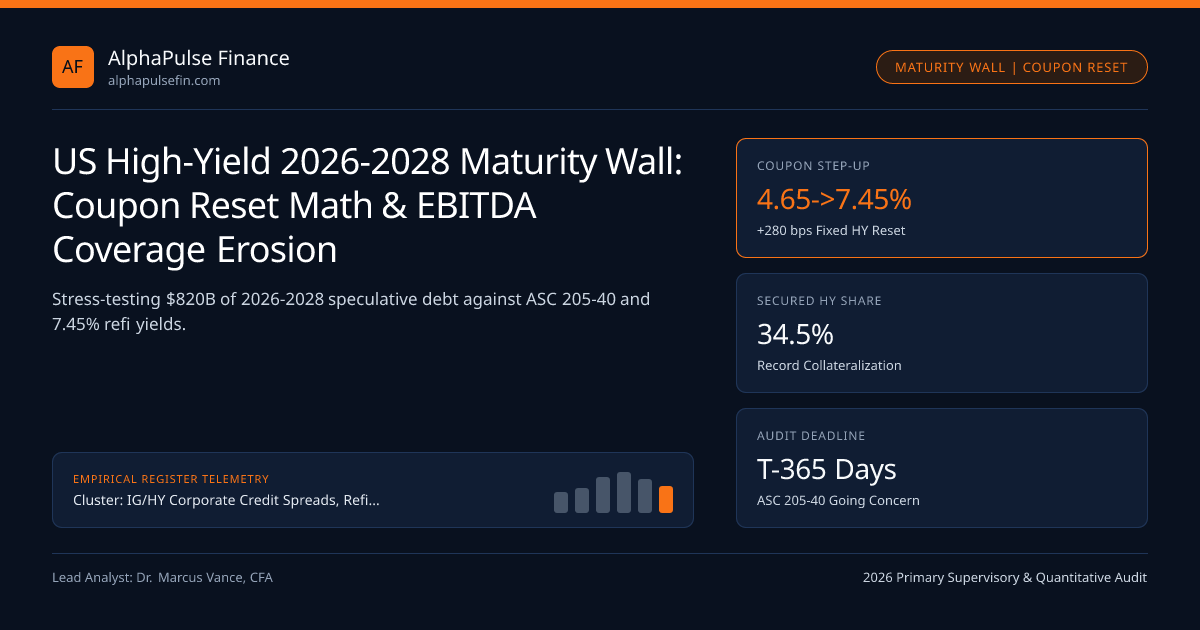
Between 2020 and late 2021, US speculative-grade corporations issued a record $910 billion of 5-year, 7-year, and 8-year senior notes at a weighted-average coupon of 4.65%—locking in cheap fixed funding that insulated cash flows throughout the initial 2022-2024 hiking cycle. In late 2026, that grace window is expiring: over $820 billion of US high-yield cash bonds and broadly syndicated leveraged loans reach contractual maturity between late 2026 and 2028, forcing CFOs to refinance at least 12 to 18 months early (before debt turns "current" on GAAP balance sheets) into a 3.75%-4.00% FOMC Corridor and 4.32% 10-Year Treasury regime.
The "Going-Concern" 12-Month Current-Debt Cliff in SEC 10-K Audits#
Why does a high-yield maturity scheduled for November 2027 trigger distress in October 2026—a full 13 months ahead of par due date? Under US GAAP ASC 205-40 (Going Concern) audited for SEC Form 10-K/10-Q filings, any long-term bond or term loan maturing within 365 days reclassifies as a Current Liability unless the borrower holds committed refinancing capacity.
If an uncommitted CCC or B-minus maturity crosses inside the 12-month horizon, external auditors issue a Going-Concern Qualification, which frequently cross-defaults revolving credit facility covenants with commercial banks supervised by the OCC and Federal Reserve and causes trade-credit vendors to demand cash-on-delivery—turning a 2028 wall into a 2026-2027 execution sprint.
Bifurcated Refinancing Access: BB/B Amend-and-Extend vs CCC Shutout#
Refinancing stress across the 2026-2028 wall splits sharply by rating cohort:
- BB and Strong Single-B Issuers (~78% of Wall): Have aggressively chipped away at 2026-2027 maturities whenever HY OAS dipped below 300 bps, accepting a +185 to +260 bps coupon step-up (e.g., refinancing a 4.75% 2027 note into a 6.875% 2031 note via syndicates led by dealers and platforms alongside Cantor Fitzgerald).
- B-Minus and CCC Issuers (~$185B Tail): Face prohibitive new-issue yields of 10.75% to 13.50% alongside leveraged-loan interest tied to SOFR (3.91%) + 525 bps. At an 11.5% coupon, an issuer running 6.2x Net Debt / EBITDA consumes 71% of entire pre-capex EBITDA purely on cash interest—leaving negative free cash flow after maintenance capex!
- MaxSustainableRefiYield = (LTMEBITDA - MaintCapex - CashTaxes) / TotalGrossDebt
- Worked Single-B vs CCC Refinancing Stress ($1.2B Gross Debt, $200M EBITDA, $55M Maint Capex + Tax):
- Maximum FCF-Breakeven Average Interest Rate = ($200M - $55M) / $1,200M = 12.08% ceiling (1.0x FCF coverage)
- At Legacy 4.75% Coupon ($57M interest): ICR = 3.51x, FCF = +$88M (+7.3% FCF/Debt deleveraging capacity)
- At 8.25% Refi Yield ($99M interest): PF-ICR drops to 2.02x, FCF shrinks by 48% to +$46M (+3.8% FCF/Debt)
Coupon Reset Coverage Erosion & Free-Cash-Flow Breakeven Yield Equations#
Credit analysts stress every 2026-2028 maturity tranche at Pro-Forma Refinanced Interest Coverage (PF-ICR) rather than deceptive trailing-twelve-month (LTM) GAAP interest expense.
US Speculative-Grade Maturity Wall & Pro-Forma Coverage Matrix by Tier#
Separating fixed-rate cash bonds (suffering delayed coupon step-ups) from floating-rate leveraged loans (benefiting modestly as SOFR eased from 5.33% peaks to 3.91%) clarifies sector winners and losers.
| Speculative Debt Cohort | 2026-2028 Maturing Volume | Maturing Coupon | Q4 2026 Refi Rate | Primary Refinancing / Exit Path |
|---|---|---|---|---|
| BB Senior Unsecured Notes | ~$245B | 4.25% | 6.40% Fixed | Par New Issue + Early Tender (FINRA TRACE) |
| Single-B Senior Notes | ~$210B | 5.10% | 7.65% (Often Secured) | Senior Secured Bond Pledge to Save ~65 bps |
| Broadly Syndicated B Loans | ~$265B | SOFR + 375 (7.66%) | SOFR + 350 (7.41%) | CLO Amend-and-Extend (OCC Leveraged Guide) |
| CCC Notes & Junior Debt | ~$100B+ | 6.35% | 11.50%+ (Shut Out) | Private Credit Rescue PIK or Out-of-Court LME (SEC) |
Trading "Pull-to-Par" Short-Dated Callables vs Distressed Maturity Traps#
Paradoxically, the early-refinancing imperative creates one of high yield's highest-Sharpe relative-value trades: BB/B Yield-to-Call Cushion Bonds. When a healthy BB issuer carries a 4.875% bond due March 2028 trading at $96.75 (6.95% YTM) that becomes callable at $100.00 par, CFO motivation to refinance 14 months early (January 2027) pulls the bond to $100 par via tender or call a full year ahead of maturity—boosting realized IRR from 6.95% to 8.85%+ reported on FINRA TRACE.
Adjacent curve and flow decompositions include Covenant-Lite Liability Management Exercises (LMEs) and Merton Structural Distance-to-Default, anchored by IG/HY Corporate Credit Spreads, Refinancing Walls & CDS Basis, IG/HY Corporate Credit Spreads, and analytical tools.
Frequently asked questions
Why are fixed-rate high-yield bonds experiencing coverage erosion in 2026 while floating-rate loans stabilize?
Floating-rate loans immediately absorbed higher SOFR in 2022-2023 and have actually seen interest costs edge lower as SOFR eased to 3.91%, whereas 2020-2021 fixed-rate bonds kept paying 4.5% until their 2026-2028 refinancing reset.
Why has the secured share of the US High Yield bond market surged to a record 34.5%?
To keep all-in coupons below 8.0% during refinancing, single-B borrowers increasingly issue Senior Secured Notes backed by plant, equipment, or pari-passu first-lien claims rather than paying +75-110 bps extra for unsecured debt.
What is a "Springing Maturity" clause in revolving credit facilities and term loans?
Bank revolvers and first-lien term loans routinely include a springing maturity covenant that automatically accelerates the loan maturity to 91 days BEFORE any junior bond (> $100M) matures if that bond has not yet been refinanced.
How do credit desks earn excess IRR on short-dated discount high-yield bonds ("cushion bonds")?
Buying a 4.75% 2028 BB bond at $96.75 yields ~6.95% if held 24 months to maturity, but if the CFO refinances and calls/tenders at $100 par in 11 months to beat the 12-month current-debt clock, the 3.25-pt capital gain doubles annualized pull-to-par.
Publication record
- Published
- November 13, 2026
- Updated
- November 14, 2026
- Author
- Dr. Marcus Vance, CFA
- Review
- Review not recorded
- Automated fact check
- Passed in the stored pipeline record
- Source URLs
- 3 recorded
AI assistance recorded: anthropic/claude-opus-4.6. This field does not establish human review or source verification.
Academic & Institutional Attribution
Cite This Research & Embed Live Data Card
Standard academic & institutional research paper citation format.
Dr. Marcus Vance, CFA. (2026, November 14). US High-Yield 2026-2028 Maturity Wall: Coupon Reset Math & EBITDA Coverage Erosion. AlphaPulse Finance. https://alphapulsefin.com/analysis/us-high-yield-maturity-wall-coupon-reset-interest-coverageRelated Corporate Credit Spread Cycles & Institutional Briefings
Explore Corporate Credit Spread Cycles Hub (20) →Corporate Credit Spread Cycles
IG/HY Corporate Credit Spreads, Refinancing Walls & CDS Basis: Institutional Credit GuideCorporate Credit Spread Cycles
Covenant-Lite Liability Management Exercises (LMEs): Uptiers, Drop-Downs & Recovery CompressionCorporate Credit Spread Cycles
IG Primary Bond New-Issue Concession (NIC): Orderbook Oversubscription & Syndicate CompressionCorporate Credit Spread Cycles
FINRA TRACE Block Dissemination Caps & Automated Credit Portfolio Trading MicrostructureCorporate Credit Spread Cycles
Fixed-Income Credit ETF Create/Redeem Arbitrage: Custom Baskets & Stale-NAV Liquidity DiscoveryCorporate Credit Spread Cycles
US BSL CLO Arbitrage: AAA Liability Spreads, 7.5% CCC Buckets & Junior OC Test DiversionCorporate Credit Spread Cycles
Private Credit Unitranche PIK Toggles & BDC Non-Accrual Dispersion: Shadow Default AuditCorporate Credit Spread Cycles
Merton Structural Distance-to-Default: Equity Put Skew Leading Corporate Credit SpreadsInflation Breakevens Real Rates
10-Year TIPS Real Yields & S&P 500 Forward P/E Compression: Equity Duration RegimesInflation Breakevens Real Rates
NSA CPI 3-Month Indexation Lag & Front-End TIPS Seasonal Carry/Roll MechanicsInflation Breakevens Real Rates
Cleveland Fed Trimmed-Mean & Median CPI vs Dallas Fed Trimmed PCE: Outlier-Filtered SignalsInflation Breakevens Real Rates
1Y & 2Y Zero-Coupon Inflation Swaps: RBOB Gasoline Crack Spreads & WTI Pass-Through
AlphaPulse Finance Data, Benchmarks & Contributor Records
CC BY 4.0 Open Data
Open Institutional Datasets (CSV / JSON) →
Download desk-compiled quantitative series & schemas.
2026 Reference Matrix
2026 Institutional Benchmarks & Thresholds →
Statutory capital, clearing, margin & rate conventions.
Editorial Records
Authors & Review Records →
View named contributors where those records are available.
Complete Index
Master Research & Dossier Archive →
Browse all published briefings by topic pillar & date.