
Corporate Credit Spread Cycles
Out-of-Court Distressed Debt Exchanges vs Prepackaged Chapter 11: The 38% Re-Default Trap
Out-of-court Distressed Debt Exchanges now outnumber traditional Chapter 11 filings 1.6-to-1, yet leave 38% of restructured borrowers re-defaulting within 36 months ("Chapter 22" syndrome) due to insufficient debt reduction.
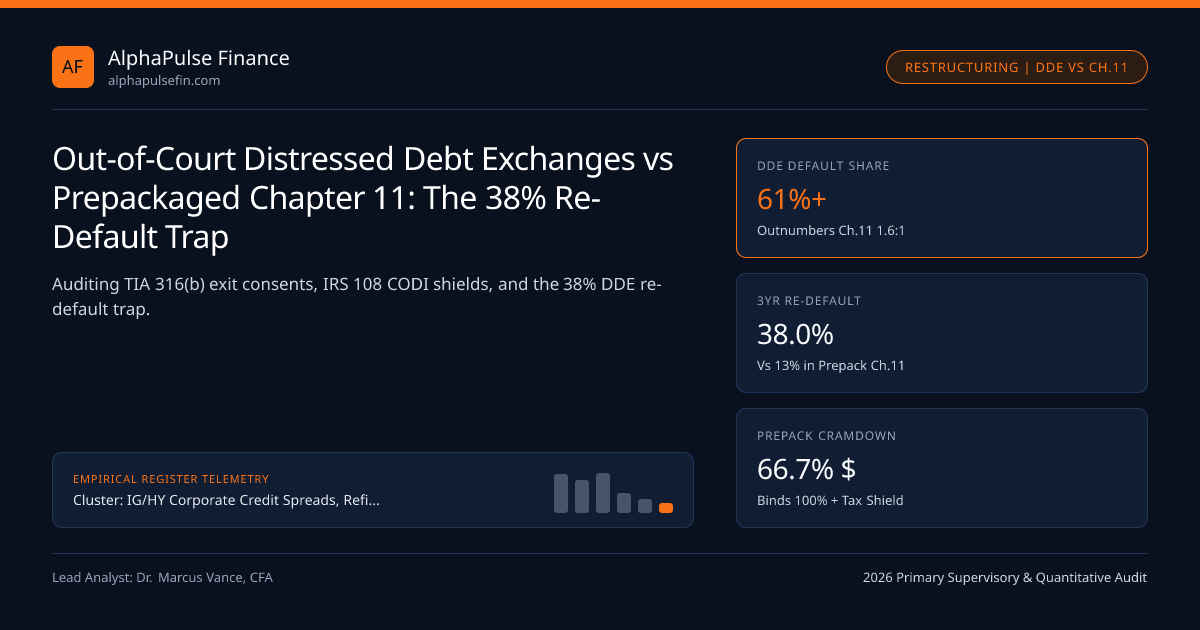
Corporate distress in the mid-2020s rarely starts on the steps of the Southern District of New York or Houston bankruptcy court. Across Moody's and S&P speculative-grade default tallies under a 3.75%-4.00% FOMC Corridor and 3.91% SOFR, out-of-court Distressed Debt Exchanges (DDEs) now represent over 61% of all default events—outnumbering traditional Chapter 11 filings roughly 1.6-to-1! Sponsors choose out-of-court exchanges under SEC Section 3(a)(9) or Rule 144A to preserve equity option value and avoid $65M to $150M of Chapter 11 professional fees. Yet empirical post-restructuring tracking reveals the catch: 38% of DDE borrowers re-default within 36 months, compared with under 14% after a comprehensive Chapter 11 balance-sheet equitization.
The Trust Indenture Act Section 316(b) Holdout Problem & Exit Consents#
Why can a borrower not simply vote 66.7% of bondholders out of court to cut principal by 40% across all bonds? Because Section 316(b) of the Trust Indenture Act of 1939 enforced by the SEC (and replicated as a "Sacred Right" in 144A indentures) makes every individual bondholder's right to receive principal and interest on the stated maturity date unanimous (100% consent required) outside of bankruptcy court!
To overcome the Holdout Free-Rider Problem (where a 7% hedge-fund holdout refuses to exchange at 68 cents so it gets paid 100 cents when everyone else forgives debt!), restructuring bankers pair SEC Section 3(a)(9) (no-commission issuer exchange) or 144A Institutional offers with coercive Exit Consents:
- Participating bondholders (>50.1% or >66.7%) vote to strip 100% of restrictive covenants and collateral liens out of the old indenture the second they tender into new secured second-lien notes—leaving stubborn holdouts trapped in covenant-stripped, subordinated "stub paper" trading at illiquid discounts on FINRA TRACE!
Why Prepackaged Chapter 11 ("30-Day Prepack") Beats DDEs on Cram-Down & CODI Tax!#
When an issuer truly needs to slash total debt from 7.5x EBITDA down to 3.0x EBITDA, a Prepackaged Chapter 11 ("Prepack")—soliciting votes before filing and emerging in 28 to 45 days—crushes an out-of-court DDE across three decisive dimensions:
- Bankruptcy Code Section 1126(c) Binding Cram-Down: Once two-thirds (66.7%) in dollar amount AND more than one-half (50.1%) in number of voting creditors in a class accept the Prepack, 100.0% of holdouts are legally bound—zero free-riders!
- IRC Section 108 Cancellation-of-Debt Income (CODI) Tax Shield: Forgiving $500M of debt out of court creates $500M of immediate taxable Cancellation-of-Debt Income ($105M cash IRS tax bill unless insolvent!)! Inside Chapter 11 (IRC §108(a)(1)(A)), 100% of CODI is excluded from current taxable income (merely reducing Net Operating Loss attributes afterward)!
- Section 365 Executory Lease Rejection: Retailers, theaters, and telecoms can reject unprofitable 15-year commercial leases in Chapter 11 capped at 1 year's rent (§502(b)(6))—impossible in an out-of-court DDE!
- PostDDE3YrDebt = NewExchangedPar * (1 + RPIKCoupon)^3 + UnexchangedHoldout_Stub
- Worked Cosmetic DDE "Chapter 22" Compounding Trap ($1,000M Debt @ 6% Cash -> Swapped at 82% into $820M @ 5% Cash + 6% PIK):
- Day-1 Optical Debt Cut = -$180M (-18% headline deleveraging; Sponsor claims victory!)
- Compounded 3-Year PIK Accrual: $820M * (1.06)^3 = $976.6M + $40M Holdout Stub = $1,016.6M DEBT AT YEAR 3 (> $1,000M start!)
Holdout Game-Theory Payoff & Post-Exchange Leverage Survival Equations#
Quantifying post-exchange leverage explains why cosmetic DDEs (cutting debt by only 14% while adding 11% PIK coupons) merely set up a worse Chapter 11 two years later.
Out-of-Court DDE vs 35-Day Prepack vs Free-Fall Chapter 11 Matrix#
Credit desks trading distressed bonds across dealers like Cantor Fitzgerald and BridgeTower Capital sharply discount post-DDE senior debt unless net leverage drops below 4.0x EBITDA.
| Restructuring Dimension | Out-of-Court DDE (3(a)(9) / 144A) | Prepackaged Chapter 11 (35 Days) | Free-Fall Chapter 11 (12+ Mos) | Distressed Investor Takeaway |
|---|---|---|---|---|
| Binding Holdout Threshold | 100% (TIA §316(b)); Leaves Stub | 66.7% $ + >50% # (100% Bound!) | Court Cram-Down (§1129(b)) | Small <5% DDE stubs often pull to par |
| Sponsor Equity Survival | High (75% - 100% Retained) | Wiped Out (0% - 10% Warrants) | 100% Wiped Out | Sponsors push DDEs to save option value |
| IRS CODI Tax Liability | Taxable Above Insolvency (§108) | 100% Tax-Exempt (Ch.11 Shield) | 100% Tax-Exempt | Huge cash tax trap on deep DDE haircuts! |
| SNAC CDS Credit Event? | NO (Unless Failure to Pay) | YES (Immediate Bankruptcy Trigger) | YES (Immediate Trigger) | DDEs starve CFTC/SEC CDS buyers! |
Trading the Post-DDE "Stub Bond" vs Newly Issued Exchange Notes#
Ironically, when an out-of-court DDE achieves 94% participation (leaving a tiny $28 million old unsecured stub maturing in 14 months ahead of the new 5-year exchanged debt!), that tiny covenant-stripped Stub Bond often pulls straight to $100.00 Par! Why? Because once the issuer wins 4 years of runway on 94% of its debt, paying off a tiny $28M nuisance stub at maturity is vastly cheaper than filing Chapter 11—rewarding disciplined small-size distressed stub buyers while punishing over-sized holdouts that break the 90% minimum tender condition.
Cycle-comparison tables continue in IG/HY Corporate Credit Spreads, Refinancing Walls & CDS Basis, Reverse Yankee Corporate Bond Issuance, and IG Primary Bond New-Issue Concession (NIC); reference IG/HY Corporate Credit Spreads and institutional datasets for taxonomy standards.
Frequently asked questions
What is the difference between an SEC Section 3(a)(9) exchange and a Rule 144A distressed exchange?
Section 3(a)(9) exempts exchanges offered to ALL existing holders (including retail) without SEC registration PROVIDED no investment bank is paid a solicitation fee for persuading tenders; Rule 144A permits paid dealer-managers but excludes non-QIB retail holders!
Why did courts in Marblegate and Caesars debate Section 316(b) of the Trust Indenture Act?
In Marblegate (2017), the Second Circuit clarified that Section 316(b) prohibits non-consensual formal amendments to core payment terms (principal/interest/maturity), NOT aggressive collateral transfers or exit consents—re-igniting modern coercive DDEs!
How does Cancellation-of-Debt Income (CODI) kill deep out-of-court debt haircuts?
If a solvent-on-paper company convinces bondholders to forgive $400M of principal out of court ($1,000M -> $600M), the IRS treats that $400M debt forgiveness as ordinary taxable income—generating an ~$84M+ cash tax bill unless completed inside Chapter 11!
When does holding out in a Distressed Debt Exchange backfire on a hedge fund?
If holdouts exceed the issuer’s 90%-95% Minimum Tender Condition, the issuer cancels the out-of-court DDE and immediately flips into a Prepackaged Chapter 11 ("toggle plan") where holdouts get crammed down equally alongside everyone else.
Publication record
- Published
- November 13, 2026
- Updated
- November 14, 2026
- Author
- Dr. Marcus Vance, CFA
- Review
- Review not recorded
- Automated fact check
- Passed in the stored pipeline record
- Source URLs
- 3 recorded
AI assistance recorded: anthropic/claude-opus-4.6. This field does not establish human review or source verification.
Academic & Institutional Attribution
Cite This Research & Embed Live Data Card
Standard academic & institutional research paper citation format.
Dr. Marcus Vance, CFA. (2026, November 14). Out-of-Court Distressed Debt Exchanges vs Prepackaged Chapter 11: The 38% Re-Default Trap. AlphaPulse Finance. https://alphapulsefin.com/analysis/distressed-debt-exchanges-out-of-court-chapter-11-redefaultRelated Corporate Credit Spread Cycles & Institutional Briefings
Explore Corporate Credit Spread Cycles Hub (20) →Corporate Credit Spread Cycles
IG/HY Corporate Credit Spreads, Refinancing Walls & CDS Basis: Institutional Credit GuideCorporate Credit Spread Cycles
Reverse Yankee Corporate Bond Issuance: EUR/USD Cross-Currency Basis & ECB-Fed ArbitrageCorporate Credit Spread Cycles
CDX NA IG & HY Intrinsic Skew: Index-to-Single-Name CDS Arbitrage MechanicsCorporate Credit Spread Cycles
Negative CDS-Bond Basis Arbitrage: Z-Spread, Corporate Repo Haircuts & Par Claim RiskCorporate Credit Spread Cycles
BBB-Minus Fallen-Angel OAS Cliffs: Mandatory Mandate Selling & Post-Downgrade Rebound AlphaCorporate Credit Spread Cycles
US High-Yield 2026-2028 Maturity Wall: Coupon Reset Math & EBITDA Coverage ErosionCorporate Credit Spread Cycles
Covenant-Lite Liability Management Exercises (LMEs): Uptiers, Drop-Downs & Recovery CompressionCorporate Credit Spread Cycles
IG Primary Bond New-Issue Concession (NIC): Orderbook Oversubscription & Syndicate CompressionInflation Breakevens Real Rates
Real 2s10s TIPS Yield Curve Slope: Auditing Ex-Ante FOMC Monetary RestrictivenessInstitutional Earnings Capex Macro
S&P 500 Operating Leverage Dispersion: Cap-Weighted Mega-Cap vs Equal-Weighted EBIT MarginsInstitutional Earnings Capex Macro
Hyperscaler AI GPU Useful-Life Accounting: 4-to-6-Year Server Depreciation Cliffs & EBIT RiskInstitutional Earnings Capex Macro
SEC Rule 10b5-1 Buyback Amendments & Quarterly Earnings Blackout Liquidity Windows
AlphaPulse Finance Data, Benchmarks & Contributor Records
CC BY 4.0 Open Data
Open Institutional Datasets (CSV / JSON) →
Download desk-compiled quantitative series & schemas.
2026 Reference Matrix
2026 Institutional Benchmarks & Thresholds →
Statutory capital, clearing, margin & rate conventions.
Editorial Records
Authors & Review Records →
View named contributors where those records are available.
Complete Index
Master Research & Dossier Archive →
Browse all published briefings by topic pillar & date.