
ARRC CME Term SOFR Scope Restrictions: Compounded SOFR in Arrears vs Cash Loan Conventions
Regulatory ARRC scope restrictions allow corporate borrowers to hedge $4.5T+ of CME Term SOFR loans while barring inter-dealer Term SOFR swaps—creating a structural +2 to +5 bps Term-vs-Compounded basis.
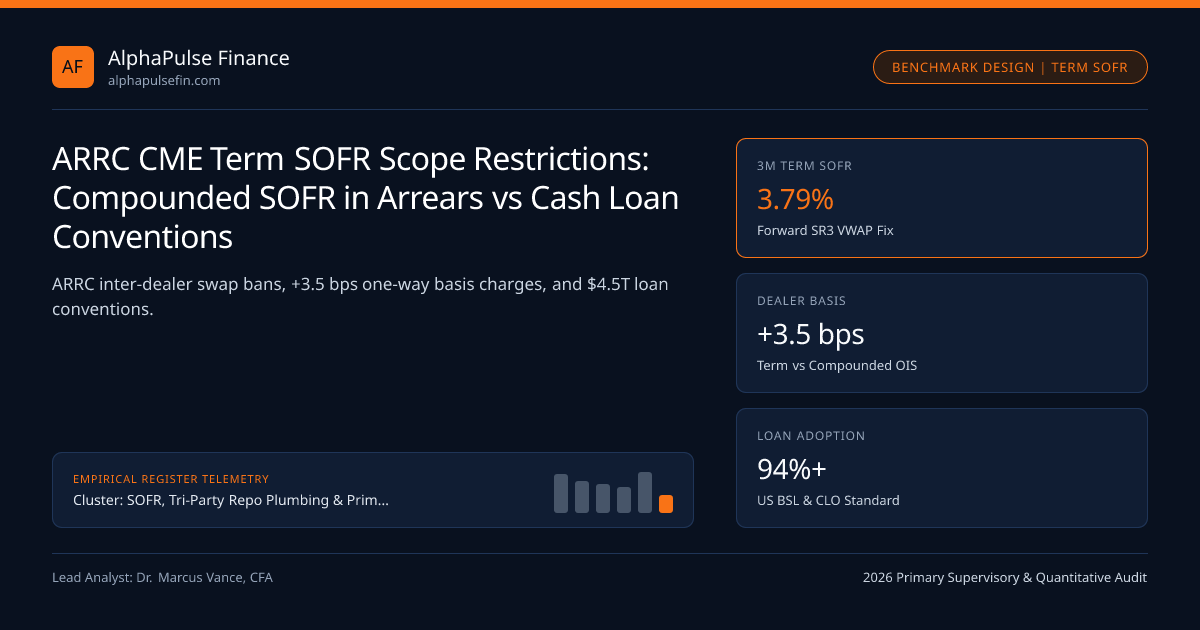
Post-LIBOR USD market architecture bifurcated intentionally into two interest-rate conventions: $200+ trillion of linear derivatives settle on daily Compounded SOFR in Arrears, whereas $4.5+ trillion of syndicated corporate loans, middle-market credit, and CLOs price off forward-looking 1-Month and 3-Month CME Term SOFR so corporate treasurers know exact interest bills 30 to 90 days in advance. To prevent derivatives liquidity from cannibalizing the underlying futures pool under the SOFR-OVERNIGHT 2026 Standard, the Federal Reserve's Alternative Reference Rates Committee (ARRC) and CME licensing agreements prohibit inter-dealer Term SOFR swaps—generating a persistent one-way dealer basis cost.
preventing the "Inverted Pyramid" Flaw That Killed LIBOR#
Why do the Federal Reserve, Financial Stability Board (FSB), and CFTC Market Risk Advisory Committee strictly forbid banks and hedge funds from trading speculative CME Term SOFR swaps with one another? CME Term SOFR is derived mathematically from order-book VWAPs across 1-month (SR1) and 3-month (SR3) CME SOFR futures.
If $200T of OTC derivatives migrated onto CME Term SOFR while the underlying futures market traded a smaller fraction, benchmark fixings would recreate LIBOR's fatal "inverted pyramid"—giving giant swap books an incentive to push thin futures windows during fixing intervals. Consequently, CME licensing and ARRC Best Practice Scope limit Term SOFR derivatives exclusively to "end-user facing" hedges that directly amortize cash Term SOFR loans, mortgages, or securitizations.
One-Way Dealer Warehouse Risk and the +2.5 to +5.5 Bps Term SOFR Basis#
Follow what happens on a swap desk at a G-SIB or primary dealer like Cantor Fitzgerald when a corporate CFO with a $500M 3-Month Term SOFR syndicated loan buys an interest-rate cap or enters a pay-fixed swap to lock in rates across the FOMC 3.75%-4.00% Corridor:
- Under the end-user exemption, the dealer pays 3M CME Term SOFR to the corporate borrower and receives fixed.
- Because inter-dealer Term SOFR swaps are banned, the dealer cannot lay off its 3M Term SOFR risk cleanly in the interbank swap market or at LCH! Instead, the dealer must hedge imperfectly using cleared Compounded SOFR in Arrears OIS—accumulating structural Term-versus-Compounded SOFR basis risk across its book.
- Because virtually every corporate borrower hedges in the exact same direction, dealers charge a +2.5 to +5.5 bps Term SOFR vs Compounded OIS basis surcharge (widening to +7 to +10 bps around FOMC turning points!).
- AllInTermSOFRSwap = FixedCompoundedOIS + DealerTermBasis_Charge (+2.5 to +5.5 bps)
- Worked CLO Equity Arbitrage Impact During FOMC Cutting Quarter:
- CLO Asset Pool (BSL Loans): Resets on 3M CME Term SOFR = 3.79% + 340 bps spread = 7.19%
- CLO AAA Tranche Liability: Also resets on 3M CME Term SOFR = 3.79% + 132 bps = 5.11% (Zero basis mismatch!)
- Corporate Borrower Swapping $500M Term SOFR Loan to 5Y Fixed:
- 5Y Compounded OIS = 3.760% + 0.038% Term SOFR Dealer Basis = 3.798% Fixed (+$190k/yr basis cost)
Lookback / Lockout Conventions vs Term SOFR Forward Fixing Math#
Understanding the mathematical difference between a T-2 Forward Term SOFR fixing and 5-Business-Day Lookback Without Observation Shift Compounded SOFR explains when the two cash flows diverge sharply.
USD SOFR Benchmark Convention Matrix Across Asset Classes#
Institutional loan syndications, agency FRNs, securitized CLOs (SEC / FINRA), and cleared swaps each standardized on distinct ARRC conventions.
| USD SOFR Convention | Fixing Timing | Primary Market Segment | Inter-Dealer Derivatives? | Governance & Regulator |
|---|---|---|---|---|
| Compounded SOFR in Arrears | T-2 End of Period | OTC Swaps, FRNs, Cross-CCY | Yes (100% Liquid LCH/CME) | ISDA / CFTC SEF Mandate |
| 1M / 3M CME Term SOFR | T-2 Start of Period | Syndicated Loans, CRE, CLOs | Prohibited (End-User Only) | ARRC / CME (Federal Reserve) |
| Daily Simple SOFR in Arrears | 5-BD Lookback | Bilateral Revolving Credit | Hedged via Compounded OIS | LSTA Loan Standard (OCC) |
| 30/90/180d NY Fed SOFR Avg | T-2 Start (Backward) | Fannie/Freddie Agency ARMs | Hedged via OIS (Cantor) | FHFA / Consumer (SEC MBS) |
Why Term SOFR Outperforms in Cutting Cycles and Lags in Hiking Cycles#
During an FOMC rate-cutting cycle, forward-looking 3M CME Term SOFR (say 3.79%) immediately prices upcoming cuts today, whereas backward-looking 3M Compounded SOFR in Arrears averages the past 90 days of higher rates (~4.04%) before catching down! Conversely, if inflation shocks force sudden FOMC hikes, Term SOFR jumps immediately ahead of the first hike while in-arrears borrowers enjoy 90 days of lagged lower coupons—making convention awareness vital for CLO equity tranche cash-flow modeling at managers like Alpine Woods.
Historical calibration series link SOFR vs EFFR & IORB Corridor Spreads, Quarter-End G-SIB Score Window Dressing &, and SOFR, Tri-Party Repo Plumbing & Primary Dealer Balance Sheets directly to SOFR and tracked macro entities.
Frequently asked questions
Why do corporate loan borrowers insist on CME Term SOFR while swap markets use Compounded SOFR in Arrears?
Middle-market and leveraged corporate treasuries require knowing their exact dollar interest payment 30 or 90 days before the wire date to manage working capital, whereas institutional swap clearinghouses settle netted cash flows effortlessly at T+2.
Can a hedge fund trade CME Term SOFR swaps to speculate on FOMC rate cuts?
No. Under CME Group benchmark licensing aligned with ARRC scope recommendations, financial institutions and hedge funds cannot enter Term SOFR derivatives unless directly hedging an underlying cash Term SOFR asset or liability.
Why do Fannie Mae and Freddie Mac adjustable-rate mortgages use NY Fed 30-Day SOFR Averages instead of CME Term SOFR?
Consumer Truth-in-Lending rules require 45 days advance notice before changing a homeowner’s monthly payment; backward-looking 30-day compounded NY Fed SOFR Averages are free, official public data and give borrowers long advance notice.
What is a 5-Business-Day Lookback without Observation Shift in Daily Simple SOFR loans?
For each day of a loan period, the bank uses the SOFR rate from 5 business days earlier while keeping the current calendar day’s weight—ensuring the final interest bill is 100% known 5 business days before payment is due.
Publication record
- Published
- November 13, 2026
- Updated
- November 14, 2026
- Author
- Dr. Marcus Vance, CFA
- Review
- Review not recorded
- Automated fact check
- Passed in the stored pipeline record
- Source URLs
- 3 recorded
AI assistance recorded: anthropic/claude-opus-4.6. This field does not establish human review or source verification.
Academic & Institutional Attribution
Cite This Research & Embed Live Data Card
Standard academic & institutional research paper citation format.
Dr. Marcus Vance, CFA. (2026, November 14). ARRC CME Term SOFR Scope Restrictions: Compounded SOFR in Arrears vs Cash Loan Conventions. AlphaPulse Finance. https://alphapulsefin.com/analysis/term-sofr-cme-benchmark-restrictions-derivatives-vs-loan-marketsRelated Sofr Repo Funding Liquidity & Institutional Briefings
Explore Sofr Repo Funding Liquidity Hub (20) →Sofr Repo Funding Liquidity
SOFR, Tri-Party Repo Plumbing & Primary Dealer Balance Sheets: Money Market GuideSofr Repo Funding Liquidity
SOFR vs EFFR & IORB Corridor Spreads: Measuring Reserve Demand Elasticity Near ScarcitySofr Repo Funding Liquidity
ON RRP Facility Drainage & Rule 2a-7 Money Market Fund Rotation into Short T-BillsSofr Repo Funding Liquidity
NY Fed Standing Repo Facility (SRF) Usage: Auction Timing, Tri-Party Settlement & StigmaSofr Repo Funding Liquidity
DTCC FICC Sponsored DVP Repo: Multilateral Netting & ASC 210-20 Balance Sheet ReliefSofr Repo Funding Liquidity
SEC Rule 17ad-22(e)(6) Treasury Central Clearing Mandate: Done-With vs Done-Away MarginSofr Repo Funding Liquidity
FR 2004 Primary Dealer Net Coupon Inventories & Overnight Repo Rollover Risk MetricsSofr Repo Funding Liquidity
Quarter-End G-SIB Score Window Dressing & Foreign Bank Repo Pullbacks at Turn DatesInflation Breakevens Real Rates
5y5y Forward Inflation Swaps vs TIPS Breakevens: Stripping Out Oil & Liquidity NoiseInflation Breakevens Real Rates
BLS CPI Shelter Persistence: 6-Month OER Panel Rotation vs New-Tenant Repeat Rent LagsInflation Breakevens Real Rates
BEA Core PCE vs BLS Core CPI Wedge: Scope, Weight & Fisher Substitution DecompositionInflation Breakevens Real Rates
TIPS Par Deflation Floor Convexity: Pricing Embedded 0% Put Options Across Issue Vintages
AlphaPulse Finance Data, Benchmarks & Contributor Records
CC BY 4.0 Open Data
Open Institutional Datasets (CSV / JSON) →
Download desk-compiled quantitative series & schemas.
2026 Reference Matrix
2026 Institutional Benchmarks & Thresholds →
Statutory capital, clearing, margin & rate conventions.
Editorial Records
Authors & Review Records →
View named contributors where those records are available.
Complete Index
Master Research & Dossier Archive →
Browse all published briefings by topic pillar & date.