
DTCC FICC Sponsored DVP Repo: Multilateral Netting & ASC 210-20 Balance Sheet Relief
Clearing over $1.45T daily, DTCC FICC Sponsored Repo enables primary dealers to net money market fund cash inflows against hedge fund reverse repos under ASC 210-20.
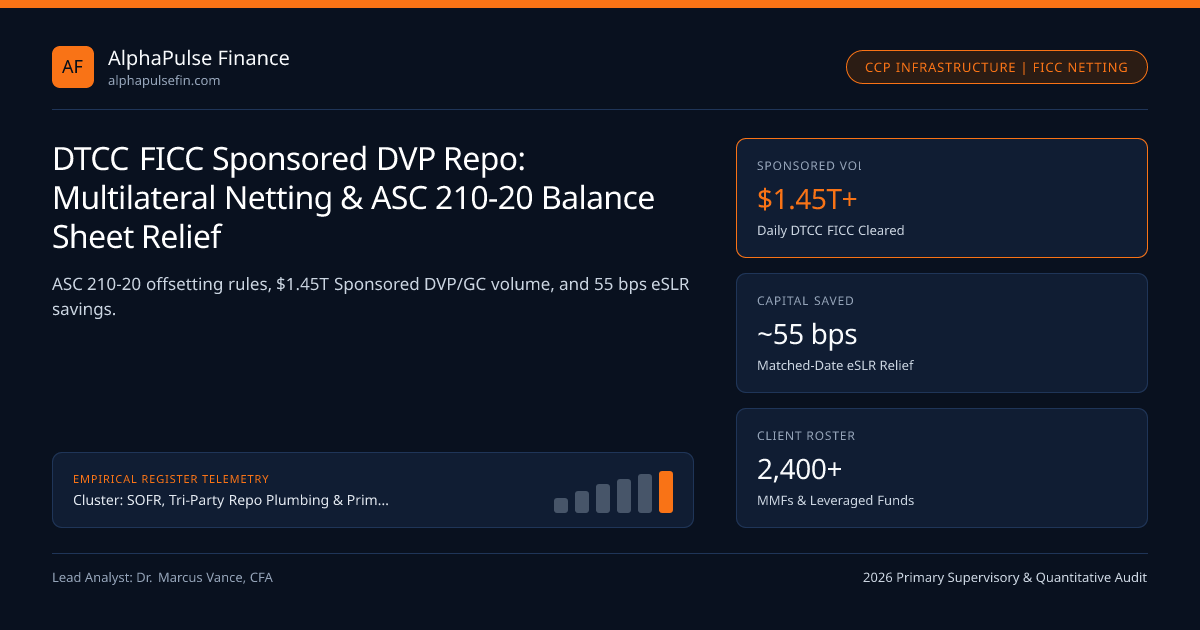
Without multilateral central clearinghouse netting, modern US Treasury market liquidity would suffocate under bank leverage capital caps. Today, over $1.45 trillion of daily overnight and term repo volume clears through the Depository Trust & Clearing Corporation's Fixed Income Clearing Corporation (FICC) Sponsored Service—allowing Netting Members (primary dealers such as Cantor Fitzgerald and G-SIB banks) to sponsor over 2,400 money market funds, sovereign wealth funds, and relative-value hedge funds into a single central counterparty (CCP) ledger that compresses Primary Dealer Balance Sheets while feeding SOFR.
US GAAP ASC 210-20-45-11 Balance Sheet Offsetting Criteria#
Under US GAAP (ASC 210-20-45-11) and IFRS (IAS 32), a broker-dealer can offset a reverse repurchase asset against a repurchase liability on its consolidated balance sheet—shrinking its Basel III Supplementary Leverage Ratio denominator to zero—only when four strict legal and operational conditions hold simultaneously:
- Both legs face the exact same legal counterparty (achieved only when FICC novates both trades as Central Counterparty).
- Both repo and reverse repo share the exact same maturity/settlement date (e.g., both overnight T+1 unwind).
- Legally enforceable master netting rights exist in bankruptcy.
- Both legs settle across the same securities settlement system (Fedwire Securities / FICC Clearing Bank account).
Before FICC expanded Sponsored Membership in 2017-2019 to allow Sponsoring Members to sponsor both cash-lending Rule 2a-7 MMFs and cash-borrowing hedge funds, a dealer borrowing from Fidelity in BNY Tri-Party and lending to Citadel bilaterally failed Criteria 1 and 4—inflating gross assets by 100%.
Sponsoring Member Guaranty Fund Economics vs Default Waterfall Risk#
Sponsored Members (the buy-side MMFs and hedge funds) do not contribute directly to FICC's mutualized Clearing Fund (Capped Contingency Liquidity Facility, or CCLF); instead, the Sponsoring Dealer guarantees its sponsored clients' performance to FICC and posts VaR initial margin under SEC Covered Clearing Agency rules.
In exchange for eliminating the 5.0% eSLR balance sheet charge (saving ~65 bps of capital cost), the dealer absorbs a much smaller Risk-Weighted Asset (RWA) default-fund capital charge (~4 to 7 bps annualized), passing on tighter bid-ask repo spreads (typically 3 to 6 bps between MMF cash in at 3.89% and hedge-fund cash out at 3.94%, near DTCC GCF).
- NetGAAPAssetsCleared = abs(SponsoredReverseT1 - SponsoredRepo_T1)
- AnnualSpreadCompression = ((GrossAssets - NetGAAPAssets) * eSLR * ROETarget) / Notional
- Worked $50B Matched Overnight Book Netting Economics:
- Unnetted Bilateral + Tri-Party: $50B leverage exposure * 5.0% eSLR = $2.50B equity -> 65.0 bps spread required
- FICC Sponsored ($50B Reverse T+1 vs $46B Repo T+1): Net exposure = $4.0B * 5.0% = $0.20B equity + $0.18B RWA
- Capital Cost Drops from 65.0 bps to ~9.9 bps -> 55.1 bps saved for Treasury market liquidity
Dealer Balance Sheet Netting Efficiency & RWA vs SLR Capital Math#
Quantifying the exact regulatory capital reduction per $100 billion of matched Sponsored Repo explains why Sponsored volume tripled between 2022 and 2026.

Sponsored DVP vs Sponsored General Collateral (GC) Comparison#
FICC offers two distinct Sponsored rails—CUSIP-specific DVP and basket-level Sponsored GC settled on BNY Tri-Party—serving different buy-side workflows alongside settlement networks like Bosonic.
| Clearing Modality | Collateral Allocation | ASC 210-20 Netting? | MMF Operational Burden | Oversight & Infrastructure |
|---|---|---|---|---|
| FICC Sponsored DVP | Specific CUSIP Fedwire | Yes (Matched Date) | Moderate (CUSIP Fails Risk) | DTCC FICC GSD (SEC Covered CCA) |
| FICC Sponsored GC | Generic UST Basket | Yes (FICC CCP) | Low (BNY Auto-Allocation) | BNY + FICC Link (Federal Reserve) |
| Traditional BNY Tri-Party | Generic Basket | No (Bilateral Legal) | Lowest (Legacy Standard) | Rule 2a-7 Funds (Ally Invest Sweeps) |
| FICC Agent Clearing (FCA) | Done-Away CUSIP/GC | Yes (For FCM/Dealer) | Multi-Dealer Execution | Independent Dealers (Cantor / FINRA) |
Done-With vs Done-Away Sponsored Execution Under SEC Clearing Rules#
Historically, 98% of FICC Sponsored Repo operated on a "Done-With" basis—meaning a hedge fund had to execute the repo trade with the exact same dealer sponsoring it into FICC. As SEC mandatory Treasury clearing takes full effect in 2026, buy-side participants demand "Done-Away" clearing—allowing a fund to get cleared sponsorship from Custodian Bank A while executing repo at tighter competitive rates with Independent Dealer B (FINRA member), unlocking multi-dealer price competition.
Adjacent curve and flow decompositions include SEC Rule 17ad-22(e)(6) Treasury Central Clearing Mandate and On-the-Run Treasury Specials in Repo, Fails-to-Deliver, anchored by SOFR, Tri-Party Repo Plumbing & Primary Dealer Balance Sheets, SOFR, and quantitative methodology.
Frequently asked questions
Why cant a primary dealer net an overnight MMF repo against a 1-month hedge fund reverse repo inside FICC?
ASC 210-20-45-11 strictly requires identical scheduled settlement/termination dates for balance sheet offsetting; an overnight obligation due tomorrow cannot offset a 30-day receivable under US GAAP.
Who pays if a Sponsored Hedge Fund defaults on a FICC Sponsored Repo?
The Sponsoring Member (the primary dealer or G-SIB bank) provides an unconditional guaranty to FICC for its sponsored clients’ obligations, relying on collateral liquidation and client margin to recover losses.
Why did money market funds initially prefer Sponsored GC over Sponsored DVP?
Sponsored DVP transfers individual specific Treasury CUSIPs over Fedwire, exposing MMFs to operational overdrafts or delivery fails if a CUSIP goes special; Sponsored GC allocates generic collateral baskets automatically on BNY Tri-Party.
What is the difference between FICC Sponsored Membership and FICC Agent Clearing?
Adapted from futures commission merchant (FCM) models, FICC’s Agent Clearing Service is streamlined to support "done-away" execution where a client trades repo with third-party dealers and clears centrally through its clearing agent.
Publication record
- Published
- November 14, 2026
- Updated
- November 14, 2026
- Author
- Dr. Marcus Vance, CFA
- Review
- Review not recorded
- Automated fact check
- Passed in the stored pipeline record
- Source URLs
- 3 recorded
AI assistance recorded: anthropic/claude-opus-4.6. This field does not establish human review or source verification.
Academic & Institutional Attribution
Cite This Research & Embed Live Data Card
Standard academic & institutional research paper citation format.
Dr. Marcus Vance, CFA. (2026, November 14). DTCC FICC Sponsored DVP Repo: Multilateral Netting & ASC 210-20 Balance Sheet Relief. AlphaPulse Finance. https://alphapulsefin.com/analysis/dtcc-ficc-sponsored-repo-multilateral-balance-sheet-nettingRelated Sofr Repo Funding Liquidity & Institutional Briefings
Explore Sofr Repo Funding Liquidity Hub (20) →Sofr Repo Funding Liquidity
SOFR, Tri-Party Repo Plumbing & Primary Dealer Balance Sheets: Money Market GuideSofr Repo Funding Liquidity
SEC Rule 17ad-22(e)(6) Treasury Central Clearing Mandate: Done-With vs Done-Away MarginSofr Repo Funding Liquidity
FR 2004 Primary Dealer Net Coupon Inventories & Overnight Repo Rollover Risk MetricsSofr Repo Funding Liquidity
Quarter-End G-SIB Score Window Dressing & Foreign Bank Repo Pullbacks at Turn DatesSofr Repo Funding Liquidity
Basel III Supplementary Leverage Ratio (SLR & eSLR) Constraints on Treasury Repo DealersSofr Repo Funding Liquidity
BNY Tri-Party vs FICC GCF & Bilateral DVP Repo: Funding Rate Segmentation & SpreadsSofr Repo Funding Liquidity
Federal Home Loan Bank (FHLB) Liquidity Arbitrage: Fed Funds Lending vs Discount WindowSofr Repo Funding Liquidity
On-the-Run Treasury Specials in Repo, Fails-to-Deliver & TMPG 300-Bps Penalty MechanicsCorporate Credit Spread Cycles
Covenant-Lite Liability Management Exercises (LMEs): Uptiers, Drop-Downs & Recovery CompressionCorporate Credit Spread Cycles
IG Primary Bond New-Issue Concession (NIC): Orderbook Oversubscription & Syndicate CompressionCorporate Credit Spread Cycles
FINRA TRACE Block Dissemination Caps & Automated Credit Portfolio Trading MicrostructureCorporate Credit Spread Cycles
Fixed-Income Credit ETF Create/Redeem Arbitrage: Custom Baskets & Stale-NAV Liquidity Discovery
AlphaPulse Finance Data, Benchmarks & Contributor Records
CC BY 4.0 Open Data
Open Institutional Datasets (CSV / JSON) →
Download desk-compiled quantitative series & schemas.
2026 Reference Matrix
2026 Institutional Benchmarks & Thresholds →
Statutory capital, clearing, margin & rate conventions.
Editorial Records
Authors & Review Records →
View named contributors where those records are available.
Complete Index
Master Research & Dossier Archive →
Browse all published briefings by topic pillar & date.