
BNY Tri-Party vs FICC GCF & Bilateral DVP Repo: Funding Rate Segmentation & Spreads
Persistent +6.5 bps spreads between DTCC FICC GCF (3.94%) and BNY Tri-Party repo (3.875%) reflect collateral specificity, settlement cutoffs, and credit tiering across US money markets.
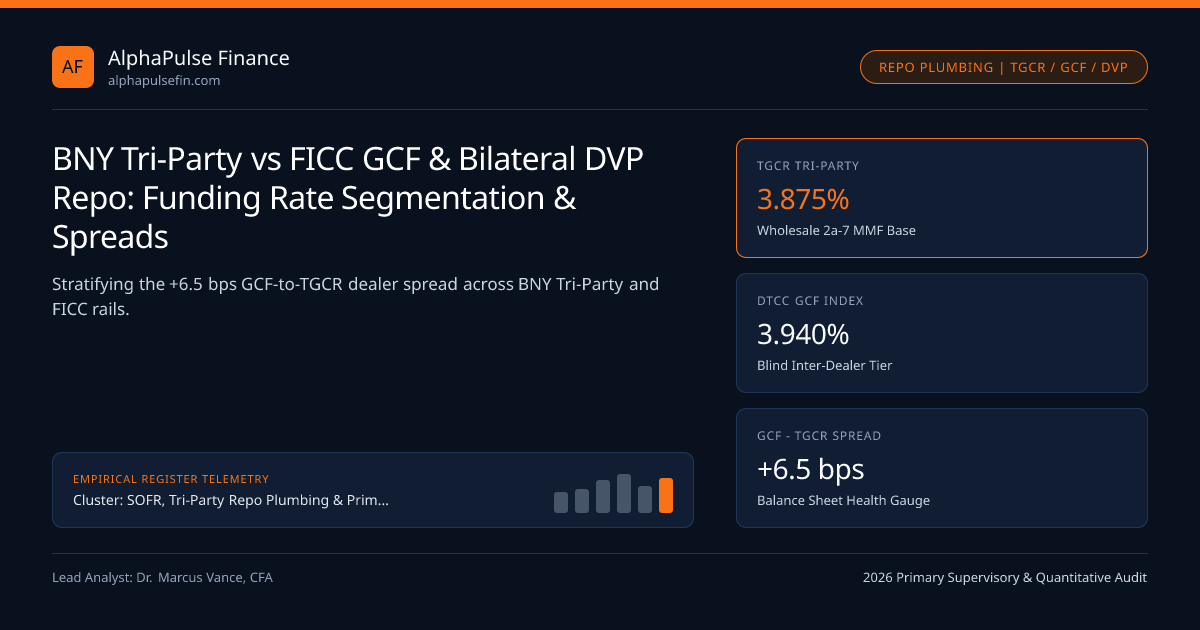
Although all three underlying data feeds are 100% backed by US Treasury securities and combined each morning into SOFR (3.91%), overnight funding rates systematically stratify into three distinct tiers: BNY Mellon Tri-Party General Collateral clears near 3.875%, FICC Cleared Delivery-versus-Payment (DVP) clears near 3.920% (after bottom-quartile specials trimming), and the DTCC General Collateral Finance (GCF) Repo Index clears at 3.940% under the GCF-REPO 2026 Standard. That +6.5 bps structural spread measures the exact liquidity friction between wholesale cash-rich money market funds and collateral-heavy smaller dealers.
Operational Mechanics of the Three Core Domestic Repo Rails#
Each venue solves a different institutional settlement problem:
- Traditional BNY Tri-Party Repo (~$1.05T ex-Fed): Cash lenders (overwhelmingly SEC Rule 2a-7 MMFs, corporate treasuries, and securities-lending cash pools) care solely about safe overnight cash yield, not which specific Treasury CUSIP they receive. Both cash and generic Treasury baskets stay strictly inside BNY Mellon's internal custodial books—avoiding external Fedwire Securities transfer fees and operational fails.
- DTCC FICC GCF Repo (~$195B-$260B): An anonymous, blind-brokered inter-dealer general-collateral market executed via inter-dealer brokers (such as Cantor Fitzgerald/BGC or Tradition) and netted by FICC, settled on BNY's tri-party platform. Smaller and mid-tier dealers lacking direct Rule 2a-7 MMF relationships pay +6.5 bps over Tri-Party in GCF to borrow wholesale cash from tier-1 G-SIB dealers.
- FICC Cleared DVP Repo (~$1.45T gross): Specific-CUSIP bilateral trades transferred across Fedwire Securities or FICC clearing accounts, used both to borrow scarce individual CUSIPs ("specials") and to finance leveraged Sponsored clients.
Post-Reform 3:30 PM Tri-Party "Afternoon Unwind" Elimination#
Prior to the Federal Reserve-led Tri-Party Repo Infrastructure Reform Task Force, BNY Mellon and JPMorgan returned 100% of overnight repo collateral to dealers at 8:30 AM ET every morning—extending trillions of dollars of uncollateralized intraday credit from clearing banks to Lehman-style broker-dealers until new repos settled at 5:00 PM!
Modern Auto-Substitution and Rolling Settlement eliminated almost 97% of clearing-bank intraday credit: continuing and rolling Tri-Party repos stay locked on BNY's books throughout the business day until 3:30 PM ET, swapping out individual sold CUSIPs simultaneously against fresh eligible collateral without returning raw cash early.
- DVPPullEffect_bps = (SOFR - BGCR) * 100
- Worked Morning NY Fed Reference Rate Decomposition:
- TGCR (Pure Tri-Party): 3.875% | GCF Repo Index: 3.940% | BGCR: 3.885% | SOFR: 3.910%
- Dealer Balance Sheet Intermediation Wedge = (3.940% - 3.875%) * 100 = +6.5 bps
- Bilateral/Sponsored DVP Demand Pull = (3.910% - 3.885%) * 100 = +2.5 bps (lifts SOFR above pure GC)
GCF-Minus-Tri-Party Intermediation Spread & SOFR Weighting Math#
Because SOFR computes the dollar-weighted 50th percentile across the union of all three segments, shifts in relative volume between lower-rate Tri-Party and higher-rate FICC DVP/GCF mechanically pull median SOFR up or down within the corridor.
Three-Rail US Treasury Repo Comparison Matrix#
Institutional treasurers and collateral networks (FINRA / Bosonic) select execution rails based on whether the trade is driven by cash investment or specific bond sourcing.
| NY Fed / DTCC Index | Underlying Repo Venues | Q4 2026 Level | Specials Included? | Primary Analytical Application |
|---|---|---|---|---|
| TGCR (Tri-Party GC) | BNY Tri-Party Only | 3.875% | No (Basket GC) | Wholesale MMF cash lending floor (SEC 2a-7) |
| BGCR (Broad GC) | BNY Tri-Party + FICC GCF | 3.885% | No (Basket GC) | Pure collateral-supply benchmark (Federal Reserve) |
| DTCC GCF Repo (GCF-REPO) | FICC Blind Inter-Dealer | 3.940% | No (Generic UST) | Marginal dealer balance sheet cost (Cantor) |
| SOFR (SOFR-OVERNIGHT) | TGCR + GCF + 75% FICC DVP | 3.910% | Trimmed (<25th Cut) | Global $200T+ derivatives & loan index (CFTC) |
Monitoring the GCF-Tri-Party Spread as a Real-Time Stress Barometer#
During calm ample-reserve sessions, the GCF - TGCR spread (where TGCR, the NY Fed's Tri-Party General Collateral Rate, tracks pure BNY Tri-Party at ~3.875%) hovers steadily between +4 and +8 bps. Whenever GCF - TGCR breaks above +15 bps outside a calendar quarter-end, it warns macro desks immediately that tier-1 bank dealers have hit internal balance sheet or VaR limits and stopped passing MMF liquidity downstream to non-bank broker-dealers.
Execution desks cross-check these sensitivities via Federal Home Loan Bank (FHLB) Liquidity Arbitrage, EUR/USD & USD/JPY Cross-Currency Basis Swaps, and SOFR, Tri-Party Repo Plumbing & Primary Dealer Balance Sheets, curated on SOFR and covered institutions.
Frequently asked questions
What is the difference between TGCR, BGCR, and SOFR published by the New York Fed?
TGCR measures pure BNY Tri-Party general collateral trades; BGCR adds blind-brokered FICC GCF general collateral trades; SOFR adds the upper 75% of specific-issue FICC Cleared DVP repo trades, capturing the broadest $2.25T+ pool.
Why did JPMorgan Chase exit the Tri-Party repo clearing business, leaving BNY Mellon as sole agent?
Heightened G-SIB capital surcharges and strict supervisory intraday liquidity requirements made operating a dual-utility tri-party clearing bank low-ROE for JPMorgan, consolidating US tri-party custody at BNY Mellon by 2018.
Why does SOFR print 2.5 bps higher than BGCR (Broad General Collateral Rate)?
SOFR includes $1T+ of FICC Cleared and Sponsored DVP trades where leveraged hedge funds and dealers pay higher bilateral rates (~3.92%-3.96%) to finance specific bond positions, pulling the overall median above pure GC.
What was the pre-2014 "8:30 AM Tri-Party Unwind" vulnerability?
Historically, tri-party banks returned cash to MMFs and collateral to dealers every morning at 8:30 AM, funding dealers on unsecured intraday clearing-bank credit for 8 hours—creating systemic run risk if the clearing bank balked.
Publication record
- Published
- November 14, 2026
- Updated
- November 14, 2026
- Author
- Dr. Marcus Vance, CFA
- Review
- Review not recorded
- Automated fact check
- Passed in the stored pipeline record
- Source URLs
- 3 recorded
AI assistance recorded: anthropic/claude-opus-4.6. This field does not establish human review or source verification.
Academic & Institutional Attribution
Cite This Research & Embed Live Data Card
Standard academic & institutional research paper citation format.
Dr. Marcus Vance, CFA. (2026, November 14). BNY Tri-Party vs FICC GCF & Bilateral DVP Repo: Funding Rate Segmentation & Spreads. AlphaPulse Finance. https://alphapulsefin.com/analysis/tri-party-bnym-vs-ficc-gcf-bilateral-dvp-repo-segmentationRelated Sofr Repo Funding Liquidity & Institutional Briefings
Explore Sofr Repo Funding Liquidity Hub (20) →Sofr Repo Funding Liquidity
SOFR, Tri-Party Repo Plumbing & Primary Dealer Balance Sheets: Money Market GuideSofr Repo Funding Liquidity
Federal Home Loan Bank (FHLB) Liquidity Arbitrage: Fed Funds Lending vs Discount WindowSofr Repo Funding Liquidity
On-the-Run Treasury Specials in Repo, Fails-to-Deliver & TMPG 300-Bps Penalty MechanicsSofr Repo Funding Liquidity
OFR Non-Centrally Cleared Bilateral Repo (NCCBR) Data: Zero-Haircut Hedge Fund LeverageSofr Repo Funding Liquidity
CME 3-Month vs 1-Month SOFR Futures: Rate-Volatility Convexity Bias vs Forward OISSofr Repo Funding Liquidity
Corporate Tax Deadlines, TGA Inflows & SOFR 99th-Percentile Intraday Funding SpikesSofr Repo Funding Liquidity
SEC Rule 2a-7 WAM/WAL Caps & Mandatory Liquidity Fees Across Government and Prime MMFsSofr Repo Funding Liquidity
EUR/USD & USD/JPY Cross-Currency Basis Swaps: Offshore Synthetic Dollar Funding vs SOFRCorporate Credit Spread Cycles
Private Credit Unitranche PIK Toggles & BDC Non-Accrual Dispersion: Shadow Default AuditCorporate Credit Spread Cycles
Merton Structural Distance-to-Default: Equity Put Skew Leading Corporate Credit SpreadsCorporate Credit Spread Cycles
US IG Corporate 10s30s Credit Curve Flattening: Insurer Annuity Demand & Dollar-Price ConvexityCorporate Credit Spread Cycles
ISDA Credit Event Auctions, Cheapest-to-Deliver Bonds & Orphan CDS Risk After LMEs
AlphaPulse Finance Data, Benchmarks & Contributor Records
CC BY 4.0 Open Data
Open Institutional Datasets (CSV / JSON) →
Download desk-compiled quantitative series & schemas.
2026 Reference Matrix
2026 Institutional Benchmarks & Thresholds →
Statutory capital, clearing, margin & rate conventions.
Editorial Records
Authors & Review Records →
View named contributors where those records are available.
Complete Index
Master Research & Dossier Archive →
Browse all published briefings by topic pillar & date.