
Federal Home Loan Bank (FHLB) Liquidity Arbitrage: Fed Funds Lending vs Discount Window
Supplying over 85% of daily unsecured federal funds volume, the $1.2T Federal Home Loan Bank system bridges GSE money market cash to foreign bank IORB arbitrage and regional bank advances.
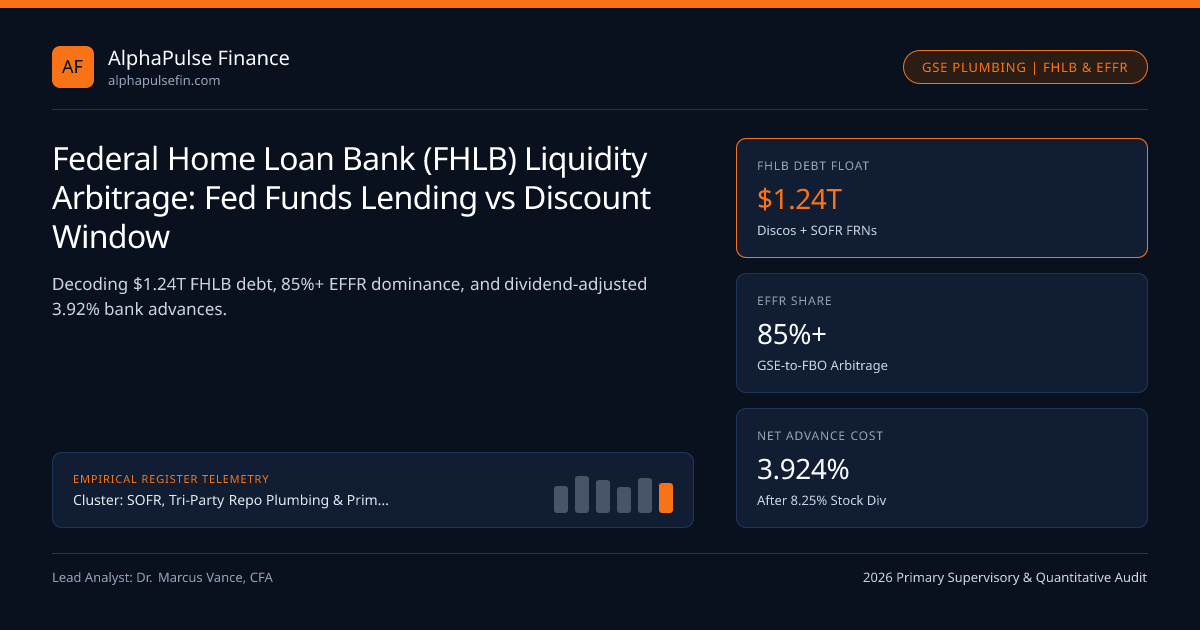
Standing at roughly $1.24 trillion in consolidated debt across 11 regional cooperatives, the Federal Home Loan Bank (FHLB) System acts simultaneously as the primary marginal cash lender setting the 3.88% Effective Federal Funds Rate (EFFR) inside the FOMC 3.75%-4.00% Corridor and as the "lender of next-to-last resort" to US commercial banks and insurers. Because statutory rules bar Government-Sponsored Enterprises (GSEs) from earning 3.90% Interest on Reserve Balances (IORB) on their Fed master accounts, FHLBs park ~$140B-$180B of mandatory liquidity buffers in unsecured federal funds at 3.88% and SOFR Repo above the 3.75% ON RRP Floor.
Why Non-IORB GSE Status Sustains the Modern Federal Funds Market#
Under Federal Housing Finance Agency (FHFA) liquidity rules, the 11 FHLBs must maintain days-of-liquidity cash buffers to meet member bank Advance requests on same-day Fedwire notice. Although FHLBs hold reserve accounts at the Federal Reserve, Congress never authorized the Fed to pay IORB to GSEs—meaning cash left idle at the Fed earns 0.00%!
To avoid 0% yield while preserving 8:30 AM ET early-morning liquidity return (much earlier than BNY Tri-Party repo), FHLBs lend $75B-$85B daily in unsecured overnight federal funds at 3.88%—supplying over 85% of total EFFR volume—almost exclusively to New York branches of high-rated Canadian, European, and Japanese banks that deposit the funds straight back into 3.90% IORB accounts.
FHLB Discount Notes, Regional Bank Runs, and Super-Lien Priority#
During the Q1 2023 regional banking turmoil, FHLB advances surged past $1.04 trillion as stressed depositories tapped FHLB credit lines rather than the Fed's Discount Window—relying on the FHLBs' statutory super-lien priority ahead of the FDIC Deposit Insurance Fund. How did FHLBs raise $300B+ in weeks? By issuing short-term FHLB Discount Notes ("Discos") and SOFR-indexed floating-rate bonds straight to SEC Rule 2a-7 government money market funds.
Notice the circular liquidity loop: frightened uninsured depositors pulled cash out of regional banks into government MMFs (via brokerage sweeps like Ally Invest), MMFs bought FHLB Discount Notes yielding SOFR + 4 bps, and FHLBs lent that exact cash back to the same regional banks at ~SOFR + 22 bps—replacing zero-cost deposits with expensive wholesale debt!
- EFFRBargainingNash = ONRRPRate + theta * (IORB - ONRRPRate)
- Worked FHLB Dividend-Adjusted Advance Cost vs 4.00% Fed Discount Window:
- Headline Overnight Advance Rate: 4.12% | Activity Stock Requirement: 4.50% of advance
- FHLB Stock Dividend: 8.25% vs 3.90% Bank Opportunity Cost -> Net Rebate = 0.045 * (8.25% - 3.90%) = +0.196% (19.6 bps)
- Effective Net Advance Cost = 4.12% - 0.196% = 3.924% (7.6 bps CHEAPER than 4.00% Discount Window!)
FHLB Disco-to-Advance Spread & EFFR Arbitrage Equilibrium Math#
Post-2023 FHFA "FHLB System at 100" supervisory reforms restrict distressed over-reliance on FHLB advances and require banks supervised by the OCC to maintain operational Discount Window collateral alongside FHLB lines.
GSE Liquidity Chain vs Central Bank Backstop Matrix#
Comparing FHLB funding costs, MMF eligibility, and bank collateral haircuts shows why healthy banks still favor short FHLB advances for routine intraday treasury smoothing.
| Funding / Liquidity Channel | Headline Rate | Activity Stock Requirement | Public Stigma | Oversight & Counterparty |
|---|---|---|---|---|
| FHLB Member Advance | 4.12% (Net ~4.00%) | 4.0% - 4.5% Stock Purchase | Zero (Routine ALM) | FHFA / FDIC Super-Lien |
| Fed Discount Window | 4.00% Primary | 0% Capital Stock Required | Historically High (Falling) | Federal Reserve / OCC |
| FHLB Fed Funds Sold | 3.88% EFFR | Unsecured Credit Line | None (FBO Arbitrage) | Canadian / Euro FBOs (OSFI) |
| FHLB Discount Notes | 3.90% - 3.94% | GSE Joint & Several Debt | Benchmark Cash Asset | SEC Rule 2a-7 Gov MMFs |
FHFA Credit Tightenings and SOFR Floating-Rate Note Issuance#
Over 65% of FHLB consolidated bonds now issue as callable or bullet SOFR-linked Floating Rate Notes (FRNs) underwritten by dealers like Cantor Fitzgerald. Whenever regional bank loan growth slows or FHFA caps single-borrower advance ratios (such as limiting advances to 30%-40% of member assets), FHLB Disco supply contracts—richening short agency discount notes to 2-4 bps through matched-maturity T-bills.
Upstream pillar coverage resides in SOFR, Tri-Party Repo Plumbing & Primary Dealer Balance Sheets, complemented by On-the-Run Treasury Specials in Repo, Fails-to-Deliver, Fedwire Securities Settlement Timing, Daylight Overdrafts, SOFR, and regulatory bodies.
Frequently asked questions
Why do commercial banks often prefer FHLB advances at 4.12% over the 4.00% Fed Discount Window?
Borrowers must buy 4.0%-4.5% in FHLB capital stock paying an ~8.0%-8.5% dividend; that dividend rebate shaves 15 to 20 bps off headline advance rates, dropping net borrowing cost below 4.00% with zero stigma.
What is the FHLB statutory super-lien and why does the FDIC scrutinize it?
Under the Federal Home Loan Bank Act, FHLB blanket liens on a failed bank’s mortgage collateral rank senior to the FDIC Deposit Insurance Fund, increasing losses borne by the FDIC when an advance-heavy bank fails.
Are FHLB Discount Notes eligible for SEC Rule 2a-7 Government Money Market Funds?
Yes. Debt issued by Government-Sponsored Enterprises (FHLBs, Fannie Mae, Freddie Mac, Farm Credit) qualifies as "government securities" alongside US Treasuries for Rule 2a-7 government MMFs.
Why do FHLBs still lend unsecured federal funds at 3.88% when SOFR repo pays 3.91%?
Unsecured federal funds borrowers return cash via Fedwire by 8:30 AM ET—giving FHLBs immediate morning cash to fund member bank advances—whereas Tri-Party repo cash often stays locked until afternoon unwind.
Publication record
- Published
- November 14, 2026
- Updated
- November 14, 2026
- Author
- Dr. Marcus Vance, CFA
- Review
- Review not recorded
- Automated fact check
- Passed in the stored pipeline record
- Source URLs
- 3 recorded
AI assistance recorded: anthropic/claude-opus-4.6. This field does not establish human review or source verification.
Academic & Institutional Attribution
Cite This Research & Embed Live Data Card
Standard academic & institutional research paper citation format.
Dr. Marcus Vance, CFA. (2026, November 14). Federal Home Loan Bank (FHLB) Liquidity Arbitrage: Fed Funds Lending vs Discount Window. AlphaPulse Finance. https://alphapulsefin.com/analysis/federal-home-loan-bank-fhlb-advances-fed-funds-arbitrageRelated Sofr Repo Funding Liquidity & Institutional Briefings
Explore Sofr Repo Funding Liquidity Hub (20) →Sofr Repo Funding Liquidity
SOFR, Tri-Party Repo Plumbing & Primary Dealer Balance Sheets: Money Market GuideSofr Repo Funding Liquidity
On-the-Run Treasury Specials in Repo, Fails-to-Deliver & TMPG 300-Bps Penalty MechanicsSofr Repo Funding Liquidity
OFR Non-Centrally Cleared Bilateral Repo (NCCBR) Data: Zero-Haircut Hedge Fund LeverageSofr Repo Funding Liquidity
CME 3-Month vs 1-Month SOFR Futures: Rate-Volatility Convexity Bias vs Forward OISSofr Repo Funding Liquidity
Corporate Tax Deadlines, TGA Inflows & SOFR 99th-Percentile Intraday Funding SpikesSofr Repo Funding Liquidity
SEC Rule 2a-7 WAM/WAL Caps & Mandatory Liquidity Fees Across Government and Prime MMFsSofr Repo Funding Liquidity
EUR/USD & USD/JPY Cross-Currency Basis Swaps: Offshore Synthetic Dollar Funding vs SOFRSofr Repo Funding Liquidity
Fedwire Securities Settlement Timing, Daylight Overdrafts & Intraday LCR Buffer TrapsCorporate Credit Spread Cycles
Merton Structural Distance-to-Default: Equity Put Skew Leading Corporate Credit SpreadsCorporate Credit Spread Cycles
US IG Corporate 10s30s Credit Curve Flattening: Insurer Annuity Demand & Dollar-Price ConvexityCorporate Credit Spread Cycles
ISDA Credit Event Auctions, Cheapest-to-Deliver Bonds & Orphan CDS Risk After LMEsCorporate Credit Spread Cycles
US G-SIB TLAC HoldCo vs OpCo Credit Spreads: SPOE Bail-In Subordination & Call Optionality
AlphaPulse Finance Data, Benchmarks & Contributor Records
CC BY 4.0 Open Data
Open Institutional Datasets (CSV / JSON) →
Download desk-compiled quantitative series & schemas.
2026 Reference Matrix
2026 Institutional Benchmarks & Thresholds →
Statutory capital, clearing, margin & rate conventions.
Editorial Records
Authors & Review Records →
View named contributors where those records are available.
Complete Index
Master Research & Dossier Archive →
Browse all published briefings by topic pillar & date.