
CME 3-Month vs 1-Month SOFR Futures: Rate-Volatility Convexity Bias vs Forward OIS
Daily zero-discounting mark-to-market on CME 3-Month SOFR futures (SR3) creates a positive convexity bias reaching +8 to +19 bps above 3-to-5-year forward SOFR OIS swaps.
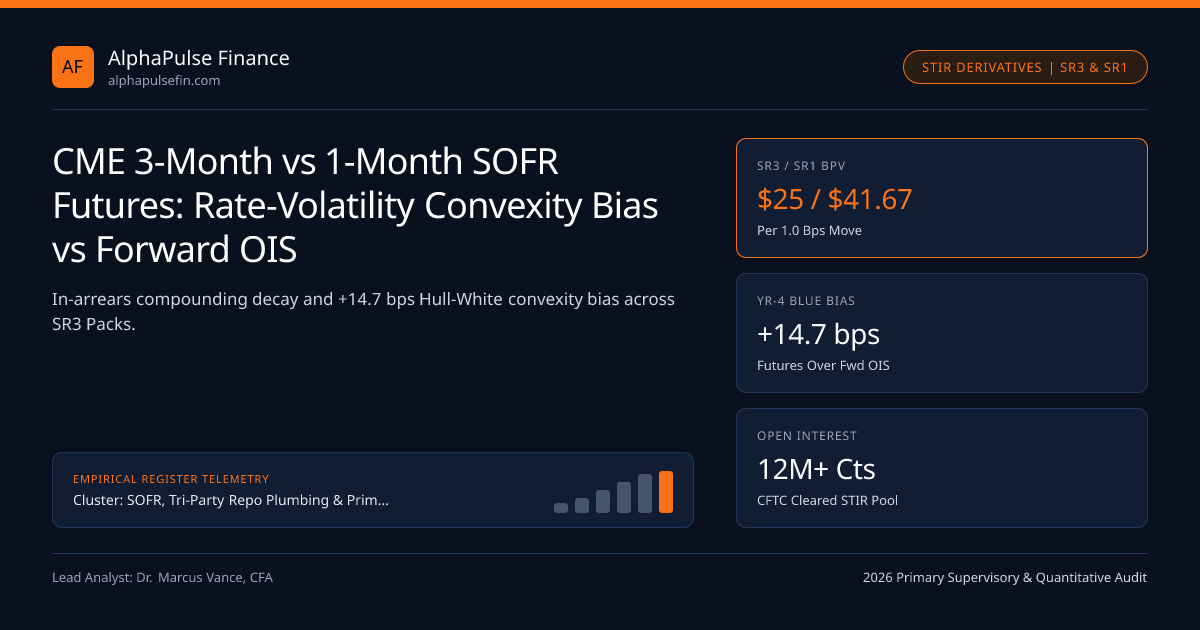
Following the June 2023 extinction of ICE LIBOR and Eurodollar futures, CME 3-Month SOFR Futures (SR3) and 1-Month SOFR Futures (SR1) became the world's deepest Short-Term Interest Rate (STIR) derivatives complex—exceeding 12 million contracts of open interest under CFTC oversight. Unlike forward-looking Eurodollars that locked in a rate before the quarter began, SR3 settles backward-looking to daily compounded SOFR under the SOFR-OVERNIGHT 2026 Standard—and requires an explicit Hull-White futures-versus-forward convexity adjustment before comparing Reds, Greens, and Blues to forward FOMC OIS swaps.
SR1 Arithmetic Average ($41.67/bp) vs SR3 Compounded-in-Arrears ($25.00/bp)#
Traders must distinguish two critical contract mechanics between front-end SR1 and quarterly IMM SR3:
- 1-Month SOFR (SR1, $5M Notional, $41.67/bp): Settles to the simple arithmetic average of daily SOFR across a single calendar month (
100 - R_mean). Because calendar months align cleanly with single FOMC dates and quarter-end turns, SR1 dominates 1-to-6-month policy timing. - 3-Month SOFR (SR3, $1M Notional, $25.00/bp): Spans IMM Wednesday-to-Wednesday quarters (March, June, September, December) and settles to daily compounded SOFR in arrears.
Crucially, during the active "front-quarter" SR3 contract currently in accrual, each morning's 8:00 AM ET SOFR fixing permanently locks in 1/90th of the final settlement index! Consequently, front-quarter SR3 empirical DV01 decays linearly by ~1.1% every business day—requiring hedge ratios at futures commission merchants (NFA / Capitals Gain) to scale contract counts upward dynamically.
Why Futures-vs-Forward OIS Convexity Bias Grows With T-Squared and Volatility#
Why does a 4-year-ahead ("Blue" pack) SR3 futures contract systematically price an implied rate +12 to +19 bps higher than the identical 3-month forward SOFR OIS swap cleared at LCH or CME? Futures contracts pay linear $25.00/bp cash variation margin immediately today without present-value discounting, whereas a forward OIS swap pays off at T + 0.25 years discounted at the prevailing yield curve!
When interest rates rise (SR3 price falls), a short SR3 futures trader immediately receives variation margin cash and reinvests it at higher prevailing SOFR rates; when rates fall, the short funds variation outflows at lower rates. To neutralize that asymmetric reinvestment advantage favoring the short seller, arbitrageurs bid down deferred SR3 futures prices—lifting futures-implied rates above true forward OIS expectations in direct proportion to normal rate variance (sigma^2) and horizon T_1 * T_2.
- ForwardOISRate = (100 - SR3Price) / 100 - ConvexityBias(T1, T2, sigmaN, aMeanRev)
- InArrearsSR3Rate = (PROD{i=1..Ndays} (1 + SOFRi * di / 360) - 1) * (360 / DQuarter)
- Worked Year-4 "Blue" SR3 Convexity Adjustment (T1 = 3.75 yrs, T2 = 4.00 yrs, sigma_N = 0.0096, Hull-White damp = 0.85):
- Unadjusted Simple Bias = 0.5 * (0.0096)^2 * 3.75 * 4.00 = 0.000691 (6.91 bps) -> Full BGM/HW w/ corr = +14.7 bps
- If Blue SR3 Futures Price = 96.090 (Raw Rate = 3.910%):
- True Market-Implied Forward 3M SOFR OIS = 3.910% - 0.147% = 3.763%
Hull-White SOFR Futures Convexity Bias & Accrual Decay Equations#
Stripping out convexity bias prevents macro analysts from falsely concluding deferred SR3 Blues/Golds are pricing FOMC rate hikes when the OIS curve is actually flat!
CME SOFR Futures Pack Color Coding & Convexity Adjustment Table#
Institutional STIR desks and primary dealers like Cantor Fitzgerald quote four-contract annual strips ("Packs": Whites, Reds, Greens, Blues, Golds) against OTC swap curves.
| CME STIR Contract / Pack | Horizon / Notional | Raw Futures Rate | Convexity Bias | Pure Implied Forward OIS |
|---|---|---|---|---|
| 1M SOFR Future (SR1) | Calendar Month / $5M | 3.905% | < +0.1 bps | 3.905% (CFTC Turn Hedge) |
| SR3 Whites Pack (Yr 1) | IMM Q1-Q4 / $1M | 3.680% | +0.9 bps | 3.671% (NFA FOMC Path) |
| SR3 Greens Pack (Yr 3) | IMM Q9-Q12 / $1M | 3.795% | +8.6 bps | 3.709% (Cantor Swap Desk) |
| SR3 Blues Pack (Yr 4) | IMM Q13-Q16 / $1M | 3.910% | +14.7 bps | 3.763% (Federal Reserve OIS) |
Mid-Curve SOFR Options and Conditional Bear/Bull Flattener Structures#
CME 1-Year and 2-Year Mid-Curve Options on Green and Blue SR3 contracts (options expiring in 6-12 months that deliver a 3-year-deferred SR3 future) allow macro funds to express low-cost views on terminal r* repricing with defined upfront premium, capturing rapid convexity-bias expansion whenever swaption normal volatility jumps +20 bps.
Fixed-income and equity strategists align these metrics with SOFR, Tri-Party Repo Plumbing & Primary Dealer Balance Sheets, Corporate Tax Deadlines, TGA Inflows &, SOFR vs EFFR & IORB Corridor Spreads, SOFR, and macro benchmarks.
Frequently asked questions
How do backward-looking SOFR futures (SR3) differ from retired Eurodollar futures?
Eurodollar futures settled on a single day’s forward-looking 3-month LIBOR survey at the start of the quarter, whereas SR3 continues trading throughout the entire 3-month quarter as daily realized SOFR fixings compound in arrears.
What are Whites, Reds, Greens, Blues, and Golds in CME SOFR futures?
Inherited from Eurodollar pit color-coding, each color denotes a consecutive 4-quarter (1-year) strip of SR3 contracts: Whites (Year 1), Reds (Year 2), Greens (Year 3), Blues (Year 4), and Golds (Year 5).
Why does ignoring convexity bias make deferred SOFR futures look artificially hawkish?
Because futures variation margin is settled immediately without discounting, shorts enjoy positive correlation between cash gains and reinvestment rates—pushing Year 4-5 futures rates 15 to 22 bps above unbiased forward swap rates.
Why do traders use SR1 instead of SR3 to trade a single upcoming FOMC meeting?
A single calendar-month SR1 contract spans ~30 days around one FOMC date without picking up adjacent meetings, whereas a 90-day SR3 contract blends two or three FOMC meetings together.
Publication record
- Published
- November 13, 2026
- Updated
- November 14, 2026
- Author
- Dr. Marcus Vance, CFA
- Review
- Review not recorded
- Automated fact check
- Passed in the stored pipeline record
- Source URLs
- 3 recorded
AI assistance recorded: anthropic/claude-opus-4.6. This field does not establish human review or source verification.
Academic & Institutional Attribution
Cite This Research & Embed Live Data Card
Standard academic & institutional research paper citation format.
Dr. Marcus Vance, CFA. (2026, November 14). CME 3-Month vs 1-Month SOFR Futures: Rate-Volatility Convexity Bias vs Forward OIS. AlphaPulse Finance. https://alphapulsefin.com/analysis/cme-sofr-futures-convexity-bias-eurodollar-transition-hedgingRelated Sofr Repo Funding Liquidity & Institutional Briefings
Explore Sofr Repo Funding Liquidity Hub (20) →Sofr Repo Funding Liquidity
SOFR, Tri-Party Repo Plumbing & Primary Dealer Balance Sheets: Money Market GuideSofr Repo Funding Liquidity
Corporate Tax Deadlines, TGA Inflows & SOFR 99th-Percentile Intraday Funding SpikesSofr Repo Funding Liquidity
SEC Rule 2a-7 WAM/WAL Caps & Mandatory Liquidity Fees Across Government and Prime MMFsSofr Repo Funding Liquidity
EUR/USD & USD/JPY Cross-Currency Basis Swaps: Offshore Synthetic Dollar Funding vs SOFRSofr Repo Funding Liquidity
Fedwire Securities Settlement Timing, Daylight Overdrafts & Intraday LCR Buffer TrapsSofr Repo Funding Liquidity
Federal Reserve Discount Window Readiness: Pre-Positioned Collateral Valuation & HaircutsSofr Repo Funding Liquidity
ARRC CME Term SOFR Scope Restrictions: Compounded SOFR in Arrears vs Cash Loan ConventionsSofr Repo Funding Liquidity
SOFR vs EFFR & IORB Corridor Spreads: Measuring Reserve Demand Elasticity Near ScarcityCorporate Credit Spread Cycles
US G-SIB TLAC HoldCo vs OpCo Credit Spreads: SPOE Bail-In Subordination & Call OptionalityCorporate Credit Spread Cycles
SASB Office CMBS Special Servicing & Regional Bank Sub-Debt Credit ContagionCorporate Credit Spread Cycles
Rising-Star BB-Plus Upgrades: Anticipating Crossover Deleveraging Into Investment GradeCorporate Credit Spread Cycles
iBoxx Total Return Swaps vs CDX Payer Swaptions: Cash-Spread Basis & Tail Convexity Hedging
AlphaPulse Finance Data, Benchmarks & Contributor Records
CC BY 4.0 Open Data
Open Institutional Datasets (CSV / JSON) →
Download desk-compiled quantitative series & schemas.
2026 Reference Matrix
2026 Institutional Benchmarks & Thresholds →
Statutory capital, clearing, margin & rate conventions.
Editorial Records
Authors & Review Records →
View named contributors where those records are available.
Complete Index
Master Research & Dossier Archive →
Browse all published briefings by topic pillar & date.