
SOFR, Tri-Party Repo Plumbing & Primary Dealer Balance Sheets: Money Market Guide
Overnight SOFR clearing at 3.91% across $2.2T+ of daily Treasury repo transactions exposes primary dealer FR 2004 balance sheet limits, FICC sponsored netting capacity, and Federal Reserve monetary policy corridor mechanics.
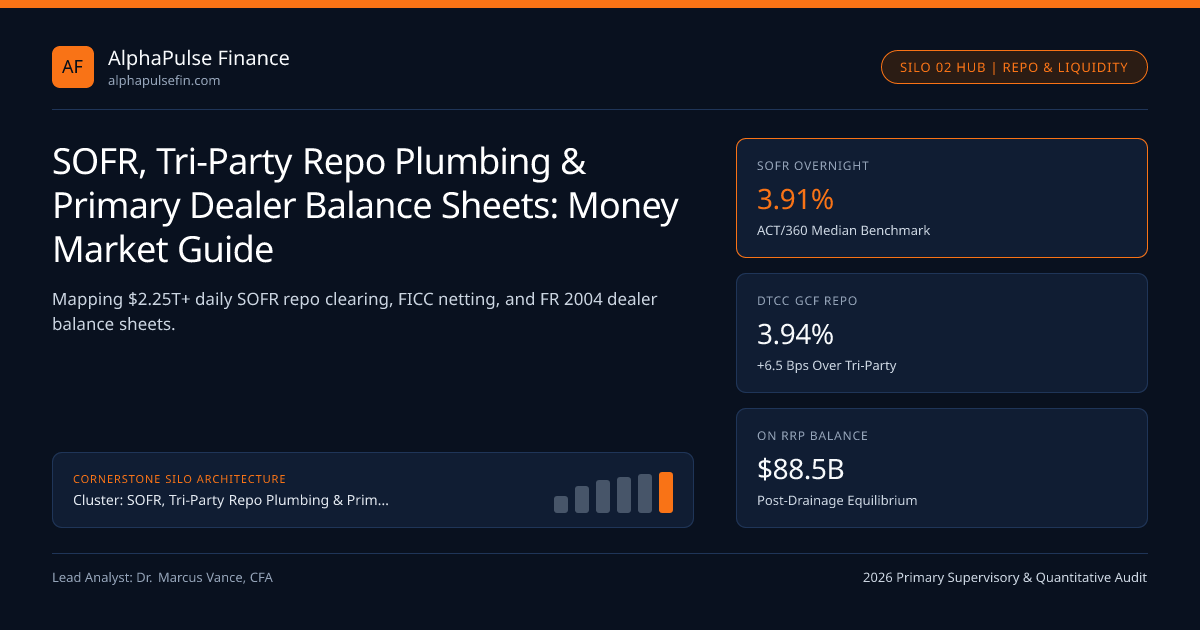
More than $2.25 trillion of overnight cash-against-Treasury collateral clears each morning to set the Secured Overnight Financing Rate (SOFR) at 3.91% ACT/360—3 bps above the 3.88% Effective Federal Funds Rate (EFFR) and 3 bps below the 3.94% DTCC General Collateral Finance (GCF) Repo Index. Since the Federal Reserve's Overnight Reverse Repurchase Agreement (ON RRP) cushion drained from over $2.55 trillion in late 2022 to roughly $88.5 billion in Q4 2026, Treasury collateral supply now presses directly against $294.0 billion of Primary Dealer Net Coupon Inventories. Managing funding risk across modern dollar money markets requires mastering the multi-tiered plumbing linking BNY Tri-Party custody, DTCC Fixed Income Clearing Corporation (FICC) multilateral netting, and the 4.00% NY Fed Standing Repo Facility (SRF).
Segmented US Repo Venues: BNY Tri-Party, FICC GCF, Cleared DVP, and NCCBR#
Unlike a unified equity exchange, the US Treasury repurchase market splits into four operationally distinct segments whose volume-weighted median forms SOFR (excluding non-centrally cleared bilateral trades). At the base sits Tri-Party Repo settled on Bank of New York Mellon's books, where SEC Rule 2a-7 government money market funds (MMFs) lend cash overnight to creditworthy primary dealers such as Cantor Fitzgerald at the lowest secured rates (~3.86%-3.89%). Because MMFs cannot lend directly to leveraged hedge funds outside cleared programs, dealers intermediate collateral across segments.
Inter-dealer liquidity clears inside FICC's blind-brokered GCF Repo service (3.94%) and Cleared Delivery-versus-Payment (DVP) platform, detailed in BNY Tri-Party vs FICC GCF and bilateral DVP segmentation. Beyond SOFR's calculation perimeter sits the vast Non-Centrally Cleared Bilateral Repo (NCCBR) segment tracked by the Office of Financial Research, where zero-haircut prime brokerage financing analyzed in OFR NCCBR zero-haircut hedge fund leverage is rapidly migrating into central clearing under SEC Rule 17ad-22(e)(6) Treasury clearing mandates.
FOMC Administered Rate Floor and Ceiling: ON RRP, IORB, and the SRF#
Within its ample-reserves operating framework supervised by the U.S. Federal Reserve System, the FOMC brackets overnight money market rates using three administered levers inside its 3.75%-4.00% target corridor:
- ON RRP Award Rate (3.75% Floor): Sets the reservation rate below which non-bank MMFs and GSEs refuse to lend cash privately. Dynamics of its $2.4T drawdown are quantified in ON RRP depletion and MMF T-bill rotation.
- Interest on Reserve Balances — IORB (3.90% Anchor): Paid to depository banks on $3.12T of reserve balances, anchoring SOFR vs EFFR and IORB reserve scarcity spreads alongside FHLB federal funds arbitrage.
- Standing Repo Facility — SRF (4.00% Ceiling): Allows primary dealers and eligible banks to monetize Treasuries into reserves, though intraday settlement timing creates the ceiling leaks analyzed in NY Fed SRF settlement frictions and Discount Window pre-positioned collateral rules.
- DealerMatchedBookSLRSaved = min(SponsoredReverseRepo, SponsoredRepoPayable) * eSLRRatio
- Worked FICC Sponsored Netting & Corridor Spread Check:
- Gross Dealer Sponsored Reverse (Hedge Fund): $80.0B | Sponsored Repo (MMF Cash): $75.0B
- Netted Balance Sheet Reduction = min($80.0B, $75.0B) = $75.0B (93.75% balance sheet compression)
- Tier 1 Capital Saved at 5.0% eSLR = $75.0B * 0.05 = $3.75B equity freed
- Corridor Spread Check: SOFR (3.91%) - ON_RRP (3.75%) = +16 bps collateral pressure premium
Primary Dealer Balance Sheet Constraints: SLR, G-SIB Scores, and FICC Netting#
Why do repo rates spike 12 to 35 bps on March 31, June 30, September 30, and December 31 even when aggregate bank reserves exceed $3.1 trillion? Under Basel III leverage rules examined in Supplementary Leverage Ratio (SLR & eSLR) constraints, gross matched-book reverse repo assets consume Tier 1 leverage capital regardless of Treasury collateral safety unless eligible for accounting offset.
To compress balance sheet footprints, dealers route client cash and hedge-fund collateral through DTCC FICC Sponsored DVP multilateral netting, offsetting matched-maturity inflows and outflows under ASC 210-20. Nevertheless, European and Canadian bank dealers reporting point-in-time leverage snapshots pull back on turn dates, driving the recurring dislocations documented in quarter-end G-SIB window dressing, FR 2004 dealer coupon financing stress, and corporate tax-date SOFR tail spikes.
Collateral Scarcity, Derivatives Conventions, and Offshore Dollar Plumbing#
Not all Treasury CUSIPs clear at general collateral rates. Heavy cash-futures basis shorting drives benchmark notes deep into "specialness," governed by Treasury specials and TMPG 300-bps fails charges. On the cash-lending side, portfolio duration rules inside $6.9T+ of US money funds follow SEC Rule 2a-7 WAM/WAL caps, while intraday settlement liquidity depends on Fedwire daylight overdrafts and LCR traps.
Across global derivatives regulated by the CFTC and SEC, SOFR liquidity anchors CME 1M/3M SOFR futures convexity, ARRC CME Term SOFR scope restrictions, and offshore synthetic funding via EUR/USD and USD/JPY cross-currency basis swaps. Full benchmark specifications are indexed on our SOFR & Repo Plumbing topic hub, datasets, and verify registries.
| Repo / Money Market Segment | Q4 2026 Rate | Included in SOFR? | Balance Sheet Netting | Primary Venue & Regulator |
|---|---|---|---|---|
| BNY Tri-Party General Collateral | 3.875% | Yes (Core Base) | No (Gross Liability) | BNY Custody / SEC 2a-7 MMFs |
| DTCC FICC Cleared DVP & Sponsored | 3.920% | Yes (Largest Slice) | Yes (ASC 210-20 Net) | FICC GSD (Cantor Fitzgerald) |
| DTCC FICC GCF Blind-Brokered | 3.940% | Yes (Inter-Dealer) | Yes (FICC Netted) | GCF-REPO / FINRA |
| Non-Cleared Bilateral (NCCBR) | 3.96% - 4.08% | No (Excluded) | Bilateral Master Repo | OFR Data / Transitioning to SEC Clearing |
| NY Fed Standing Repo (SRF) | 4.000% | No (Official Ops) | Fed Tri-Party Reserve | SRF-FACILITY (Federal Reserve) |
Money Market Supervision & Clearing Infrastructure Matrix#
Institutional cash, collateral, and settlement rails span federal banking agencies, securities self-regulators (FINRA), and institutional settlement networks including Bosonic and Ally Invest.
Frequently asked questions
Why does the NY Fed trim the bottom 25% of FICC DVP volume when calculating SOFR?
In bilateral DVP repo, traders seeking a specific scarce CUSIP (such as the on-the-run 10-year note) lend cash at artificially low "special" rates; trimming the lowest 25% of DVP rates ensures SOFR reflects general collateral funding.
Why did SOFR cross above IORB between 2023 and 2026?
During 2021-2022, excess cash and T-bill scarcity pinned SOFR near the ON RRP floor below IORB. Once heavy Treasury issuance swelled dealer inventories and drained ON RRP to $88.5B, borrowers had to pay above IORB to attract cash.
Are non-centrally cleared bilateral repos (NCCBR) included in SOFR?
Historically no, because NCCBR lacked a centralized real-time settlement feed until the Office of Financial Research launched its daily NCCBR collection in late 2024; SEC mandatory clearing will pull most NCCBR volume into FICC DVP.
What does a widening GCF-to-Tri-Party repo spread indicate?
Because giant money market funds lend into BNY Tri-Party while smaller dealers borrow in FICC GCF, a widening GCF-Tri-Party spread proves large G-SIB dealers are unwilling to expand their balance sheets to intermediate cash.
Publication record
- Published
- November 14, 2026
- Updated
- November 14, 2026
- Author
- Dr. Marcus Vance, CFA
- Review
- Review not recorded
- Automated fact check
- Passed in the stored pipeline record
- Source URLs
- 4 recorded
AI assistance recorded: anthropic/claude-opus-4.6. This field does not establish human review or source verification.
Academic & Institutional Attribution
Cite This Research & Embed Live Data Card
Standard academic & institutional research paper citation format.
Dr. Marcus Vance, CFA. (2026, November 14). SOFR, Tri-Party Repo Plumbing & Primary Dealer Balance Sheets: Money Market Guide. AlphaPulse Finance. https://alphapulsefin.com/analysis/sofr-tri-party-repo-primary-dealer-balance-sheet-plumbingRelated Sofr Repo Funding Liquidity & Institutional Briefings
Explore Sofr Repo Funding Liquidity Hub (20) →Sofr Repo Funding Liquidity
SOFR vs EFFR & IORB Corridor Spreads: Measuring Reserve Demand Elasticity Near ScarcitySofr Repo Funding Liquidity
ON RRP Facility Drainage & Rule 2a-7 Money Market Fund Rotation into Short T-BillsSofr Repo Funding Liquidity
NY Fed Standing Repo Facility (SRF) Usage: Auction Timing, Tri-Party Settlement & StigmaSofr Repo Funding Liquidity
DTCC FICC Sponsored DVP Repo: Multilateral Netting & ASC 210-20 Balance Sheet ReliefSofr Repo Funding Liquidity
SEC Rule 17ad-22(e)(6) Treasury Central Clearing Mandate: Done-With vs Done-Away MarginSofr Repo Funding Liquidity
FR 2004 Primary Dealer Net Coupon Inventories & Overnight Repo Rollover Risk MetricsSofr Repo Funding Liquidity
Quarter-End G-SIB Score Window Dressing & Foreign Bank Repo Pullbacks at Turn DatesSofr Repo Funding Liquidity
Basel III Supplementary Leverage Ratio (SLR & eSLR) Constraints on Treasury Repo DealersCorporate Credit Spread Cycles
IG/HY Corporate Credit Spreads, Refinancing Walls & CDS Basis: Institutional Credit GuideInflation Breakevens Real Rates
TIPS Breakevens, CPI Shelter Persistence & Forward Real Rates: Institutional GuideInstitutional Earnings Capex Macro
S&P 500 Margin Dispersion, Hyperscaler Capex & Buyback Flows: Institutional Earnings GuideFomc Treasury Term Premium
NY Fed ACM 5-Factor vs Kim-Wright Term Premia: Affine Yield Curve Decomposition
AlphaPulse Finance Data, Benchmarks & Contributor Records
CC BY 4.0 Open Data
Open Institutional Datasets (CSV / JSON) →
Download desk-compiled quantitative series & schemas.
2026 Reference Matrix
2026 Institutional Benchmarks & Thresholds →
Statutory capital, clearing, margin & rate conventions.
Editorial Records
Authors & Review Records →
View named contributors where those records are available.
Complete Index
Master Research & Dossier Archive →
Browse all published briefings by topic pillar & date.