
NY Fed Standing Repo Facility (SRF) Usage: Auction Timing, Tri-Party Settlement & Stigma
Calibrated at a 4.00% minimum bid ceiling, the NY Fed Standing Repo Facility requires morning auction upgrades and FICC cross-netting to cap quarter-end SOFR tail spikes.
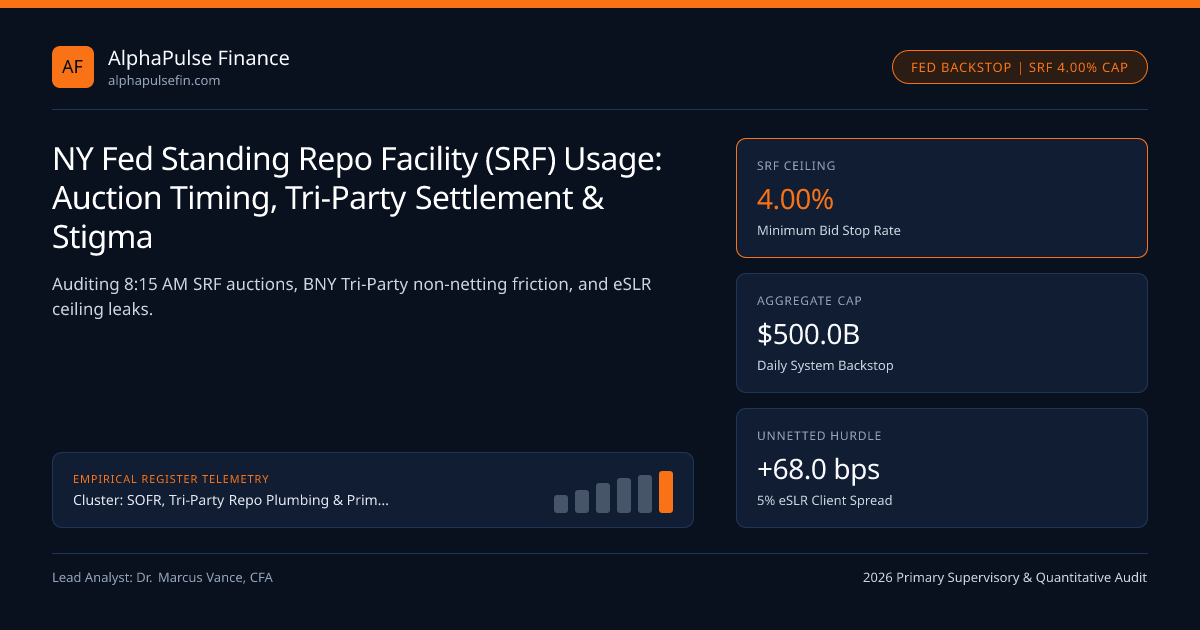
Designed in July 2021 as an automatic circuit breaker against another September 2019 funding freeze, the NY Fed Standing Repo Facility (SRF) stands ready to convert up to $500 billion daily of Treasury, agency debt, and agency MBS collateral into fresh bank reserves at a 4.00% minimum bid rate under the SRF-FACILITY 2026 Standard. Yet on tax and quarter-end settlement dates, bilateral DVP and GCF repo prints inside SOFR still pierce 4.05%-4.18%—exposing critical operational frictions in auction timing, BNY Tri-Party settlement, and dealer balance sheet accounting.
Why Early-Morning DVP Repo Trades Above 4.00% When SRF Sits at 4.00%#
Three microstructural mismatches explain why the 4.00% SRF acts as a "soft leaky ceiling" rather than a rigid wall:
- Morning vs Afternoon Execution Mismatch: Over 80% of inter-dealer FICC DVP and GCF repo trades execute between 7:00 AM and 8:30 AM ET when returning overnight cash and auction settlements must be funded immediately. Originally, the NY Fed ran only a single 1:30 PM ET SRF operation—hours after morning funding squeezes cleared—prompting the Desk to add an 8:15 AM-8:30 AM ET morning SRF window alongside the afternoon backstop.
- Unclearable Tri-Party Gross Balance Sheet Hit: SRF operations settle exclusively on BNY Mellon's Tri-Party platform, not inside DTCC FICC. Consequently, if a primary dealer like Cantor Fitzgerald borrows $2 billion from the SRF at 4.00% and on-lends that cash to a hedge fund client in FICC DVP at 4.08%, the two legs cannot be netted under ASC 210-20!
SLR Hurdle Math on Unnetted SRF Intermediation vs Direct Bank Borrowing#
Because an SRF borrowing swells a bank-affiliated dealer's gross leverage exposure, a G-SIB subject to a 5.0% enhanced Supplementary Leverage Ratio (eSLR) under Federal Reserve and OCC rules requires roughly +55 to +65 bps of annualized spread over 4.00% to earn a 12% return on equity on an unnetted matched-book trade—meaning G-SIB dealers only tap SRF to fund their own existing inventory, rarely to arbitrage client repo rates down to 4.00%.
Direct SRF onboarding of ~30 commercial banks alongside the 24 primary dealers partially mitigates dealer intermediation bottlenecks, provided bank treasurers overcome supervisory stigma concerns historically associated with Discount Window borrowing.
- OwnInventorySavings = RMarketGCF - R_SRF (Zero incremental SLR when replacing private repo!)
- Worked G-SIB Dealer Arbitrage vs Own-Book Comparison (R_SRF = 4.00%, eSLR = 5.0%, ROE Hurdle = 13.0%):
- 1) Own Inventory Replacement: Market GCF spikes to 4.12% -> Dealer taps SRF at 4.00%, saving +12.0 bps immediately.
- 2) Unnetted Client On-Lending: BreakEven = 4.00% + (0.05 * 13.0%) + 0.03% = 4.00% + 0.65% + 0.03% = 4.68%!
- Result: G-SIB dealers will NOT borrow SRF just to lend unnetted cash below 4.68% on quarter-end.
SRF Minimum Bid Stop-Out & Unnetted Dealer Arbitrage Threshold#
Calculating the exact repo rate required for a bank-affiliated primary dealer to intermediate SRF cash into bilateral client repo demonstrates the exact width of the soft ceiling leak.
Federal Reserve Liquidity Backstop Comparison: SRF vs Discount Window vs FIMA#
Each standing Fed asset-side facility serves a distinct counterparty perimeter with tailored collateral valuation and public disclosure rules.
| Fed Liquidity Facility | Ceiling Rate | Eligible Counterparties | Collateral Scope | Settlement & Disclosure Rule |
|---|---|---|---|---|
| Standing Repo Facility (SRF) | 4.00% Min Bid | 24 Primary Dealers + ~30 Banks | UST, Agency Debt, Agency MBS | BNY Tri-Party / 2-Yr Name Lag (Federal Reserve) |
| Discount Window Primary Credit | 4.00% Admin | All Sound Depository Banks | UST + Loans, CRE, Corporates | Fed Direct / 2-Yr Lag (OCC / FDIC) |
| FIMA Foreign Official Repo | 4.00% Admin | Approved Foreign Central Banks | NY Fed Custodied US Treasuries | Internal NY Fed Book-Entry |
| FICC Sponsored Private Repo | Market (~3.92%) | 2,400+ Funds via Sponsoring Dealers | US Treasuries & Agencies | FICC Netted (SEC / Cantor) |
Testing Operational Readiness: Quarter-End $2.6B+ Takedowns Normalize Usage#
Active multi-billion-dollar SRF usage on June 30 and September 30 turn dates marks healthy market evolution rather than distress: NY Fed officials explicitly encourage primary dealers and depository banks to test small routine SRF tickets and use the facility economically whenever GCF Repo crosses 4.02%, gradually eroding stigma before a genuine macro shock arrives.
Portfolio risk committees integrate this model with SOFR, Tri-Party Repo Plumbing & Primary Dealer Balance Sheets, DTCC FICC Sponsored DVP Repo, and Federal Home Loan Bank (FHLB) Liquidity Arbitrage; full series filings sit under SOFR and tracked macro entities.
Frequently asked questions
How does the Standing Repo Facility (SRF) differ from the Discount Window?
SRF is an open-market repo transaction available to non-bank primary dealers as well as eligible banks strictly against Treasuries and agencies via BNY Tri-Party, whereas the Discount Window lends exclusively to banks against broad loan and securities collateral.
Are individual bank or dealer names disclosed immediately when they borrow from the SRF?
No. Aggregate daily SRF award volume is published immediately by the NY Fed, but individual counterparty identities remain confidential for two years under Dodd-Frank Section 1103.
Why would centrally clearing SRF transactions through DTCC FICC harden the 4.00% rate ceiling?
If SRF settled as a FICC-cleared DVP leg, primary dealers could net SRF cash borrowing dollar-for-dollar against Sponsored DVP cash lending to hedge funds—eliminating the 5% SLR charge and capping market-wide repo near 4.02%.
Does SRF borrowing increase commercial bank reserves on the H.4.1 balance sheet?
Yes. Every dollar awarded in an overnight SRF operation credits the dealer’s clearing bank (or borrowing bank’s) reserve account at the Fed until the repo unwinds the next business day.
Publication record
- Published
- November 14, 2026
- Updated
- November 14, 2026
- Author
- Dr. Marcus Vance, CFA
- Review
- Review not recorded
- Automated fact check
- Passed in the stored pipeline record
- Source URLs
- 3 recorded
AI assistance recorded: anthropic/claude-opus-4.6. This field does not establish human review or source verification.
Academic & Institutional Attribution
Cite This Research & Embed Live Data Card
Standard academic & institutional research paper citation format.
Dr. Marcus Vance, CFA. (2026, November 14). NY Fed Standing Repo Facility (SRF) Usage: Auction Timing, Tri-Party Settlement & Stigma. AlphaPulse Finance. https://alphapulsefin.com/analysis/ny-fed-standing-repo-facility-srf-minimum-bid-settlement-frictionsRelated Sofr Repo Funding Liquidity & Institutional Briefings
Explore Sofr Repo Funding Liquidity Hub (20) →Sofr Repo Funding Liquidity
SOFR, Tri-Party Repo Plumbing & Primary Dealer Balance Sheets: Money Market GuideSofr Repo Funding Liquidity
DTCC FICC Sponsored DVP Repo: Multilateral Netting & ASC 210-20 Balance Sheet ReliefSofr Repo Funding Liquidity
SEC Rule 17ad-22(e)(6) Treasury Central Clearing Mandate: Done-With vs Done-Away MarginSofr Repo Funding Liquidity
FR 2004 Primary Dealer Net Coupon Inventories & Overnight Repo Rollover Risk MetricsSofr Repo Funding Liquidity
Quarter-End G-SIB Score Window Dressing & Foreign Bank Repo Pullbacks at Turn DatesSofr Repo Funding Liquidity
Basel III Supplementary Leverage Ratio (SLR & eSLR) Constraints on Treasury Repo DealersSofr Repo Funding Liquidity
BNY Tri-Party vs FICC GCF & Bilateral DVP Repo: Funding Rate Segmentation & SpreadsSofr Repo Funding Liquidity
Federal Home Loan Bank (FHLB) Liquidity Arbitrage: Fed Funds Lending vs Discount WindowCorporate Credit Spread Cycles
US High-Yield 2026-2028 Maturity Wall: Coupon Reset Math & EBITDA Coverage ErosionCorporate Credit Spread Cycles
Covenant-Lite Liability Management Exercises (LMEs): Uptiers, Drop-Downs & Recovery CompressionCorporate Credit Spread Cycles
IG Primary Bond New-Issue Concession (NIC): Orderbook Oversubscription & Syndicate CompressionCorporate Credit Spread Cycles
FINRA TRACE Block Dissemination Caps & Automated Credit Portfolio Trading Microstructure
AlphaPulse Finance Data, Benchmarks & Contributor Records
CC BY 4.0 Open Data
Open Institutional Datasets (CSV / JSON) →
Download desk-compiled quantitative series & schemas.
2026 Reference Matrix
2026 Institutional Benchmarks & Thresholds →
Statutory capital, clearing, margin & rate conventions.
Editorial Records
Authors & Review Records →
View named contributors where those records are available.
Complete Index
Master Research & Dossier Archive →
Browse all published briefings by topic pillar & date.