
Basel III Supplementary Leverage Ratio (SLR & eSLR) Constraints on Treasury Repo Dealers
Risk-blind 5% HoldCo and 6% bank-subsidiary enhanced Supplementary Leverage Ratios treat US Treasury repos identically to high-yield loans, capping primary dealer market-making elasticity.
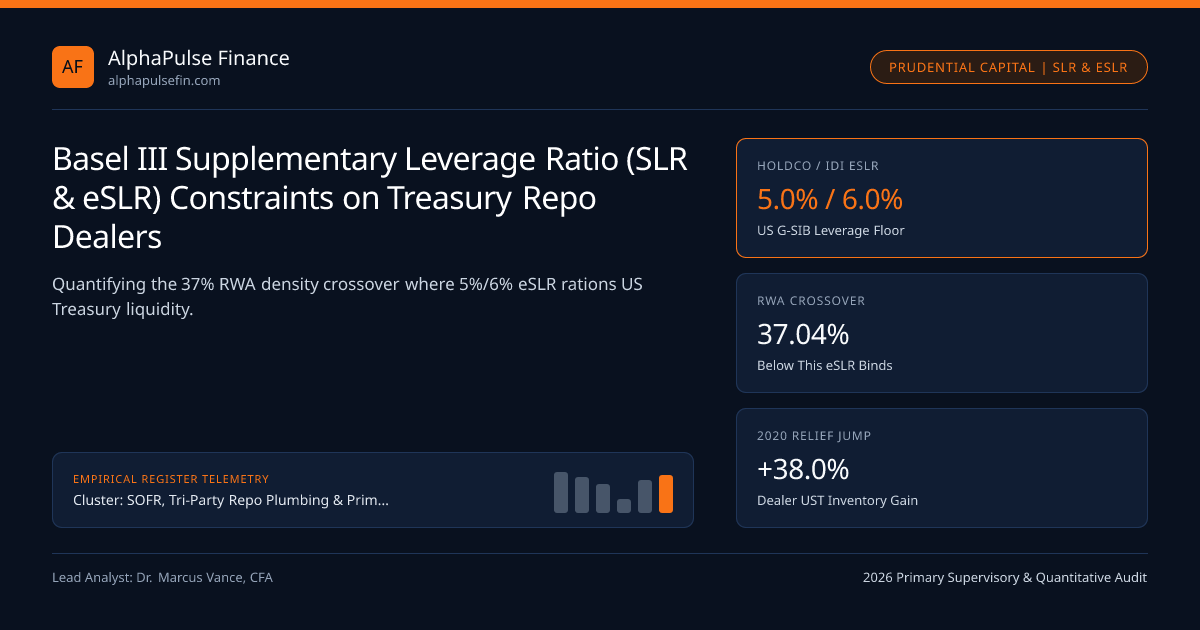
Under Basel III capital rules implemented by the Federal Reserve, OCC, and FDIC, US Global Systemically Important Banks (G-SIBs) face an enhanced Supplementary Leverage Ratio (eSLR) requiring 5.0% Tier 1 capital at the consolidated Bank Holding Company (BHC) level and 6.0% Tier 1 capital at the Insured Depository Institution (IDI) subsidiary—regardless of asset credit risk. Because US Treasuries, SOMA Bank Reserves, and unnetted SOFR Reverse Repos carry a 0% Risk-Weighted Asset (RWA) weight yet count 100% in Total Leverage Exposure, eSLR flips from a "backstop" into the binding constraint on Primary Dealer Treasury Intermediation.
When the Risk-Blind Leverage Backstop Overrides Risk-Based CET1 Ratios#
Regulators originally designed leverage ratios as a simple safeguard against banks under-reporting asset risk weights. However, as marketable US Treasury debt expanded 135% over a decade while central bank reserves stabilized at $3.12T, safe zero-risk-weight assets swelled as a share of G-SIB balance sheets.
Whenever a G-SIB's average RWA density (Total RWA / Total Leverage Exposure) drops below ~36% to 38%, the 5.0% HoldCo eSLR (or 6.0% IDI eSLR) demands more nominal Tier 1 equity dollars than a 13.5% risk-based CET1 requirement! Once eSLR binds, every marginal $1 billion of low-margin Treasury repo or secondary bond inventory requires $50M to $60M of expensive bank equity—penalizing safe Treasury liquidity provision while incentivizing higher-yielding, riskier corporate lending to utilize otherwise idle RWA headroom.
Natural Experiment Proof: The April 2020 - March 2021 Temporary SLR Exclusion#
Following the March 2020 "dash for cash" Treasury market freeze, Federal Reserve interim final rules temporarily excluded on-balance-sheet US Treasuries and Fed reserve balances from BHC Total Leverage Exposure between April 1, 2020 and March 31, 2021. Cross-sectional difference-in-differences studies by NY Fed economists comparing SLR-constrained G-SIB dealers against unconstrained non-bank dealers like Cantor Fitzgerald proved causal impact:
- Constrained G-SIB dealers immediately expanded cash Treasury inventory by +38% relative to unconstrained peers.
- Ten-year and 30-year Treasury bid-ask spreads reported on FINRA TRACE narrowed by 31%, while 30-year swap spread inversions richened by 16 bps.
- BindingeSLRCondition: Tier1ReqeSLR (0.05 * TLE) > Tier1ReqRiskBased (r_T1 * RWA)
- CriticalRWADensity = eSLRRatio / rT1_RiskBased
- Worked US G-SIB Binding Constraint Audit (BHC Risk-Based Tier 1 Requirement = 13.5%, eSLR = 5.0%):
- Critical RWA Density = 5.0% / 13.5% = 37.04%
- Bank A ($3.2T TLE, $1.08T RWA -> 33.75% density): Risk-Based Req = $145.8B vs eSLR Req = $160.0B!
- Excess "SLR Tax" = $14.2B of trapped equity -> Recalibrating eSLR to 4.1% frees $28.8B ($700B+ TLE headroom)
Critical RWA Density Threshold & eSLR Reform Calibration Math#
Federal banking agency proposals to recalibrate eSLR buffers—either by setting the eSLR surcharge to 0.5 * Method_1_GSIB_Score (lowering HoldCo minimums from 5.0% toward 3.75%-4.25%) or excluding central bank reserves plus held-for-trading broker-dealer Treasuries—directly alter the critical RWA density point.
Capital Regime Comparison Across Treasury Market Makers#
Divergent capital frameworks across G-SIB bank subs, BHC broker-dealers (SEC Rule 15c3-1), and principal trading firms shape who provides liquidity during stress.
| Intermediary Type | Primary Capital Rule | UST Repo Capital Weight | Stress Elasticity | Supervisory Agency |
|---|---|---|---|---|
| US G-SIB Insured Bank (IDI) | 6.0% Enhanced SLR | 100% Leverage / 0% RWA | Constrained (Avoids Repo) | OCC / FDIC |
| US G-SIB Broker-Dealer Sub | 5.0% BHC eSLR + 15c3-1 | 100% Unnetted / 0% FICC Net | Moderate (FICC Dependent) | Federal Reserve & SEC |
| Independent Non-Bank Dealer | SEC Rule 15c3-1 (2% Agg) | Haircut-Based Net Capital | High (Steps In on Turns) | FINRA (Cantor Fitzgerald) |
| Principal Trading Firm (PTF) | Exchange / CCP Margin | Intraday Flat / VaR Only | High Intraday, Zero O/N Warehousing | SEC Dealer Registration |
Why Broker-Dealer Subsidiary Carve-Outs Beat Blanket IDI Exemptions#
Targeted regulatory reform distinguishes passive Held-to-Maturity (HTM) bond duration risk inside insured banks (which felled Silicon Valley Bank in 2023) from hedged, daily-marked-to-market SEC-registered broker-dealer inventory. Exempting central bank reserves at the IDI plus short-term hedged Treasury market-making inventory at the broker-dealer expands secondary auction absorption by an estimated $450B+ without encouraging unhedged long-duration bets inside FDIC-insured depositories.
For end-to-end regime mapping, consult SOFR, Tri-Party Repo Plumbing & Primary Dealer Balance Sheets, sibling briefs BNY Tri-Party vs FICC GCF & Bilateral DVP Repo and SEC Rule 2a-7 WAM/WAL Caps &, SOFR, and analytical tools.
Frequently asked questions
What is the difference between the standard 3% SLR and the 5%/6% enhanced SLR (eSLR)?
Category II and III large banks face the Basel III 3.0% Tier 1 Supplementary Leverage Ratio, whereas the eight US G-SIBs must hold an extra +2.0% buffer at the holding company (5.0%) and +3.0% at insured bank subsidiaries (6.0%).
Why does holding massive Federal Reserve cash reserves worsen a banks SLR ratio?
Central bank reserves carry zero default and zero duration risk (0% RWA), yet every dollar of Fed reserves increases the SLR denominator 1-for-1, requiring 5 to 6 cents of Tier 1 equity per dollar of cash held.
Why do critics oppose simply exempting all US Treasuries from bank leverage ratios?
Long-maturity 10-year and 30-year Treasuries carry zero credit risk but substantial interest-rate duration risk (as seen at Silicon Valley Bank in 2023); targeted reform therefore focuses on reserves and hedged broker-dealer market-making inventory.
How do non-bank primary dealers like Cantor Fitzgerald operate without G-SIB eSLR caps?
Independent non-bank broker-dealers are not owned by bank holding companies and instead operate under SEC Rule 15c3-1 Uniform Net Capital haircuts, giving them high flexibility to warehouse overnight matched-book repo.
Publication record
- Published
- November 14, 2026
- Updated
- November 14, 2026
- Author
- Dr. Marcus Vance, CFA
- Review
- Review not recorded
- Automated fact check
- Passed in the stored pipeline record
- Source URLs
- 3 recorded
AI assistance recorded: anthropic/claude-opus-4.6. This field does not establish human review or source verification.
Academic & Institutional Attribution
Cite This Research & Embed Live Data Card
Standard academic & institutional research paper citation format.
Dr. Marcus Vance, CFA. (2026, November 14). Basel III Supplementary Leverage Ratio (SLR & eSLR) Constraints on Treasury Repo Dealers. AlphaPulse Finance. https://alphapulsefin.com/analysis/supplementary-leverage-ratio-slr-eslr-treasury-intermediationRelated Sofr Repo Funding Liquidity & Institutional Briefings
Explore Sofr Repo Funding Liquidity Hub (20) →Sofr Repo Funding Liquidity
SOFR, Tri-Party Repo Plumbing & Primary Dealer Balance Sheets: Money Market GuideSofr Repo Funding Liquidity
BNY Tri-Party vs FICC GCF & Bilateral DVP Repo: Funding Rate Segmentation & SpreadsSofr Repo Funding Liquidity
Federal Home Loan Bank (FHLB) Liquidity Arbitrage: Fed Funds Lending vs Discount WindowSofr Repo Funding Liquidity
On-the-Run Treasury Specials in Repo, Fails-to-Deliver & TMPG 300-Bps Penalty MechanicsSofr Repo Funding Liquidity
OFR Non-Centrally Cleared Bilateral Repo (NCCBR) Data: Zero-Haircut Hedge Fund LeverageSofr Repo Funding Liquidity
CME 3-Month vs 1-Month SOFR Futures: Rate-Volatility Convexity Bias vs Forward OISSofr Repo Funding Liquidity
Corporate Tax Deadlines, TGA Inflows & SOFR 99th-Percentile Intraday Funding SpikesSofr Repo Funding Liquidity
SEC Rule 2a-7 WAM/WAL Caps & Mandatory Liquidity Fees Across Government and Prime MMFsCorporate Credit Spread Cycles
US BSL CLO Arbitrage: AAA Liability Spreads, 7.5% CCC Buckets & Junior OC Test DiversionCorporate Credit Spread Cycles
Private Credit Unitranche PIK Toggles & BDC Non-Accrual Dispersion: Shadow Default AuditCorporate Credit Spread Cycles
Merton Structural Distance-to-Default: Equity Put Skew Leading Corporate Credit SpreadsCorporate Credit Spread Cycles
US IG Corporate 10s30s Credit Curve Flattening: Insurer Annuity Demand & Dollar-Price Convexity
AlphaPulse Finance Data, Benchmarks & Contributor Records
CC BY 4.0 Open Data
Open Institutional Datasets (CSV / JSON) →
Download desk-compiled quantitative series & schemas.
2026 Reference Matrix
2026 Institutional Benchmarks & Thresholds →
Statutory capital, clearing, margin & rate conventions.
Editorial Records
Authors & Review Records →
View named contributors where those records are available.
Complete Index
Master Research & Dossier Archive →
Browse all published briefings by topic pillar & date.