
OFR Non-Centrally Cleared Bilateral Repo (NCCBR) Data: Zero-Haircut Hedge Fund Leverage
Office of Financial Research mandatory data collection across ~$2.1T of non-centrally cleared bilateral repo revealed over 70% of hedge fund Treasury trades carried zero haircut prior to clearing reforms.
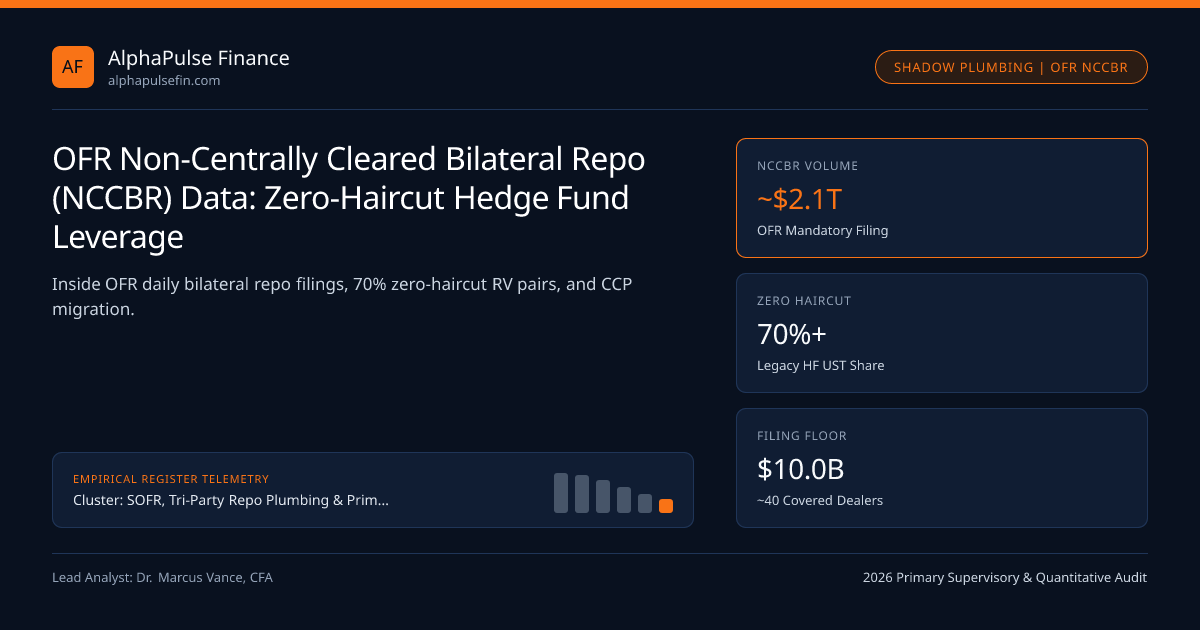
For decades, the largest corner of leveraged US Treasury financing operated as a statistical blind spot outside Tri-Party and DTCC FICC clearing feeds—omitted even from SOFR (3.91%). Following its May 2024 final rule under Dodd-Frank Section 153, the US Treasury's Office of Financial Research (OFR) launched mandatory daily transaction-level reporting across Non-Centrally Cleared Bilateral Repo (NCCBR)—uncovering ~$2.1 trillion+ of daily outstanding commitments where over 70% of Cayman-domiciled relative-value hedge fund Treasury borrowings carried a 0.0% initial haircut against Primary Dealer Balance Sheets.
Why Prime Brokers Offered Zero-Haircut Repo on Bilateral Master Agreements#
In standard BNY Tri-Party repo, money market funds enforce an automatic 2.0% over-collateralization haircut on US Treasuries ($102 of bonds for $100 of cash). Why did G-SIB prime brokers and primary dealers like Cantor Fitzgerald routinely lend billions in NCCBR to multi-strategy hedge funds at 0.0%—or even negative—haircuts?
Two portfolio-level mechanisms explain the apparent generosity:
- Netted Long/Short Relative-Value Pairs: When a relative-value fund executes a DV01-neutral 2s10s curve steepener or old-versus-new 10Y roll with the same dealer—financing a $500M long off-the-run bond via repo while borrowing a $500M short on-the-run bond via reverse repo under one Global Master Repurchase Agreement (GMRA)—both legs offset economically and satisfy ASC 210-20 bilateral same-counterparty netting without needing FICC!
- Cross-Product Prime Brokerage Margin: Prime brokers assess portfolio VaR across equities, swaps, and futures in a master cross-margining agreement rather than imposing standalone bond haircuts.

Hidden Systemic Tail Risk: Tenor Mismatch and Uncoordinated Haircut Pro-Cyclicality#
OFR pilot and live filings exposed two vulnerabilities that motivated the SEC and Financial Stability Oversight Council (FSOC) to force NCCBR into central clearing:
- Asymmetric Tenor Maturity: Dealers borrowed cash overnight while lending 30-to-90-day term NCCBR to hedge funds, creating acute liquidity mismatch on Federal Reserve supervisory stress tests.
- Sudden Haircut Cliffs: Because 0% bilateral haircuts allow theoretically infinite leverage on cash-cash relative value (
1 / 0%, bounded only by prime-broker VaR pods), a sudden 1.5% bilateral haircut imposition during a MOVE volatility spike forces immediate $1.5B equity calls per $100B notional—triggering synchronized fire sales across FINRA TRACE.
- DeleveragingCashCall = GrossRepoNotional * (HaircutStress - HaircutInitial_0)
- Worked Zero-Haircut Bilateral RV Margin Cliff ($40B Long Old-10Y / $40B Short On-the-Run 10Y):
- Initial GMRA Net Balance Sheet = |$40B - $40B| = $0 | Initial Standalone Haircut = 0.00% ($0 posted)
- Prime Broker Imposes +1.00% Stress Haircut Per Leg During MOVE > 130 Shock:
- Immediate Cash Margin Call = ($40B + $40B) * 0.010 = $800.0M cash due T+1 (forces spread unwind!)
Netted Cash-Cash Relative Value Leverage & Margin Cliff Equation#
Calculating effective leverage on a zero-haircut bilateral old/new Treasury spread trade illustrates why mandatory CCP portfolio margining stabilizes deleveraging tails.
Four Repo Segments: Visibility & Haircut Comparison After OFR Final Rule#
Combining OFR's NCCBR dataset with NY Fed Tri-Party and DTCC FICC statistics finally gives institutional desks 100% visibility across the ~$4.6T+ US repo complex.
| US Repo Data Collection | Administrator | Approx Daily Size | Typical UST Haircut | Included in 8 AM SOFR? |
|---|---|---|---|---|
| Tri-Party Repo (Ex-Fed) | NY Fed / BNY Mellon | ~$1.05T | 2.0% Fixed Schedule | Yes (TGCR Core) |
| FICC GCF Blind Repo | DTCC FICC | ~$0.24T | FICC Clearing Fund VaR | Yes (BGCR Layer) |
| FICC DVP & Sponsored | DTCC FICC (SEC CCA) | ~$1.45T+ | 1.2% - 2.1% Segregated VaR | Yes (Top 75% Rates) |
| OFR NCCBR Bilateral | Treasury OFR (FINRA BDs) | ~$1.6T - $2.1T | 0.0% (Migrating to CCP) | No (Monitored Separately) |
Tracking Migration From NCCBR Into FICC Sponsored & Agent Clearing#
Across 2025-2026 OFR Short-Term Funding Monitor releases, daily NCCBR Treasury volume exhibits a steady structural decline as G-SIB prime brokers migrate bilateral hedge-fund pods into FICC's Agent Clearing and Sponsored DVP rails—lifting FICC DVP volume inside SOFR while compressing opaque zero-haircut bilateral exposures toward exempted sovereign and non-US collateral buckets.
Additional stress-test parameters appear in SOFR, Tri-Party Repo Plumbing & Primary Dealer Balance Sheets, CME 3-Month vs 1-Month SOFR Futures, and ARRC CME Term SOFR Scope Restrictions within the SOFR dossier and quantitative methodology.
Frequently asked questions
Why did the Office of Financial Research (OFR) create the NCCBR data rule in 2024?
Prior to 2024, US regulators had daily transaction visibility into BNY Tri-Party and DTCC FICC cleared repo, but zero daily data on ~$2T+ of uncleared bilateral prime-brokerage repo fueling leveraged Treasury trades.
How could a primary dealer legally net uncleared bilateral repos without using DTCC FICC?
If a hedge fund executes both a repo (cash borrowing) and an equal-maturity reverse repo (bond borrowing to cover a short) directly with the exact same dealer under one GMRA settling on Fedwire, ASC 210-20 permits bilateral offsetting.
Why are Cayman Islands entities the largest borrower group in OFR NCCBR statistics?
Institutional multi-strategy and fixed-income relative-value hedge funds managed in New York, Chicago, and London standardly domicile their master trading funds in the Cayman Islands for tax-neutral global investor pooling.
Will NCCBR disappear completely once SEC mandatory Treasury clearing is fully phased in?
US Treasury NCCBR facing FICC members largely migrates into cleared DVP/Agent Clearing, but NCCBR remains active for non-Treasury collateral (corporate bonds, equities, private ABS) and exempted sovereign counterparties.
Publication record
- Published
- November 13, 2026
- Updated
- November 15, 2026
- Author
- Dr. Marcus Vance, CFA
- Review
- Review not recorded
- Automated fact check
- Passed in the stored pipeline record
- Source URLs
- 3 recorded
AI assistance recorded: anthropic/claude-opus-4.6. This field does not establish human review or source verification.
Academic & Institutional Attribution
Cite This Research & Embed Live Data Card
Standard academic & institutional research paper citation format.
Dr. Marcus Vance, CFA. (2026, November 15). OFR Non-Centrally Cleared Bilateral Repo (NCCBR) Data: Zero-Haircut Hedge Fund Leverage. AlphaPulse Finance. https://alphapulsefin.com/analysis/ofr-non-centrally-cleared-bilateral-repo-nccbr-zero-haircutsRelated Sofr Repo Funding Liquidity & Institutional Briefings
Explore Sofr Repo Funding Liquidity Hub (20) →Sofr Repo Funding Liquidity
SOFR, Tri-Party Repo Plumbing & Primary Dealer Balance Sheets: Money Market GuideSofr Repo Funding Liquidity
CME 3-Month vs 1-Month SOFR Futures: Rate-Volatility Convexity Bias vs Forward OISSofr Repo Funding Liquidity
Corporate Tax Deadlines, TGA Inflows & SOFR 99th-Percentile Intraday Funding SpikesSofr Repo Funding Liquidity
SEC Rule 2a-7 WAM/WAL Caps & Mandatory Liquidity Fees Across Government and Prime MMFsSofr Repo Funding Liquidity
EUR/USD & USD/JPY Cross-Currency Basis Swaps: Offshore Synthetic Dollar Funding vs SOFRSofr Repo Funding Liquidity
Fedwire Securities Settlement Timing, Daylight Overdrafts & Intraday LCR Buffer TrapsSofr Repo Funding Liquidity
Federal Reserve Discount Window Readiness: Pre-Positioned Collateral Valuation & HaircutsSofr Repo Funding Liquidity
ARRC CME Term SOFR Scope Restrictions: Compounded SOFR in Arrears vs Cash Loan ConventionsCorporate Credit Spread Cycles
ISDA Credit Event Auctions, Cheapest-to-Deliver Bonds & Orphan CDS Risk After LMEsCorporate Credit Spread Cycles
US G-SIB TLAC HoldCo vs OpCo Credit Spreads: SPOE Bail-In Subordination & Call OptionalityCorporate Credit Spread Cycles
SASB Office CMBS Special Servicing & Regional Bank Sub-Debt Credit ContagionCorporate Credit Spread Cycles
Rising-Star BB-Plus Upgrades: Anticipating Crossover Deleveraging Into Investment Grade
AlphaPulse Finance Data, Benchmarks & Contributor Records
CC BY 4.0 Open Data
Open Institutional Datasets (CSV / JSON) →
Download desk-compiled quantitative series & schemas.
2026 Reference Matrix
2026 Institutional Benchmarks & Thresholds →
Statutory capital, clearing, margin & rate conventions.
Editorial Records
Authors & Review Records →
View named contributors where those records are available.
Complete Index
Master Research & Dossier Archive →
Browse all published briefings by topic pillar & date.