
On-the-Run Treasury Specials in Repo, Fails-to-Deliver & TMPG 300-Bps Penalty Mechanics
Heavy short-hedging in benchmark 10-year US Treasury notes drives specific-issue repo rates 25 to 180 bps below SOFR, bounded by the TMPG 300-bps fails penalty.
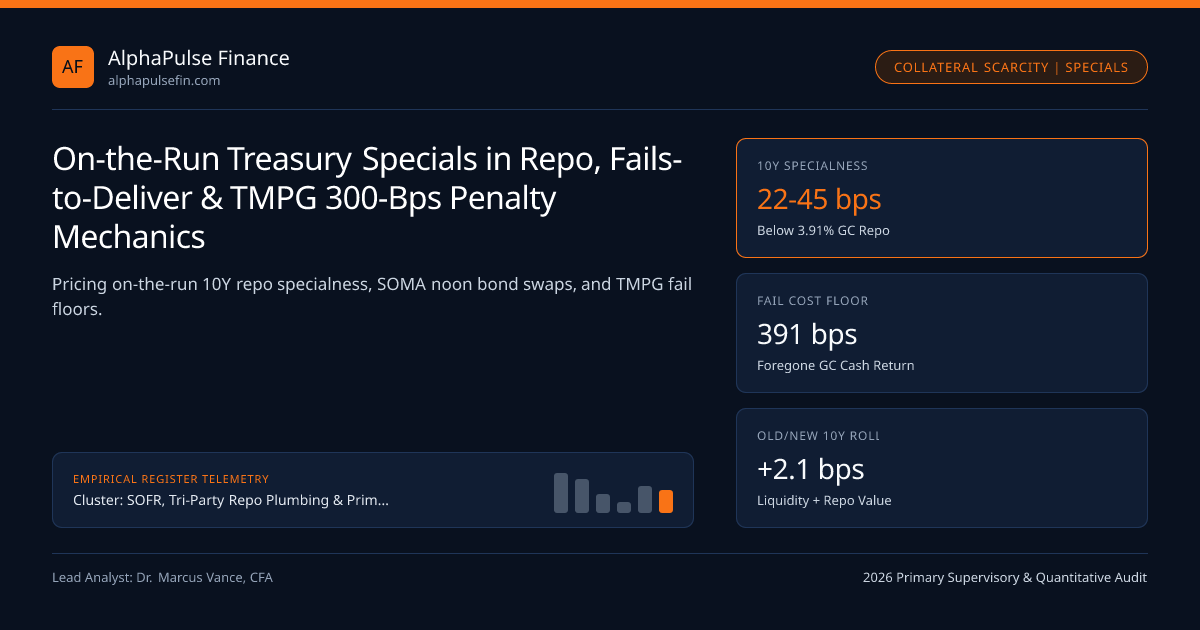
While generic US Treasury baskets clear near 3.91% in Overnight SOFR, specific-issue DVP repo rates on newly auctioned 10-Year Benchmark Notes routinely plunge to 3.55%, 2.10%, or even negative rates (-0.85%) right before quarterly reopenings. Known as trading "on special," collateral scarcity emerges whenever corporate bond underwriters, mortgage hedgers, and macro desks establish short positions exceeding the lendable float on Primary Dealer Balance Sheets—bounded downward strictly by the Treasury Market Practices Group (TMPG) 300-bps fails-to-deliver charge.
How Specific-Issue Shorting Creates Negative Repo Specialness#
In a short cash Treasury sale, a dealer or hedge fund sells the liquid on-the-run 10-year CUSIP today (say to hedge a $2 billion investment-grade corporate bond underwriting) and must borrow that exact 9-character CUSIP in reverse repo to deliver it to the buyer on T+1. Because the buyer only accepts that specific CUSIP, the short seller willingly accepts a steep discount on the cash it posts as collateral.
When aggregate short interest approaches lendable float—particularly late in an auction cycle after buy-and-hold foreign central banks and domestic mutual funds lock the CUSIP away in unlent custody—specific-issue repo falls 150 to 450 bps below general collateral (GC). Long holders who lend their on-the-run 10-year note at 1.41% specific repo and reinvest the cash proceeds at 3.91% GC pocket +250 bps of riskless annualized "repo specialness alpha" on top of the bond's 4.32% coupon!
Why the TMPG 300-Bps Fails Floor Allows Deeply Negative Repo Rates#
Before May 2009, failing to deliver a Treasury security on settlement date simply postponed payment without explicit penalty—implying a 0.00% floor on repo rates (because if specific repo went negative, a borrower could just deliberately fail to deliver at 0% cost, creating $2.7T/week of daisy-chain fails in autumn 2008).
Sponsored by the Federal Reserve Bank of New York, the TMPG Fails Charge sets the penalty equal to max(3.00% - Fed_Funds_Floor, 0), meaning a failing seller pays a minimum 300-bps annualized penalty whenever the FOMC target corridor floor sits at or above 3.00%. Under an FOMC floor of 3.75%, rather than failing and forfeiting 3.75% cash interest on delayed settlement proceeds, short sellers bid specific repo down toward GC - 300 bps or -3.00% effective economic floor depending on fail-claim conventions across FINRA and FICC DVP participants like Cantor Fitzgerald.
- TMPGExplicitPenalty = max(0.0300 - RFOMCTarget_Lower, 0)
- YieldValueofSpecial = (SpecialnessSpread * (DaysOnSpecial / 360)) / ModDur_Bond
- Worked 10-Year On-the-Run Specialness Yield Advantage (90-Day Cycle, Avg Specialness = 45 bps):
- Cumulative 90-Day Financing Pickup = 0.45% * (90 / 360) = +0.1125% ($0.1125 per $100 par)
- Divided by 10Y Modified Duration (8.15 yrs): Fair Yield Richening = 0.1125% / 8.15 = 1.38 bps lower yield
- Total Fail Cost Check at 3.91% GC: Failing seller loses 3.91% cash return -> repo floors near 0.00%!
TMPG Fails Charge Formula & Specialness Old/New Yield Roll Value#
Under official TMPG Treasury/Agency rules, the annualized fail claim rate equals max(3% - Target_Range_Bottom, 0%) in addition to the seller forfeiting time-value interest on delayed sale proceeds. Examining the exact TMPG algebra when Target Range Bottom equals 3.75% (> 3.00%) shows max(3.00% - 3.75%, 0) equals 0% explicit surcharge, because failing to deliver already costs the seller 3.75%-3.91% of foregone overnight interest on unpaid cash proceeds. Conversely, when policy rates were 0.00%, the explicit 3.00% charge kept total economic fail cost at or above 300 bps at all times.
Lifecycle of On-the-Run Specialness & SOMA Securities Lending#
To prevent chronic delivery squeezes without eliminating natural market incentives, the NY Fed operates a daily 12:00 PM ET SOMA Securities Lending facility exclusively for the 24 primary dealers.
| Scarcity / Backstop Mechanism | Trigger / Rate Formula | Q4 2026 Calibration | Eligible Counterparties | Governance & Reporting |
|---|---|---|---|---|
| Normal On-the-Run 10Y Special | GC Repo minus Scarcity Bid | 3.56% - 3.70% Repo | All FICC DVP & Bilateral | Purged from SOFR (<25th Pct) |
| NY Fed SOMA Noon Sec-Lending | Bond-for-Bond Fee Auction | >= 1.00% Lending Fee | 24 Primary Dealers Only | NY Fed Desk (Cantor) |
| TMPG Explicit Fails Charge | max(3.00% - Fed Floor, 0%) | 0.00% (+3.91% Lost Cash) | Market-Wide Cash & Repo | TMPG / FINRA / SEC |
| FICC Automated Pair-Off / Net | Multilateral CCP Novation | >60% Fail Reduction | FICC GSD Netting + Sponsored | DTCC FICC (Federal Reserve) |
Pricing the On-the-Run vs First-Off-the-Run ("Old 10Y") Roll Spread#
Why does the current on-the-run 10-year note trade 1.5 to 3.5 bps lower in yield (richer in price) than the "Old" 10-year note issued just three months ago? Present-valuing 90 days of expected +25 to +65 bps repo specialness advantage over an 8.15-year modified duration directly accounts for 0.8 to 2.0 bps of yield richening—creating the classic WI-to-Old Roll arbitrage ahead of each Quarterly Refunding Announcement.
Quantitative pods link this specification with OFR Non-Centrally Cleared Bilateral Repo (NCCBR) Data, Federal Reserve Discount Window Readiness, and SOFR, Tri-Party Repo Plumbing & Primary Dealer Balance Sheets; browse SOFR or tracked macro entities for live benchmarks.
Frequently asked questions
Why does the TMPG explicit fails charge drop to 0% when the Fed funds target range exceeds 3.00%?
A seller who fails to deliver a bond does not receive the buyer’s cash on T+1 and therefore loses overnight interest on those proceeds. Once overnight rates exceed 3.00%, lost cash interest alone already penalizes fails by >300 bps without an extra surcharge.
How could US Treasury specific-issue repo rates turn negative (-2.50%) during 2020-2021?
When the FOMC target floor was 0.00%, lost cash interest on a fail was zero, so the explicit 3.00% TMPG penalty applied—driving desperate borrowers to accept repo rates down to -2.95% before choosing to fail at -3.00%.
Does the NY Fed SOMA Securities Lending program lend cash or change bank reserves?
Neither. SOMA noon securities lending is strictly a bond-for-bond collateral swap: primary dealers pledge general Treasury collateral and pay a lending fee (>=100 bps) to borrow a scarce CUSIP overnight, leaving bank reserves untouched.
Why does repo specialness usually peak the day before a 10-year reopening auction settles?
Dealers build maximum When-Issued and cash hedges right into the auction while existing $42B float is tightly held; the moment $39B of fungible reopening supply settles under the identical CUSIP, float jumps 93% and specialness collapses.
Publication record
- Published
- November 14, 2026
- Updated
- November 14, 2026
- Author
- Dr. Marcus Vance, CFA
- Review
- Review not recorded
- Automated fact check
- Passed in the stored pipeline record
- Source URLs
- 3 recorded
AI assistance recorded: anthropic/claude-opus-4.6. This field does not establish human review or source verification.
Academic & Institutional Attribution
Cite This Research & Embed Live Data Card
Standard academic & institutional research paper citation format.
Dr. Marcus Vance, CFA. (2026, November 14). On-the-Run Treasury Specials in Repo, Fails-to-Deliver & TMPG 300-Bps Penalty Mechanics. AlphaPulse Finance. https://alphapulsefin.com/analysis/treasury-specials-repo-fails-to-deliver-tmpg-penalty-chargeRelated Sofr Repo Funding Liquidity & Institutional Briefings
Explore Sofr Repo Funding Liquidity Hub (20) →Sofr Repo Funding Liquidity
SOFR, Tri-Party Repo Plumbing & Primary Dealer Balance Sheets: Money Market GuideSofr Repo Funding Liquidity
OFR Non-Centrally Cleared Bilateral Repo (NCCBR) Data: Zero-Haircut Hedge Fund LeverageSofr Repo Funding Liquidity
CME 3-Month vs 1-Month SOFR Futures: Rate-Volatility Convexity Bias vs Forward OISSofr Repo Funding Liquidity
Corporate Tax Deadlines, TGA Inflows & SOFR 99th-Percentile Intraday Funding SpikesSofr Repo Funding Liquidity
SEC Rule 2a-7 WAM/WAL Caps & Mandatory Liquidity Fees Across Government and Prime MMFsSofr Repo Funding Liquidity
EUR/USD & USD/JPY Cross-Currency Basis Swaps: Offshore Synthetic Dollar Funding vs SOFRSofr Repo Funding Liquidity
Fedwire Securities Settlement Timing, Daylight Overdrafts & Intraday LCR Buffer TrapsSofr Repo Funding Liquidity
Federal Reserve Discount Window Readiness: Pre-Positioned Collateral Valuation & HaircutsCorporate Credit Spread Cycles
US IG Corporate 10s30s Credit Curve Flattening: Insurer Annuity Demand & Dollar-Price ConvexityCorporate Credit Spread Cycles
ISDA Credit Event Auctions, Cheapest-to-Deliver Bonds & Orphan CDS Risk After LMEsCorporate Credit Spread Cycles
US G-SIB TLAC HoldCo vs OpCo Credit Spreads: SPOE Bail-In Subordination & Call OptionalityCorporate Credit Spread Cycles
SASB Office CMBS Special Servicing & Regional Bank Sub-Debt Credit Contagion
AlphaPulse Finance Data, Benchmarks & Contributor Records
CC BY 4.0 Open Data
Open Institutional Datasets (CSV / JSON) →
Download desk-compiled quantitative series & schemas.
2026 Reference Matrix
2026 Institutional Benchmarks & Thresholds →
Statutory capital, clearing, margin & rate conventions.
Editorial Records
Authors & Review Records →
View named contributors where those records are available.
Complete Index
Master Research & Dossier Archive →
Browse all published briefings by topic pillar & date.