
Agency MBS Current-Coupon Spreads & Negative Convexity Hedging into 10Y Treasury Selloffs
Negative convexity across $9.1T of agency MBS forces mortgage servicers and money managers to shed duration as yields rise, amplifying 10-year US Treasury volatility during macro rate selloffs.
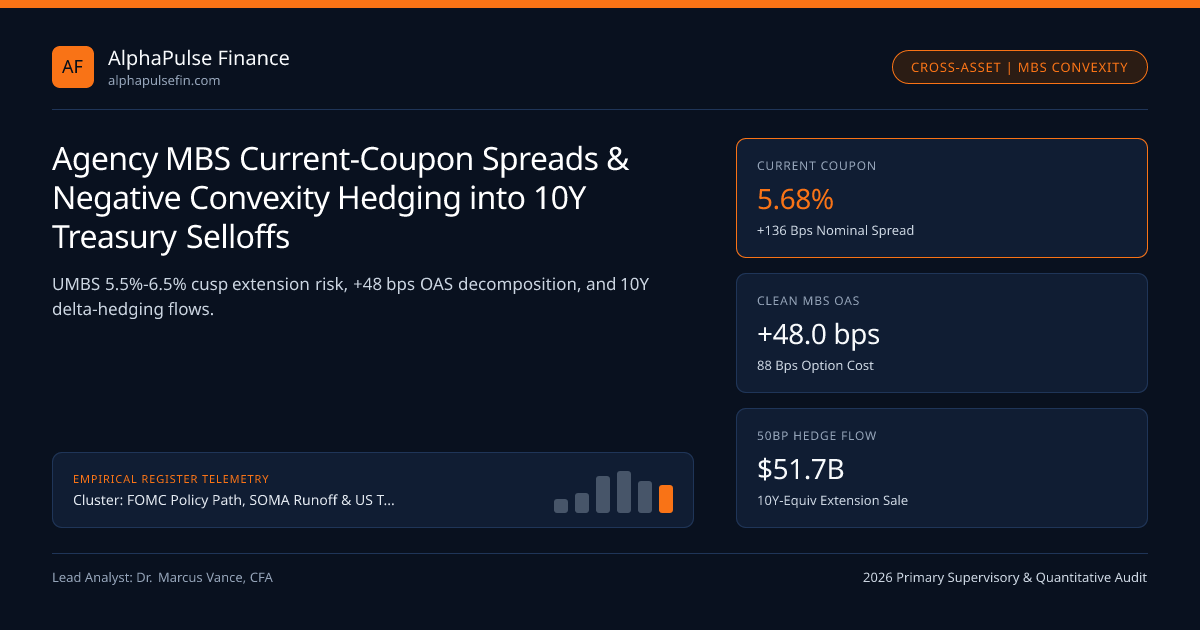
Standing at $9.1 trillion outstanding, the US agency mortgage-backed securities (MBS) market represents the second-largest fixed-income asset class in the world—and embeds a massive short Bermudan swaption held by American homeowners, who may prepay fixed-rate 30-year mortgages at par without penalty whenever rates drop. When 10-Year Benchmark Treasury Yields sell off by 50 bps across key refinancing cusps, expected mortgage cash flows lengthen ("extension risk"), forcing mortgage servicing rights (MSR) hedgers and active MBS portfolios to pay fixed on swaps or sell 10-year Treasury futures—creating a pro-cyclical feedback loop into sovereign term premia.
Seasoned Lock-In Pools vs High-Coupon 5.5%-6.5% Cusp Convexity#
Post-2022 rate dispersion bifurcated the UMBS 30-year universe into two distinct convexity cohorts. Roughly 62% of outstanding pools carry deep discount 2.0%-3.5% coupons held heavily inside Federal Reserve SOMA (~$2.18T) and commercial bank Held-to-Maturity (HTM) portfolios under OCC and FDIC supervision; sitting 250+ bps out-of-the-money for refinancing, those deep discounts exhibit mild positive convexity like bullet bonds.
Conversely, the $2.4 trillion vintage of 5.50%, 6.00%, and 6.50% UMBS pools originated between 2023 and 2026 sits squarely "on the refinancing cusp" when primary 30-year mortgage rates trade near 6.05%-6.35%. Across cusp coupons, empirical Option-Adjusted Duration (OAD) swings violently from 3.4 years at a 3.80% 10-year Treasury yield to 6.8 years at a 4.80% 10-year yield.
Current-Coupon Nominal Spread vs OAS Decomposition#
Par current-coupon UMBS 30-year yields (~5.68% secondary TBA) trade roughly +136 bps above interpolated 5Y/10Y Treasury blends—wider than the +95 bps pre-2020 norm. Decomposing that +136 bps nominal spread reveals ~88 bps of prepayment option cost (driven by elevated swaption implied volatility) leaving +48 bps of pure Option-Adjusted Spread (OAS) compensation for bank and real-money buyers executing TBA trades reported to FINRA TRACE.
Because SOMA Reserve Management passively lets $13.8B/month of MBS roll off while commercial banks cap HTM additions, active money managers and REITs absorb net TBA supply through primary dealers like Cantor Fitzgerald—hedging convexity dynamically in CFTC-cleared swaps and futures.
- DeltaDV01Hedge = -NotionalHedged * OptionAdjConvexity * Deltay * 0.01
- Worked +50 Bps Selloff Extension Flow ($432B Actively Delta-Hedged Cusp Cohort, OAC = -1.95):
- Duration Extension per $100 Par = -(-1.95) * (+0.50) = +0.975 years of added OAD
- Incremental Market DV01 Created = $432B * 0.975 * 0.0001 = $42.12M of unwanted DV01
- Equivalent 10-Year Note Selling Needed (ModDur 8.15) = $42.12M / 0.000815 = $51.68B 10Y-Equiv
Convexity Hedging DV01 Amplification Formula#
Quantifying aggregate market duration extension per 25-bps Treasury selloff shows how delta-hedgers inject mechanical selling pressure into the 10-year point.
UMBS 30-Year Coupon Stack Convexity & Spread Profile#
Comparing deep-discount SOMA pools against active TBA production coupons highlights where extension gamma concentrates across the coupon stack.
| UMBS 30Y Cohort | Outstanding Float | Option-Adj Duration | Option-Adj Convexity | Primary Holder & Regulatory Regime |
|---|---|---|---|---|
| UMBS 2.0% - 3.0% Discount | $4.85T | 7.2 - 7.6 yrs | +0.15 to +0.32 | SOMA & Bank HTM (OCC / FDIC) |
| UMBS 3.5% - 4.5% Seasoned | $1.85T | 5.9 - 6.6 yrs | -0.25 to -0.65 | Core Bond Mutual Funds (SEC 1940 Act) |
| UMBS 5.5% Production TBA | $1.30T | 5.10 yrs | -1.65 | TBA Forward Dealers (Cantor / FINRA) |
| UMBS 6.0% - 6.5% Cusp | $1.10T | 4.1 - 4.6 yrs | -2.10 to -2.45 | MSR Servicers & REITs (CFTC Swap Hedges) |
Why Modern Convexity Selloffs Are Smaller Than 2003 Yet Still Potent#
During July-August 2003, aggressive delta-hedging by Fannie Mae and Freddie Mac retained portfolios drove 10-year Treasury yields up 145 bps in six weeks. Post-conservatorship GSE portfolio caps eliminated GSE-driven convexity cascades, leaving dynamic MSR servicers and leveraged MBS REITs (~18% hedged share of the $2.4T cusp cohort) as the residual channel—adding an estimated +6 to +11 bps of excess 10-year yield amplification during rapid 50-bps selloffs.
Desk replication notes span FOMC Policy Path, SOMA Runoff & US Treasury Term Premia, ICE BofA MOVE Index & 1y10y Swaption Volatility, and 10-Year US Treasury Auction Tails, Indirect, organized across FOMC Policy Path and tracked macro entities.
Frequently asked questions
What is negative convexity in agency mortgage-backed securities?
Because homeowners refinance when mortgage rates drop and keep existing low-rate loans when rates rise, an MBS bond shortens in duration during rallies (capping price upside above par) and lengthens during selloffs (accelerating price losses).
Why do mortgage servicing rights (MSR) holders buy Treasuries when yields fall and sell when yields rise?
MSRs act like interest-only (IO) strips whose value rises when prepayments slow; to keep net portfolio duration stable, MSR hedgers sell Treasury futures when yields rise and buy duration back when yields fall.
What is the difference between MBS nominal Z-spread and Option-Adjusted Spread (OAS)?
Nominal spread compares static single-scenario MBS cash flows to Treasuries, whereas OAS runs Monte Carlo interest-rate paths to subtract the fair market value of the homeowner’s prepayment call option.
Why does TBA (To-Be-Announced) trading make agency MBS nearly as liquid as US Treasuries?
TBA rules collapse tens of thousands of individual Freddie Mac and Fannie Mae UMBS mortgage pools into fungible forward contracts by coupon and settlement month, concentrating $290B+ of daily volume reported to FINRA TRACE.
Publication record
- Published
- November 14, 2026
- Updated
- November 14, 2026
- Author
- Dr. Marcus Vance, CFA
- Review
- Review not recorded
- Automated fact check
- Passed in the stored pipeline record
- Source URLs
- 3 recorded
AI assistance recorded: anthropic/claude-opus-4.6. This field does not establish human review or source verification.
Academic & Institutional Attribution
Cite This Research & Embed Live Data Card
Standard academic & institutional research paper citation format.
Dr. Marcus Vance, CFA. (2026, November 14). Agency MBS Current-Coupon Spreads & Negative Convexity Hedging into 10Y Treasury Selloffs. AlphaPulse Finance. https://alphapulsefin.com/analysis/mbs-current-coupon-convexity-extension-treasury-volatility-spilloverRelated Fomc Treasury Term Premium & Institutional Briefings
Explore Fomc Treasury Term Premium Hub (20) →Fomc Treasury Term Premium
FOMC Policy Path, SOMA Runoff & US Treasury Term Premia: Institutional Rates GuideFomc Treasury Term Premium
ICE BofA MOVE Index & 1y10y Swaption Volatility: VaR Shocks on Treasury Term PremiaFomc Treasury Term Premium
Inertial Taylor Rules vs Balanced-Approach Benchmarks Across FOMC Policy NormalizationFomc Treasury Term Premium
SOMA Reserve Management Purchases (RMP): Calibrating Bank Reserves Above LCLoR ThresholdsFomc Treasury Term Premium
The 20-Year US Treasury Yield Curve Kink: Stripping Economics & Butterfly ArbitrageFomc Treasury Term Premium
NY Fed ACM 5-Factor vs Kim-Wright Term Premia: Affine Yield Curve DecompositionFomc Treasury Term Premium
Treasury Quarterly Refunding Coupon Supply & TBAC Weighted Average Maturity LimitsFomc Treasury Term Premium
10-Year US Treasury Auction Tails, Indirect Bidder Takedown & When-Issued ConcessionSofr Repo Funding Liquidity
EUR/USD & USD/JPY Cross-Currency Basis Swaps: Offshore Synthetic Dollar Funding vs SOFRSofr Repo Funding Liquidity
Fedwire Securities Settlement Timing, Daylight Overdrafts & Intraday LCR Buffer TrapsSofr Repo Funding Liquidity
Federal Reserve Discount Window Readiness: Pre-Positioned Collateral Valuation & HaircutsSofr Repo Funding Liquidity
ARRC CME Term SOFR Scope Restrictions: Compounded SOFR in Arrears vs Cash Loan Conventions
AlphaPulse Finance Data, Benchmarks & Contributor Records
CC BY 4.0 Open Data
Open Institutional Datasets (CSV / JSON) →
Download desk-compiled quantitative series & schemas.
2026 Reference Matrix
2026 Institutional Benchmarks & Thresholds →
Statutory capital, clearing, margin & rate conventions.
Editorial Records
Authors & Review Records →
View named contributors where those records are available.
Complete Index
Master Research & Dossier Archive →
Browse all published briefings by topic pillar & date.