
SOMA Monthly Redemption Caps, MBS Prepayment Drag & Secondary T-Bill Reinvestment
With agency MBS prepayments locked near $13.8B per month against a $35B cap, redirecting MBS principal paydowns into front-end Treasury bills reshapes Federal Reserve SOMA maturity composition across capital markets.
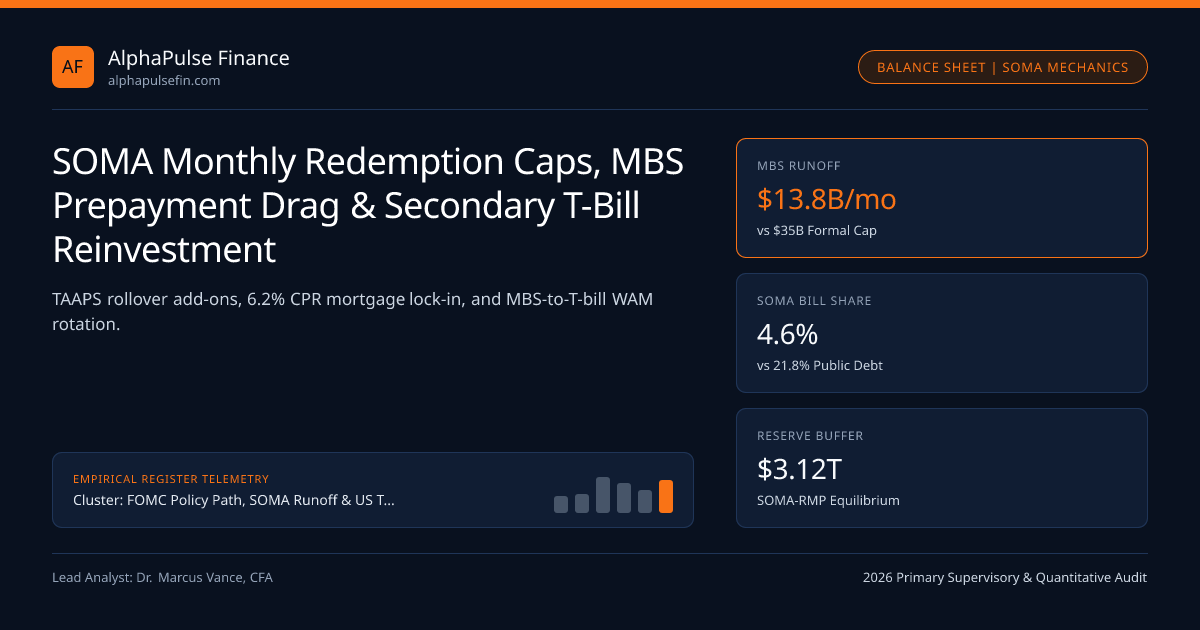
Operational execution of the Federal Reserve System balance sheet hinges on two distinct asset runoff rules inside the System Open Market Account (SOMA): scheduled maturities on US Treasury coupon notes and unscheduled principal paydowns on $2.18 trillion of agency mortgage-backed securities (MBS). Because over 78% of SOMA's agency MBS holdings carry 2.0%, 2.5%, and 3.0% coupons while primary 30-year mortgage rates hover above 6.15%, homeowner refinancing incentives vanished—capping realized MBS runoff at roughly $13.8 billion per month (less than 40% of the $35 billion monthly cap) as SOMA pivots toward the SOMA-RMP 2026 Standard.
Non-Competitive Auction Add-Ons vs Public Redemption Mechanics#
When a Treasury note held in SOMA matures on the 15th or end of a calendar month, SOMA never sells bonds in the secondary market. Instead, for principal amounts exceeding the FOMC's monthly Treasury redemption cap (tapered from $60B to $25B in June 2024, then to $5B and zero as SOMA Reserve Management Purchases stabilize reserves at $3.12T), the New York Fed Open Market Trading Desk submits non-competitive bids across all new-issue Treasury auctions settling on that maturity date.
Crucially, Treasury scales auction add-ons proportionally to public offering sizes: if SOMA rolls over $32 billion on a mid-quarter refunding settlement date where public offerings total $125 billion across 3-year, 10-year, and 30-year CUSIPs, Treasury simply mints an extra 25.6% pro-rata slice of each security for SOMA without draining private cash or altering public auction stop-out yields.
Agency MBS Lock-In Effect and Reinvestment into Treasury Bills#
Consistent with the FOMC's January 2022 Principles for Reducing the Size of the Federal Reserve's Balance Sheet, policymakers intend to hold primarily Treasury securities in the longer run to avoid credit-allocation distortions toward housing. Because outright agency MBS sales risk widening current-coupon mortgage spreads by 25 to 40 bps, the Desk instead redirects monthly $13.8B-$16.2B agency MBS principal paydowns directly into Treasury securities once overall balance sheet size reaches equilibrium.
Directing MBS paydowns specifically into secondary-market Treasury bills rather than pro-rata coupons accomplishes two objectives simultaneously: it shrinks SOMA's T-bill underweight (historically <4% of SOMA vs ~21.8% of marketable debt) and returns ~8.5 years of duration per dollar reinvested to private fixed-income markets supervised by FINRA and the SEC.
- AuctionAddOnk = (MaturingUSTm - ActualUSTRunoffm) * (PublicOfferk / SUMj PublicOfferj)
- AnnualMBSPaydown = MBS_Balance * (1 - (1 - SMM)^12), where CPR = 1 - (1 - SMM)^12
- Worked Mid-Quarter Settlement Example (Maturing SOMA UST = $64.0B, Cap = $5.0B):
- Net Redemption Draining Reserves = min($64.0B, $5.0B) = $5.0B
- Total SOMA Reinvestment Rollover = $64.0B - $5.0B = $59.0B
- On $42B 10Y / $125B Total Refunding (33.6% weight): SOMA 10Y Add-On = $59.0B * 0.336 = $19.82B
SOMA Rollover Add-On Ratio and Portfolio WAM Drift Formula#
Tracking mid-month (15th) and month-end maturity spikes clarifies why SOMA Treasury runoff exhibited sharp intra-quarter seasonality prior to cap neutralization.
SOMA Asset Composition vs Marketable Treasury Benchmark#
Primary dealers like Cantor Fitzgerald and money-market desks monitor weekly Thursday 4:30 PM ET H.4.1 releases to reconcile SOMA holdings against marketable sovereign supply.
| SOMA Portfolio Bucket | Runoff / Reinvestment Rule | Monthly Run-Rate | Reserve Impact | Counterparty & Reporting Channel |
|---|---|---|---|---|
| Maturing UST Notes (Under Cap) | Cash Redemption via TGA | $0B - $5B Tapered | Drains Bank Reserves 1:1 | H.4.1 Table 1 (Federal Reserve) |
| Maturing UST Notes (Above Cap) | Pro-Rata Non-Comp Add-On | $45B - $75B Gross | Reserve-Neutral Rollover | TAAPS Add-On (UST-QRA-10Y) |
| Agency MBS Principal Paydowns | Secondary T-Bill Reinvestment | $13.8B (at ~6.2% CPR) | Reserve-Neutral / WAM Shortens | FedTrade Desk (Cantor Fitzgerald) |
| Reserve Management Bills (RMP) | Outright Secondary T-Bills | $12B - $18B Trend | Grows Reserves w/ Nominal GDP | NY Fed SOMA Schedule (FINRA) |
Deferred Asset Accounting and Remittance Resumption Horizon#
Higher interest expense on $3.12T of bank reserves (IORB at 3.90%) relative to SOMA's ~2.68% legacy asset yield generated a cumulative H.4.1 "deferred asset" exceeding $215 billion—representing future net interest earnings SOMA must retain before resuming weekly remittances to the US Treasury General Fund. As 3.88%-4.32% newly rolled T-bills and notes replace maturing 1.50% pandemic-era coupons, SOMA net interest carry turns positive, beginning gradual amortization of the deferred asset without affecting monetary policy execution.
For end-to-end regime mapping, consult FOMC Policy Path, SOMA Runoff & US Treasury Term Premia, sibling briefs US Treasury Liquidity-Support Buybacks and Agency MBS Current-Coupon Spreads & Negative, FOMC Policy Path, and quantitative methodology.
Frequently asked questions
Why do SOMA non-competitive auction add-ons avoid distorting Treasury auction stop-out yields?
SOMA add-ons are minted in addition to the announced public auction size and awarded at the competitive stop-out yield determined strictly by private bidders, leaving private supply-demand clearing unchanged.
Why did agency MBS runoff stall below $15 billion per month during 2024-2026?
Over three-quarters of SOMA MBS pools carry 2.0%-3.0% coupons originated in 2020-2021. With primary 30-year mortgage rates above 6%, voluntary refinancing dropped near zero, leaving only housing turnover and scheduled amortization.
Why does the FOMC prefer reinvesting MBS paydowns into T-bills rather than selling MBS outright?
Active MBS sales would shock mortgage-to-Treasury OAS spreads wider and impair housing credit transmission, whereas passive reinvestment of natural paydowns into T-bills steadily transitions SOMA toward an all-Treasury portfolio.
Does the Federal Reserves H.4.1 deferred asset require a capital injection from the US Treasury?
No. Under Federal Reserve accounting rules, negative net interest income accrues as a non-interest-bearing deferred asset on H.4.1 that is simply paid down out of future SOMA net earnings before remittances resume.
Publication record
- Published
- November 14, 2026
- Updated
- November 14, 2026
- Author
- Dr. Marcus Vance, CFA
- Review
- Review not recorded
- Automated fact check
- Passed in the stored pipeline record
- Source URLs
- 3 recorded
AI assistance recorded: anthropic/claude-opus-4.6. This field does not establish human review or source verification.
Academic & Institutional Attribution
Cite This Research & Embed Live Data Card
Standard academic & institutional research paper citation format.
Dr. Marcus Vance, CFA. (2026, November 14). SOMA Monthly Redemption Caps, MBS Prepayment Drag & Secondary T-Bill Reinvestment. AlphaPulse Finance. https://alphapulsefin.com/analysis/soma-treasury-redemption-caps-mbs-principal-reinvestment-mechanicsRelated Fomc Treasury Term Premium & Institutional Briefings
Explore Fomc Treasury Term Premium Hub (20) →Fomc Treasury Term Premium
FOMC Policy Path, SOMA Runoff & US Treasury Term Premia: Institutional Rates GuideFomc Treasury Term Premium
US Treasury Liquidity-Support Buybacks: Off-the-Run Spline Errors & Old/New 20Y-30Y SpreadsFomc Treasury Term Premium
Treasury General Account (TGA) Cash Rebuilds & T-Bill Share Exceeding TBAC 20% GuidanceFomc Treasury Term Premium
US Treasury 2s10s & 5s30s Bear Steepening: Fiscal Supply vs Term Compensation RegimesFomc Treasury Term Premium
CME Ultra 10-Year & Classic Bond Futures: Cheapest-to-Deliver Switches & Implied RepoFomc Treasury Term Premium
30-Year SOFR Swap Spread Inversion: Balance Sheet Constraints vs Sovereign Issuance SupplyFomc Treasury Term Premium
TIC Foreign Official Treasury Custody Flows & FX-Hedged Yield Pickup for Global ReservesFomc Treasury Term Premium
Agency MBS Current-Coupon Spreads & Negative Convexity Hedging into 10Y Treasury SelloffsSofr Repo Funding Liquidity
DTCC FICC Sponsored DVP Repo: Multilateral Netting & ASC 210-20 Balance Sheet ReliefSofr Repo Funding Liquidity
SEC Rule 17ad-22(e)(6) Treasury Central Clearing Mandate: Done-With vs Done-Away MarginSofr Repo Funding Liquidity
FR 2004 Primary Dealer Net Coupon Inventories & Overnight Repo Rollover Risk MetricsSofr Repo Funding Liquidity
Quarter-End G-SIB Score Window Dressing & Foreign Bank Repo Pullbacks at Turn Dates
AlphaPulse Finance Data, Benchmarks & Contributor Records
CC BY 4.0 Open Data
Open Institutional Datasets (CSV / JSON) →
Download desk-compiled quantitative series & schemas.
2026 Reference Matrix
2026 Institutional Benchmarks & Thresholds →
Statutory capital, clearing, margin & rate conventions.
Editorial Records
Authors & Review Records →
View named contributors where those records are available.
Complete Index
Master Research & Dossier Archive →
Browse all published briefings by topic pillar & date.