
CME Ultra 10-Year & Classic Bond Futures: Cheapest-to-Deliver Switches & Implied Repo
Cash-futures basis arbitrage across $950B+ of CFTC leveraged-fund Treasury futures shorts governs how primary dealers clear benchmark 10-year and 30-year auction duration.
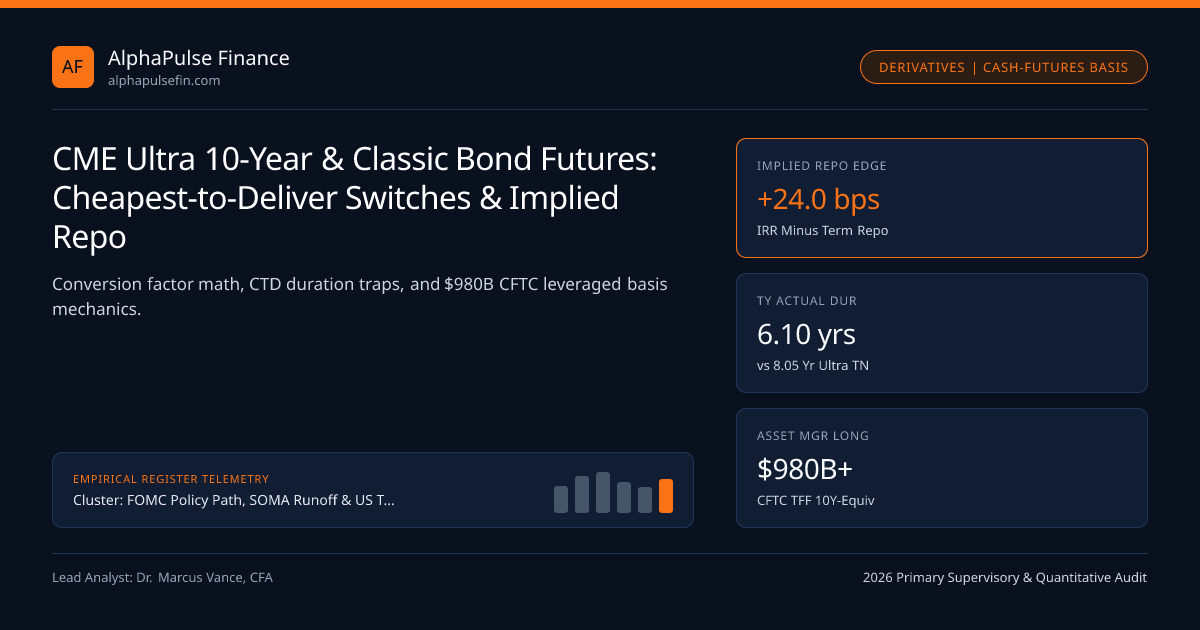
Over $950 billion of US Treasury cash-futures basis trades connect real-money asset managers buying unfunded CME Treasury futures to relative-value hedge funds warehousing cash bonds financed in SOFR Repo. Because pension funds and active bond ETFs prefer capital-efficient long positions in Ultra 10-Year (TN) and Classic T-Bond (ZB) futures, futures contracts consistently trade marginally rich to their physical Cheapest-to-Deliver (CTD) 10-Year Benchmark Notes—generating implied repo rates 12 to 38 bps above overnight financing costs and absorbing supply off Primary Dealer Books.
CME 6% Notional Coupon Conversion Factors and CTD Selection Bias#
Every CME Treasury futures contract allows the short seller to deliver any eligible Treasury CUSIP inside a defined remaining-maturity window (e.g., 6.5 to 7.75 years for Classic 10-Year TY; 9.42 to 10.0 years for Ultra 10-Year TN), adjusted by a deterministic Conversion Factor (CF_i) that prices each bond to yield exactly 6.00% semiannually as of the first delivery day.
When prevailing market yields (4.32% on 10-year notes) sit well below CME's 6.00% notional standard, conversion factors systematically favor lowest-duration, highest-coupon, shortest-maturity bonds inside the delivery basket. Conversely, if long-end yields ever crossed above 6.00%, CTD identity would abruptly switch to the longest-duration bond in the basket—giving the futures short a valuable embedded quality/switch option reflected in Net Basis (Basis Net of Carry, or BNOC).
CFTC Traders in Financial Futures (TFF) Split: Asset Managers Long, Hedge Funds Short#
Weekly CFTC Traders in Financial Futures reports reveal a structural symbiotic balance rather than directional speculation: Institutional Asset Managers hold over $980B in 10-year-equivalent net long Treasury futures to match benchmark index duration while freeing cash to buy higher-yielding corporate credit or agency MBS. Relative-value hedge funds take the opposite side—shorting futures and buying physical CTD cash bonds through primary dealers like Cantor Fitzgerald financed via FICC sponsored repo.
As examined by the Office of Financial Research and SEC clearing studies, basis unwind risks emerge only when intraday futures variation margin spikes simultaneously with repo haircut increases or quarter-end dealer balance sheet contraction.
- InvoicePrice = (FuturesPrice * CFCTD) + AccruedInterest_Delivery
- ImpliedRepoIRR = ((InvoicePrice + CouponReceived - DirtyCashToday) / DirtyCashToday) * (360 / Days)
- Worked Ultra 10-Year (TN) Basis Trade (90 Days to Delivery):
- Cash CTD Dirty Price: 101.420 | Invoice Price at Delivery (incl coupon): 102.460
- Implied Repo Rate IRR = ((102.460 - 101.420) / 101.420) * (360 / 90) = 4.102% ACT/360
- Actual Term Sponsored Repo Cost: 3.862% -> Net Arbitrage Lock = +24.0 bps annualized
Gross Basis, Implied Repo Rate (IRR), and Net Basis (BNOC) Equations#
Arbitrageurs rank every deliverable CUSIP by its Implied Repo Rate—the synthetic annualized return earned by buying cash today, funding coupon reinvestment, and delivering into the futures contract at expiry.
CME Treasury Futures Delivery Basket & CTD Microstructure Table#
Understanding basket eligibility prevents hedgers at institutional desks and registered brokerages (FINRA / NFA) from mismatching cash 10-year duration against Classic TY (which actually tracks 7-year duration!).
| CME Contract | Ticker | Deliverable Remaining Maturity | CTD Empirical Duration | Regulatory & Clearing Venue |
|---|---|---|---|---|
| 2-Year US T-Note ($200k) | ZT | 1 Yr 9 Mos to 2 Yrs | 1.78 yrs | CBOT / CME Clearing (CFTC) |
| Classic 10-Year T-Note | TY (ZN) | 6 Yrs 6 Mos to 7 Yrs 9 Mos | 6.10 yrs | Leveraged Basis Core (NFA) |
| Ultra 10-Year T-Note | TN | 9 Yrs 5 Mos to 10 Yrs | 8.05 yrs | Matches UST-QRA-10Y (Cantor) |
| Ultra US T-Bond | UB | 25 Yrs to 30 Yrs | 16.10 yrs | Cash TRACE Hedge (FINRA) |
Quarterly Roll Calendar Pressure and Wild-Card / End-of-Month Options#
Treasury futures liquidity rolls from front-month to deferred contracts during the final week of February, May, August, and November—ahead of first notice day when long holders risk physical delivery assignment. During the five-day roll window, asset managers rolling longs forward widen the calendar spread by 1.5 to 3.5 ticks (32nds), allowing basis funds to harvest annualized roll alpha of +18 to +32 bps over SOFR after repo financing.
Additional stress-test parameters appear in FOMC Policy Path, SOMA Runoff & US Treasury Term Premia, 30-Year SOFR Swap Spread Inversion, and The 20-Year US Treasury Yield Curve Kink within the FOMC Policy Path dossier and analytical tools.
Frequently asked questions
Why does the Classic 10-Year Treasury Note future (TY/ZN) behave like a 7-year bond?
CME TY delivery rules accept Treasury notes with 6.5 to 7.75 years remaining to maturity, excluding newly issued 10-year notes entirely; at yields below 6%, the 6.5-year bond is Cheapest-to-Deliver.
What causes a Cheapest-to-Deliver (CTD) switch in Treasury futures?
A CTD switch occurs when a large parallel yield move (such as yields crossing 6%) or localized curve twist shifts the highest Implied Repo Rate from one basket CUSIP to another, boosting the short’s delivery option value.
Are CFTC leveraged-fund Treasury futures shorts a directional bet on higher yields?
Rarely. Over 75%-85% of CFTC leveraged-fund futures shorts are paired dollar-for-dollar against long physical CTD cash Treasuries in market-neutral basis arbitrage.
What is the CME Wild-Card Option during delivery month?
Futures settlement prices lock at 2:00 PM CT (3:00 PM ET), while shorts can declare delivery intent until later afternoon deadlines—allowing shorts to profit if cash bond prices plunge between 3:00 PM and 5:00 PM ET.
Publication record
- Published
- November 14, 2026
- Updated
- November 14, 2026
- Author
- Dr. Marcus Vance, CFA
- Review
- Review not recorded
- Automated fact check
- Passed in the stored pipeline record
- Source URLs
- 3 recorded
AI assistance recorded: anthropic/claude-opus-4.6. This field does not establish human review or source verification.
Academic & Institutional Attribution
Cite This Research & Embed Live Data Card
Standard academic & institutional research paper citation format.
Dr. Marcus Vance, CFA. (2026, November 14). CME Ultra 10-Year & Classic Bond Futures: Cheapest-to-Deliver Switches & Implied Repo. AlphaPulse Finance. https://alphapulsefin.com/analysis/cme-treasury-futures-cheapest-to-deliver-gross-basis-convexityRelated Fomc Treasury Term Premium & Institutional Briefings
Explore Fomc Treasury Term Premium Hub (20) →Fomc Treasury Term Premium
FOMC Policy Path, SOMA Runoff & US Treasury Term Premia: Institutional Rates GuideFomc Treasury Term Premium
30-Year SOFR Swap Spread Inversion: Balance Sheet Constraints vs Sovereign Issuance SupplyFomc Treasury Term Premium
TIC Foreign Official Treasury Custody Flows & FX-Hedged Yield Pickup for Global ReservesFomc Treasury Term Premium
Agency MBS Current-Coupon Spreads & Negative Convexity Hedging into 10Y Treasury SelloffsFomc Treasury Term Premium
ICE BofA MOVE Index & 1y10y Swaption Volatility: VaR Shocks on Treasury Term PremiaFomc Treasury Term Premium
Inertial Taylor Rules vs Balanced-Approach Benchmarks Across FOMC Policy NormalizationFomc Treasury Term Premium
SOMA Reserve Management Purchases (RMP): Calibrating Bank Reserves Above LCLoR ThresholdsFomc Treasury Term Premium
The 20-Year US Treasury Yield Curve Kink: Stripping Economics & Butterfly ArbitrageSofr Repo Funding Liquidity
BNY Tri-Party vs FICC GCF & Bilateral DVP Repo: Funding Rate Segmentation & SpreadsSofr Repo Funding Liquidity
Federal Home Loan Bank (FHLB) Liquidity Arbitrage: Fed Funds Lending vs Discount WindowSofr Repo Funding Liquidity
On-the-Run Treasury Specials in Repo, Fails-to-Deliver & TMPG 300-Bps Penalty MechanicsSofr Repo Funding Liquidity
OFR Non-Centrally Cleared Bilateral Repo (NCCBR) Data: Zero-Haircut Hedge Fund Leverage
AlphaPulse Finance Data, Benchmarks & Contributor Records
CC BY 4.0 Open Data
Open Institutional Datasets (CSV / JSON) →
Download desk-compiled quantitative series & schemas.
2026 Reference Matrix
2026 Institutional Benchmarks & Thresholds →
Statutory capital, clearing, margin & rate conventions.
Editorial Records
Authors & Review Records →
View named contributors where those records are available.
Complete Index
Master Research & Dossier Archive →
Browse all published briefings by topic pillar & date.