
30-Year Treasury Bond Auction Liquidity, Convexity Hedging & Pension LDI Absorption
Thirty-year US Treasury long bonds trading near 4.61% par yield deliver +3.42 years-squared of positive convexity, drawing structural STRIPS immunization flows from funded corporate pension plans across capital markets.
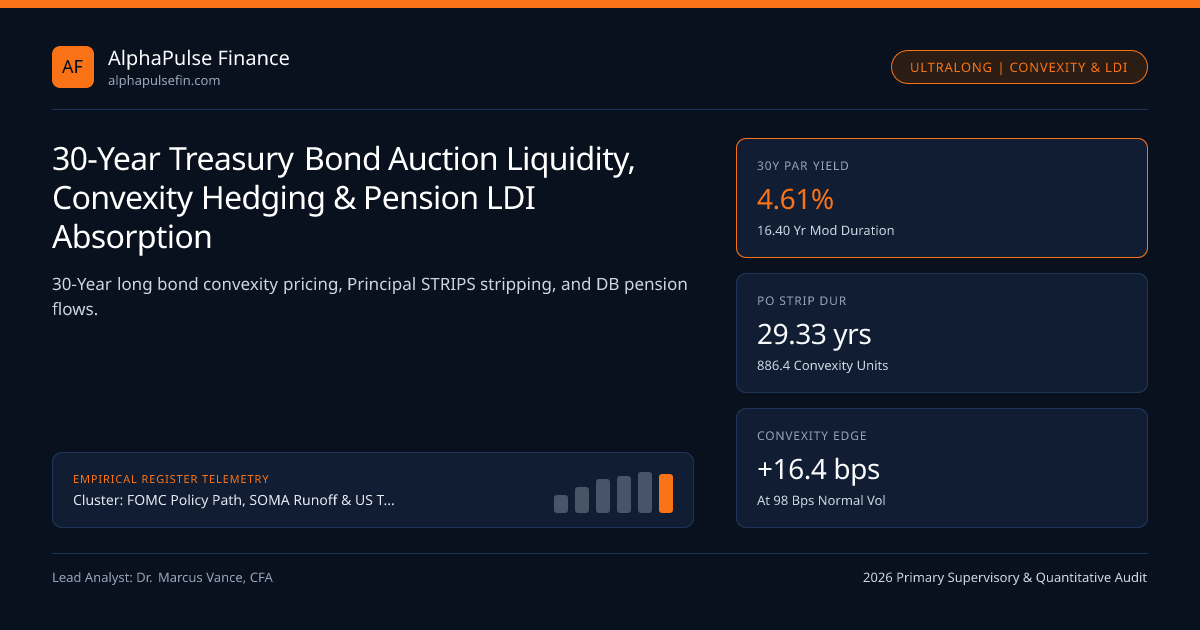
Long-end sovereign risk peaks at the Thursday 1:00 PM ET auction of 30-Year Long Bond Refunding Issuance, where $25 billion of new-issue notional ($22 billion on reopenings) injects $41.0 million of DV01 after dealers have already digested 3-year and 10-year supply earlier in the week. Calibrated at a 4.61% par yield under the UST-QRA-30Y 2026 Standard, the 30-year bond exhibits a modified duration of 16.40 years and positive convexity of roughly 342 (3.42% price gain boost per 100 bps parallel rally). Structural balance between fiscal deficits and Liability-Driven Investing (LDI) allocations from corporate defined-benefit (DB) pensions above 103% Milliman funded status governs 10s30s slope dynamics.
Corporate Defined-Benefit Pension De-Risking and Principal STRIPS Stripping#
Under ERISA minimum funding rules and ASC 715 corporate pension accounting, US S&P 500 defined-benefit plans discount 20-to-40-year benefit liabilities using high-grade AA corporate bond yields (averaging 5.38% in Q4 2026). Once higher discount rates lifted aggregate corporate pension funded ratios to 103.8%, plan sponsors accelerated hibernation and pension risk transfer (PRT) buyouts—selling public equities and rotating into long-duration fixed income.
Because a par 30-year coupon bond has a 16.40-year modified duration whereas a 30-year zero-coupon liability has a nearly 29.3-year modified duration, LDI managers instruct primary dealers like Cantor Fitzgerald to strip newly issued 30-year bonds into Separate Trading of Registered Interest and Principal of Securities (STRIPS) via the Federal Reserve commercial book-entry system. Monthly Treasury STRIPS reports confirm over 34% of seasoned ultralong bond CUSIPs sit held in stripped principal-only (PO) form.
Positive Convexity Value vs Implied 30-Year Rate Volatility#
Unlike callable agency mortgages that suffer negative convexity, non-callable 30-year Treasuries accelerate in price appreciation when yields fall and decelerate in price losses when yields rise. Quantitative desks value that second-order Taylor-series curvature dynamically against 1y30y swaption implied normal volatility (~98 bps annualized).
When implied ultralong rate volatility rises by 15 bps/year, the theoretical convexity advantage of 30-year Principal STRIPS over a duration-matched bullet of 10-year notes (UST-2S10S) increases by 3.8 bps of annualized yield give-up, explaining why 20s30s and 25s30s par yield curves frequently invert among strippable Principal-Only tranches.
- AnnualConvexityValuebps = 0.5 * Convexity * (sigmanormal)^2 * 10,000
- Worked 30-Year Bond Evaluation (Par Yield = 4.61%, ModDur = 16.40, Convexity = 342, sigma = 0.0098):
- Rally of -100 bps (-0.01): -16.40(-0.01) + 0.5(342)(0.0001) = +16.40% + 1.71% = +18.11%
- Selloff of +100 bps (+0.01): -16.40(+0.01) + 0.5(342)(0.0001) = -16.40% + 1.71% = -14.69%
- Annualized Volatility Value = 0.5 * 342 * (0.0098)^2 * 10,000 = +16.42 bps/year
Duration, Convexity Advantage, and Butterfly Carry Equations#
Portfolio managers comparing a 10s30s barbell against an intermediate 20-year bullet isolate the convexity yield value directly from realized or swaption-implied yield variance.
Ultralong Buyer Segmentation and Regulatory Capital Treatment#
Demand elasticity at 4.60%-4.85% 30-year yields differs sharply across domestic pensions, US life insurers under NAIC Risk-Based Capital rules, and levered macro funds clearing futures under CFTC and SEC oversight.
| Ultralong Instrument / Cohort | Modified Duration | Convexity | DV01 per $100M Par | Regulatory & Market Context |
|---|---|---|---|---|
| 30Y On-the-Run Coupon Bond | 16.40 yrs | 342.0 | $164,000 | Primary QRA Liquidity (Cantor Fitzgerald) |
| 30Y Principal STRIP (PO) | 29.33 yrs | 886.4 | $81,800 (at $27.89 px) | Fedwire Book-Entry (Federal Reserve) |
| CME Ultra T-Bond Future (UB) | 17.85 yrs | 394.5 | $178,500 eq. | 25Y-30Y Deliverable Basket (CFTC) |
| 30Y Corporate AA LDI Benchmark | 14.92 yrs | 298.0 | $149,200 | ASC 715 Pension Discount (SEC Filers) |
Thursday Refunding Exhaustion and 10s30s Flattener Entry Triggers#
Because 30-year auctions clear last in the quarterly refunding sequence, Thursday mornings routinely exhibit "duration exhaustion" where 10s30s steepens 2.5 to 4.0 bps between Tuesday's 3-year stop and Thursday's 12:30 PM ET WI peak. Systematic rates desks executed via FINRA-regulated dealers and institutional allocators such as Alpine Woods enter 50:50 DV01-weighted 10s30s flatteners into Thursday 1:00 PM concessions whenever 30-year yields cross 4.65% and corporate AA spreads remain tighter than +95 bps.
Adjacent curve and flow decompositions include 2-Year Treasury Note Auctions vs Overnight Index Swaps and US Treasury 2s10s & 5s30s Bear Steepening, anchored by FOMC Policy Path, SOMA Runoff & US Treasury Term Premia, FOMC Policy Path, and analytical tools.
Frequently asked questions
Why do Principal STRIPS frequently trade at lower yields than par 30-year Treasury bonds?
Principal STRIPS carry roughly 886 units of convexity compared with 342 on a par coupon bond and require less upfront capital per dollar of DV01, making pensions and volatility-hedging desks willing to accept 4 to 9 bps less yield.
How can primary dealers reconstitute stripped 30-year Treasury bonds?
Under Treasury STRIPS rules, any financial institution with a Federal Reserve commercial book-entry account can combine a matching Principal STRIP with 60 generic semiannual Coupon STRIPS of identical payment dates to reconstitute a fungible coupon bond.
What distinguishes CME Ultra T-Bond (UB) futures from Classic T-Bond (ZB) futures?
Classic ZB futures accept deliverable Treasury bonds with 15 to 25 years remaining to maturity, whereas Ultra UB futures restrict the basket to 25 to 30 years remaining, tracking true 30-year LDI duration far more closely.
Why did higher interest rates accelerate corporate pension buying of 30-year Treasuries?
Rising AA corporate discount rates cut the present value of future pension liabilities faster than plan assets declined, lifting S&P 500 DB funded status above 100% and motivating sponsors to lock in surpluses with long Treasuries.
Publication record
- Published
- November 14, 2026
- Updated
- November 14, 2026
- Author
- Dr. Marcus Vance, CFA
- Review
- Review not recorded
- Automated fact check
- Passed in the stored pipeline record
- Source URLs
- 3 recorded
AI assistance recorded: anthropic/claude-opus-4.6. This field does not establish human review or source verification.
Academic & Institutional Attribution
Cite This Research & Embed Live Data Card
Standard academic & institutional research paper citation format.
Dr. Marcus Vance, CFA. (2026, November 14). 30-Year Treasury Bond Auction Liquidity, Convexity Hedging & Pension LDI Absorption. AlphaPulse Finance. https://alphapulsefin.com/analysis/thirty-year-long-bond-duration-convexity-pension-ldi-demandRelated Fomc Treasury Term Premium & Institutional Briefings
Explore Fomc Treasury Term Premium Hub (20) →Fomc Treasury Term Premium
FOMC Policy Path, SOMA Runoff & US Treasury Term Premia: Institutional Rates GuideFomc Treasury Term Premium
2-Year Treasury Note Auctions vs Overnight Index Swaps: Front-End FOMC Policy PricingFomc Treasury Term Premium
FOMC SEP Dot-Plot Dispersion & Longer-Run Median Drift: Committee Reaction UncertaintyFomc Treasury Term Premium
Holston-Laubach-Williams vs Lubik-Matthes Neutral Rate (r*) Estimation in US RatesFomc Treasury Term Premium
SOMA Monthly Redemption Caps, MBS Prepayment Drag & Secondary T-Bill ReinvestmentFomc Treasury Term Premium
US Treasury Liquidity-Support Buybacks: Off-the-Run Spline Errors & Old/New 20Y-30Y SpreadsFomc Treasury Term Premium
Treasury General Account (TGA) Cash Rebuilds & T-Bill Share Exceeding TBAC 20% GuidanceFomc Treasury Term Premium
US Treasury 2s10s & 5s30s Bear Steepening: Fiscal Supply vs Term Compensation RegimesMarket Insights
The Next Wave of Food Inflation Is ComingSofr Repo Funding Liquidity
SOFR vs EFFR & IORB Corridor Spreads: Measuring Reserve Demand Elasticity Near ScarcitySofr Repo Funding Liquidity
ON RRP Facility Drainage & Rule 2a-7 Money Market Fund Rotation into Short T-BillsSofr Repo Funding Liquidity
NY Fed Standing Repo Facility (SRF) Usage: Auction Timing, Tri-Party Settlement & Stigma
AlphaPulse Finance Data, Benchmarks & Contributor Records
CC BY 4.0 Open Data
Open Institutional Datasets (CSV / JSON) →
Download desk-compiled quantitative series & schemas.
2026 Reference Matrix
2026 Institutional Benchmarks & Thresholds →
Statutory capital, clearing, margin & rate conventions.
Editorial Records
Authors & Review Records →
View named contributors where those records are available.
Complete Index
Master Research & Dossier Archive →
Browse all published briefings by topic pillar & date.